Wang Anbang, Li Jingyang, Al-Huqail Arwa Abdulkreem, Al-Harbi Mohammad S, Ali Esmat F, Wang Jiashui, Ding Zheli, Rekaby Saudi A, Ghoneim Adel M, Eissa Mamdouh A
Hainan Banana Healthy Seedling Propagation Engineering Research Center, Haikou Experimental Station, Chinese Academy of Tropical Agricultural Sciences (CATAS), Haikou 571101, China.
Department of Biology, College of Science, Princess Nourah Bint Abdulrahman University, Riyadh 13324-8824, Saudi Arabia.
Nanomaterials (Basel). 2021 Oct 11;11(10):2670. doi: 10.3390/nano11102670.
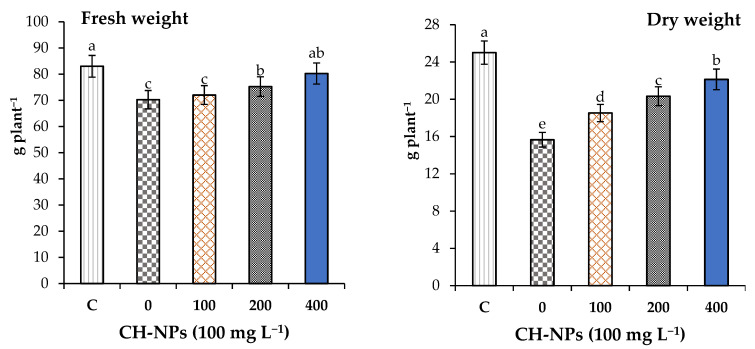
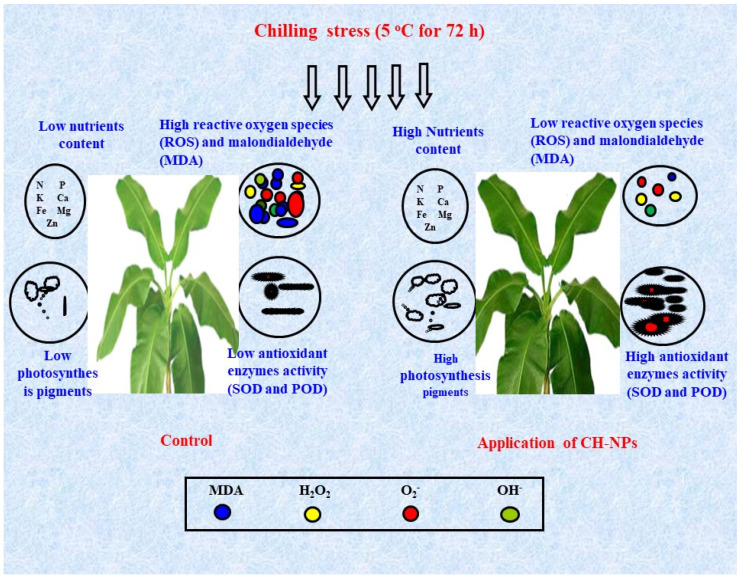
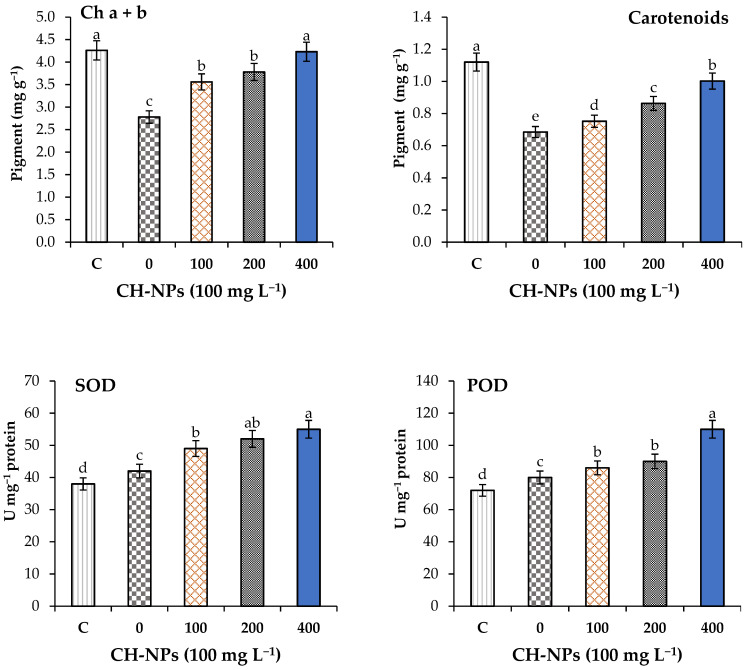
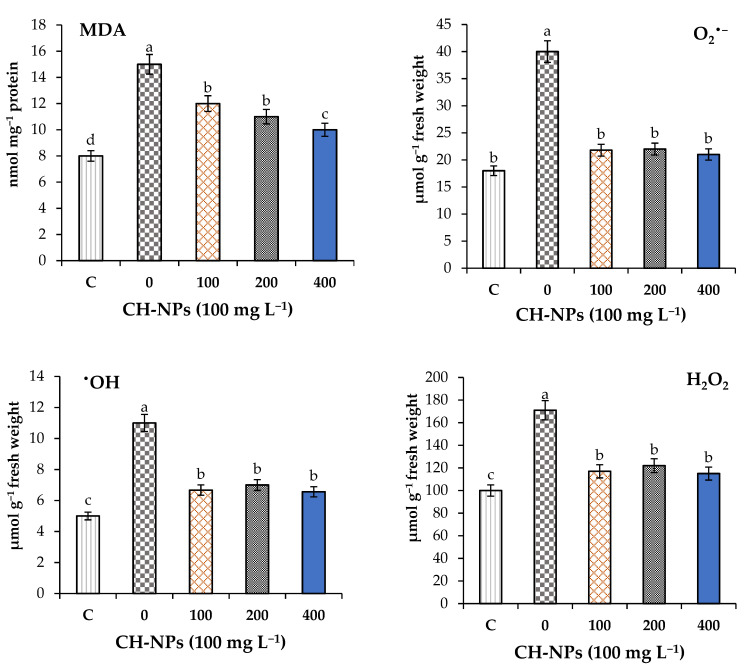
Exposure of banana plants, one of the most important tropical and subtropical plants, to low temperatures causes a severe drop in productivity, as they are sensitive to cold and do not have a strong defense system against chilling. Therefore, this study aimed to improve the growth and resistance to cold stress of banana plants using foliar treatments of chitosan nanoparticles (CH-NPs). CH-NPs produced by nanotechnology have been used to enhance tolerance and plant growth under different abiotic stresses, e.g., salinity and drought; however, there is little information available about their effects on banana plants under cold stress. In this study, banana plants were sprayed with four concentrations of CH-NPs-i.e., 0, 100, 200, and 400 mg L of deionized water-and a group that had not been cold stressed or undergone CH-NP treatment was used as control. Banana plants ( var. Baxi) were grown in a growth chamber and exposed to cold stress (5 °C for 72 h). Foliar application of CH-NPs caused significant increases ( < 0.05) in most of the growth parameters and in the nutrient content of the banana plants. Spraying banana plants with CH-NPs (400 mg L) increased the fresh and dry weights by 14 and 41%, respectively, compared to the control. A positive correlation was found between the foliar application of CH-NPs, on the one hand, and photosynthesis pigments and antioxidant enzyme activities on the other. Spraying banana plants with CH-NPs decreased malondialdehyde (MDA) and reactive oxygen species (ROS), i.e., hydrogen peroxide (HO), hydroxyl radicals (OH), and superoxide anions (O). CH-NPs (400 mg L) decreased MDA, HO, OH, and O by 33, 33, 40, and 48%, respectively, compared to the unsprayed plants. We hypothesize that CH-NPs increase the efficiency of banana plants in the face of cold stress by reducing the accumulation of reactive oxygen species and, in consequence, the degree of oxidative stress. The accumulation of osmoprotectants (soluble carbohydrates, proline, and amino acids) contributed to enhancing the cold stress tolerance in the banana plants. Foliar application of CH-NPs can be used as a sustainable and economically feasible approach to achieving cold stress tolerance.
香蕉是最重要的热带和亚热带植物之一,低温会导致其产量大幅下降,因为香蕉对寒冷敏感,且没有强大的抗寒防御系统。因此,本研究旨在通过壳聚糖纳米颗粒(CH-NPs)叶面处理来提高香蕉植株的生长和抗寒能力。纳米技术制备的CH-NPs已被用于增强植物在不同非生物胁迫(如盐度和干旱)下的耐受性和生长;然而,关于其在冷胁迫下对香蕉植株影响的信息却很少。在本研究中,用四种浓度(即0、100、200和400 mg/L去离子水)的CH-NPs对香蕉植株进行喷雾处理,将一组未受冷胁迫或未进行CH-NP处理的植株作为对照。香蕉植株(巴西蕉品种)在生长室中生长,并暴露于冷胁迫(5℃处理72小时)。叶面喷施CH-NPs使香蕉植株的大多数生长参数和养分含量显著增加(P<0.05)。与对照相比,用400 mg/L的CH-NPs喷施香蕉植株,其鲜重和干重分别增加了14%和41%。一方面,叶面喷施CH-NPs与光合作用色素和抗氧化酶活性之间存在正相关。喷施CH-NPs降低了香蕉植株中丙二醛(MDA)和活性氧(ROS),即过氧化氢(H₂O₂)、羟基自由基(OH)和超氧阴离子(O₂⁻)的含量。与未喷施的植株相比,400 mg/L的CH-NPs使MDA、H₂O₂、OH和O₂⁻分别降低了33%、33%、40%和48%。我们推测,CH-NPs通过减少活性氧的积累,从而降低氧化应激程度,提高香蕉植株在冷胁迫下的效率。渗透保护剂(可溶性碳水化合物、脯氨酸和氨基酸)的积累有助于增强香蕉植株的抗寒能力。叶面喷施CH-NPs可作为一种可持续且经济可行的方法来实现香蕉植株的抗寒能力。