Dennis Emily K, Chaturvedi Sudha, Chaturvedi Vishnu
Mycology Laboratory, Wadsworth Center, New York State Department of Health, Albany, NY, United States.
Department of Biomedical Sciences, University at Albany, Albany, NY, United States.
Front Microbiol. 2021 Oct 7;12:757835. doi: 10.3389/fmicb.2021.757835. eCollection 2021.
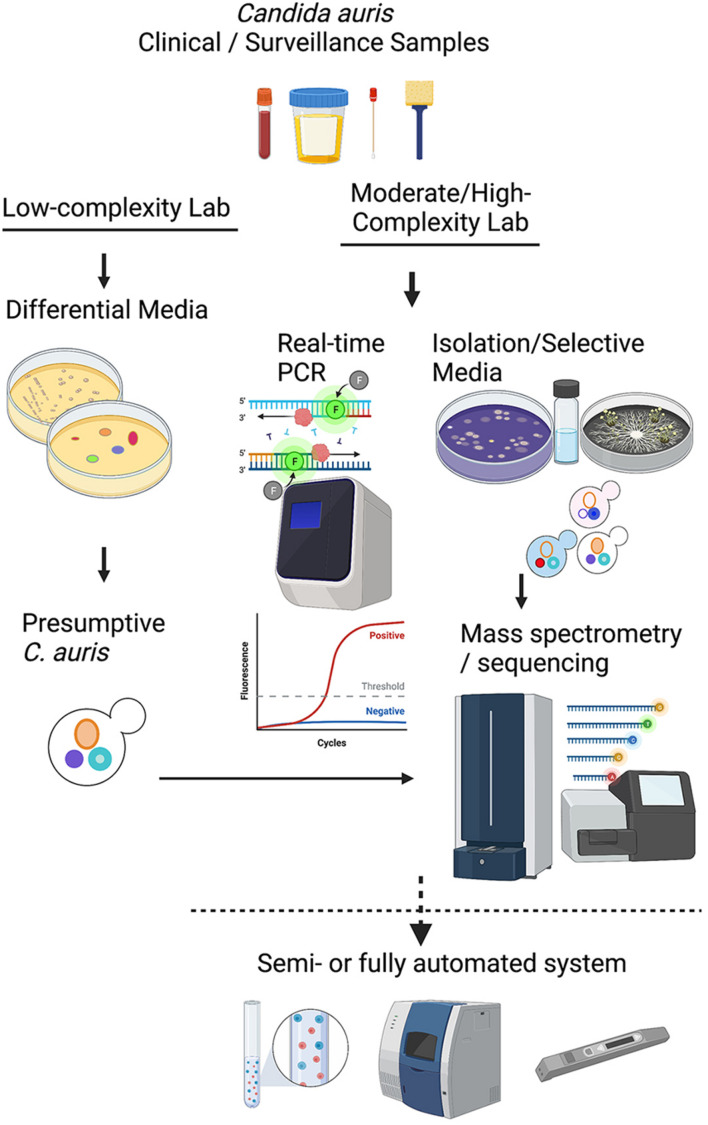
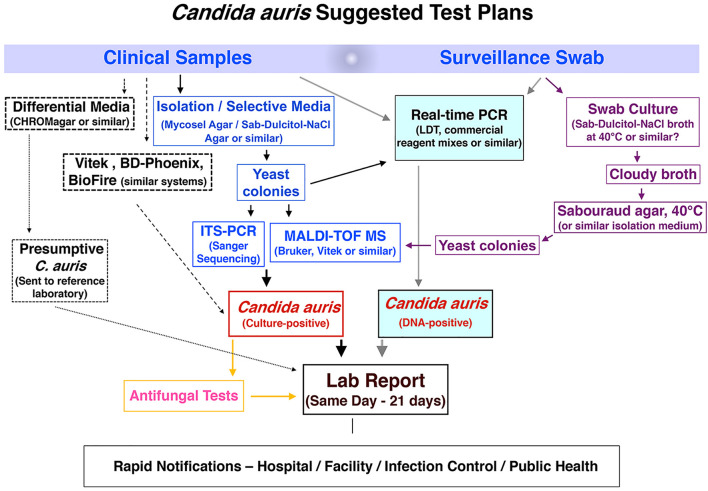
The recognition of a new yeast, , in 2009 in East Asia, and its rapid global spread, was a reminder of the threats posed by multidrug-resistant fungal pathogens. had likely remained unrecognized for a long time as accurate tests were not available. The laboratory community responded to the challenge by publishing 35 new or revised diagnostic methods between 2014 and early 2021. The commercial sector also modified existing diagnostic devices. These diagnostic tests run the gamut from traditional culture-based differential and selective media, biochemical assimilations, and rapid protein profiles, as well as culture-independent DNA-based diagnostics. We provide an overview of these developments, especially the tests with validation data that were subsequently adopted for common use. We share a workflow developed in our laboratory to process over 37,000 surveillance samples and 5,000 isolates from the outbreak in the New York metropolitan area. Our preview covers new devices and diagnostic approaches on the horizon based on microfluidics, optics, and nanotechnology. Frontline laboratories need rapid, cheap, stable, and easy-to-implement tests to improve diagnosis, surveillance, patient isolation, admission screening, and environmental control. Among the urgent needs is a lateral flow assay or similar device for presumptive identification. All laboratories will benefit from devices that allow rapid antifungal susceptibility testing, including detection of mutations conferring drug resistance. Hopefully, multiplex test panels are on the horizon for synergy of testing with ongoing surveillance of other healthcare-associated infections. genome analysis has a proven role for outbreak investigations, and diagnostic laboratories need quick access to regional and national genome analysis networks.
2009年在东亚发现的一种新型酵母菌及其在全球的迅速传播,提醒人们注意多重耐药真菌病原体带来的威胁。由于缺乏准确的检测方法,这种酵母菌可能长期未被识别。实验室界通过在2014年至2021年初期间发布35种新的或修订的诊断方法来应对这一挑战。商业部门也对现有的诊断设备进行了改进。这些诊断测试涵盖了从基于传统培养的鉴别和选择培养基、生化同化、快速蛋白质谱,到基于非培养的DNA诊断等各种方法。我们概述了这些进展,特别是那些具有验证数据并随后被普遍采用的测试。我们分享了我们实验室开发的一种工作流程,用于处理来自纽约大都市地区疫情的超过37000份监测样本和5000株分离株。我们的预览涵盖了基于微流体、光学和纳米技术的即将出现的新设备和诊断方法。一线实验室需要快速、廉价、稳定且易于实施的测试,以改善诊断、监测、患者隔离、入院筛查和环境控制。其中迫切需要的是一种用于初步鉴定的侧向流动分析或类似设备。所有实验室都将受益于能够进行快速抗真菌药敏试验的设备,包括检测赋予耐药性的突变。希望能出现多重检测面板,以便在对其他医疗相关感染进行持续监测的同时进行协同检测。基因组分析在疫情调查中已被证明发挥了作用,诊断实验室需要快速接入区域和国家基因组分析网络。