Wang Zheng, Wang Xiaojing, Wang Yingruo, Zhu Yanli, Liu Xinqiang, Zhou Qihui
Institute for Translational Medicine, Department of Orthodontics, The Affiliated Hospital of Qingdao University, Qingdao University, Qingdao, 266003, China.
School of Stomatology, Qingdao University, Qingdao, 266003, China.
J Nanobiotechnology. 2021 Oct 30;19(1):353. doi: 10.1186/s12951-021-01099-6.
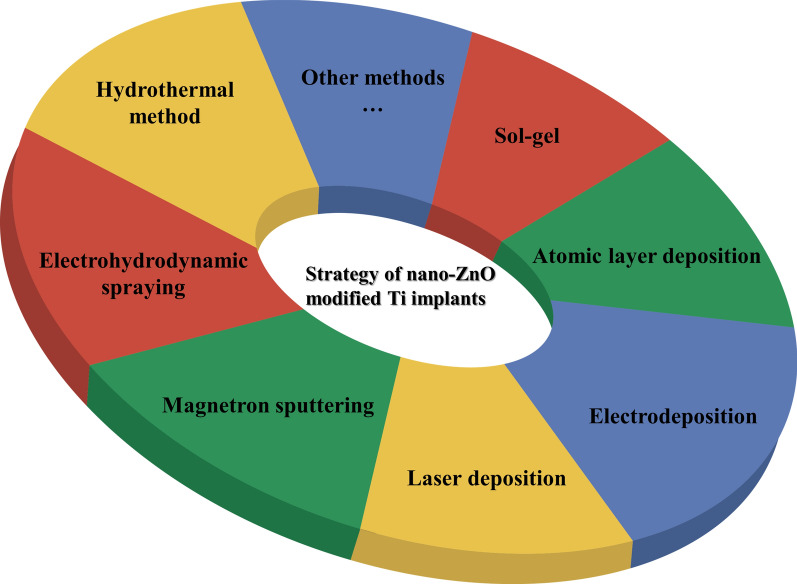
Titanium (Ti) implants are widely used in dentistry and orthopedics owing to their excellent corrosion resistance, biocompatibility, and mechanical properties, which have gained increasing attention from the viewpoints of fundamental research and practical applications. Also, numerous studies have been carried out to fine-tune the micro/nanostructures of Ti and/or incorporate chemical elements to improve overall implant performance. Zinc oxide nanoparticles (nano-ZnO) are well-known for their good antibacterial properties and low cytotoxicity along with their ability to synergize with a variety of substances, which have received increasingly widespread attention as biomodification materials for implants. In this review, we summarize recent research progress on nano-ZnO modified Ti-implants. Their preparation methods of nano-ZnO modified Ti-implants are introduced, followed by a further presentation of the antibacterial, osteogenic, and anti-corrosion properties of these implants. Finally, challenges and future opportunities for nano-ZnO modified Ti-implants are proposed.
钛(Ti)植入物因其优异的耐腐蚀性、生物相容性和机械性能而广泛应用于牙科和骨科领域,从基础研究和实际应用的角度来看,这些性能越来越受到关注。此外,人们已经开展了大量研究来微调钛的微观/纳米结构和/或掺入化学元素,以提高植入物的整体性能。氧化锌纳米颗粒(纳米ZnO)以其良好的抗菌性能、低细胞毒性以及与多种物质协同作用的能力而闻名,作为植入物的生物改性材料,其受到了越来越广泛的关注。在这篇综述中,我们总结了纳米ZnO改性钛植入物的最新研究进展。介绍了纳米ZnO改性钛植入物的制备方法,随后进一步阐述了这些植入物的抗菌、成骨和抗腐蚀性能。最后,提出了纳米ZnO改性钛植入物面临的挑战和未来机遇。