Zheng Weiping, Zhou Qihui, Yuan Changqing
Department of Stomatology, The Affiliated Hospital of Qingdao University, Qingdao 266003, China.
School of Stomatology, Qingdao University, Qingdao 266003, China.
Bioinorg Chem Appl. 2021 Apr 23;2021:9977131. doi: 10.1155/2021/9977131. eCollection 2021.
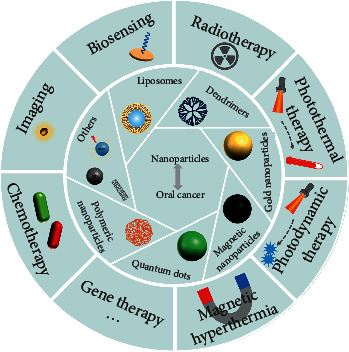
Oral cancer is the sixth most common malignant cancer, affecting the health of people with an unacceptably high mortality rate. Despite numerous clinical methods in the diagnosis and therapy of oral cancer (e.g., magnetic resonance imaging, computed tomography, surgery, and chemoradiotherapy), they still remain far from optimal. Therefore, an urgent need exists for effective and practical techniques of early diagnosis and effective therapy of oral cancer. Currently, various types of nanoparticles have aroused wide public concern, representing a promising tool for diagnostic probes and therapeutic devices. Their inherent physicochemical features, including ultrasmall size, high reactivity, and tunable surface modification, enable them to overcome some of the limitations and achieve the expected diagnostic and therapeutic effect. In this review, we introduce different types of nanoparticles that emerged for the diagnosis and therapy of oral cancers. Then, the challenges and future perspectives for nanoparticles applied in oral cancer diagnosis and therapy are presented. The objective of this review is to help researchers better understand the effect of nanoparticles on oral cancer diagnosis and therapy and may accelerate breakthroughs in this field.
口腔癌是第六大常见恶性肿瘤,对人们的健康造成影响,死亡率高得令人无法接受。尽管在口腔癌的诊断和治疗中有众多临床方法(如磁共振成像、计算机断层扫描、手术和放化疗),但它们仍远非最佳选择。因此,迫切需要有效且实用的口腔癌早期诊断和有效治疗技术。目前,各类纳米粒子已引起广泛公众关注,是诊断探针和治疗器械的一种有前景的工具。它们固有的物理化学特性,包括超小尺寸、高反应性和可调节的表面修饰,使它们能够克服一些局限性并实现预期的诊断和治疗效果。在这篇综述中,我们介绍了用于口腔癌诊断和治疗的不同类型纳米粒子。然后,阐述了纳米粒子应用于口腔癌诊断和治疗所面临的挑战及未来前景。这篇综述的目的是帮助研究人员更好地理解纳米粒子对口腔癌诊断和治疗的作用,并可能加速该领域的突破。