School of Electronics and Computer Science, University of Southampton, Southampton, UK.
University Hospitals Southampton NHS Foundation Trust, Southampton, UK.
Sci Rep. 2021 Nov 2;11(1):21513. doi: 10.1038/s41598-021-00937-9.
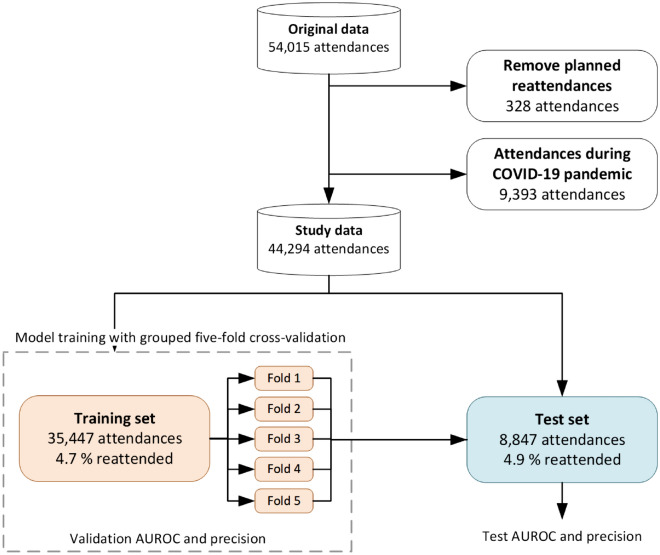
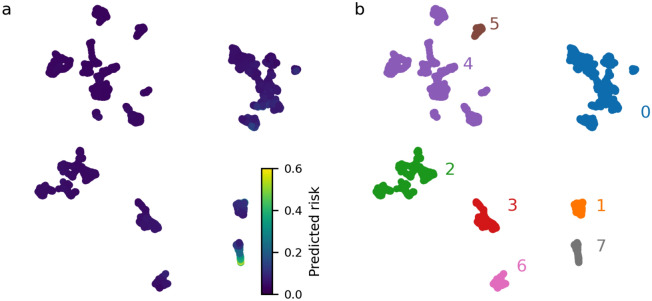
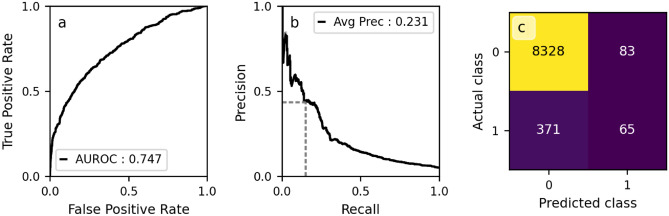
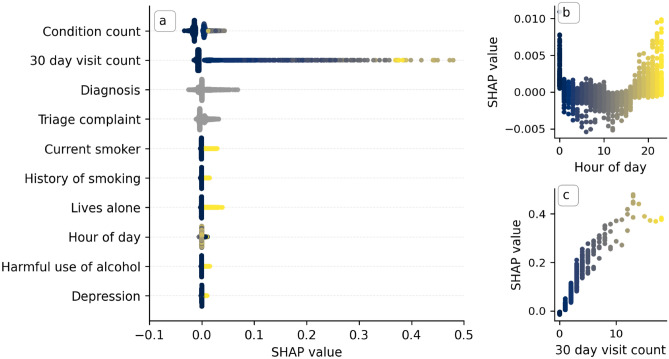
Short-term reattendances to emergency departments are a key quality of care indicator. Identifying patients at increased risk of early reattendance could help reduce the number of missed critical illnesses and could reduce avoidable utilization of emergency departments by enabling targeted post-discharge intervention. In this manuscript, we present a retrospective, single-centre study where we created and evaluated an extreme gradient boosting decision tree model trained to identify patients at risk of reattendance within 72 h of discharge from an emergency department (University Hospitals Southampton Foundation Trust, UK). Our model was trained using 35,447 attendances by 28,945 patients and evaluated on a hold-out test set featuring 8847 attendances by 7237 patients. The set of attendances from a given patient appeared exclusively in either the training or the test set. Our model was trained using both visit level variables (e.g., vital signs, arrival mode, and chief complaint) and a set of variables available in a patients electronic patient record, such as age and any recorded medical conditions. On the hold-out test set, our highest performing model obtained an AUROC of 0.747 (95% CI 0.722-0.773) and an average precision of 0.233 (95% CI 0.194-0.277). These results demonstrate that machine-learning models can be used to classify patients, with moderate performance, into low and high-risk groups for reattendance. We explained our models predictions using SHAP values, a concept developed from coalitional game theory, capable of explaining predictions at an attendance level. We demonstrated how clustering techniques (the UMAP algorithm) can be used to investigate the different sub-groups of explanations present in our patient cohort.
短期到急诊科复诊是医疗服务质量的一个关键指标。识别出有早期复诊风险的患者,有助于减少漏诊严重疾病的数量,并且可以通过针对性的出院后干预来减少对急诊科的不必要利用。在本手稿中,我们进行了一项回顾性的单中心研究,我们创建并评估了一个极端梯度提升决策树模型,该模型旨在识别从急诊科出院后 72 小时内有复诊风险的患者(英国南安普敦大学医院基金会信托)。我们的模型使用了 35447 次就诊和 28945 名患者的数据进行训练,并在一个包含 8847 次就诊和 7237 名患者的独立测试集上进行了评估。来自给定患者的就诊记录仅出现在训练集或测试集中。我们的模型使用就诊级别变量(例如生命体征、就诊方式和主要诉求)和患者电子病历中可用的一组变量(例如年龄和任何记录的医疗状况)进行了训练。在独立测试集上,表现最好的模型获得了 0.747 的 AUROC(95%CI 0.722-0.773)和 0.233 的平均精度(95%CI 0.194-0.277)。这些结果表明,机器学习模型可以用于将患者分类为低风险和高风险复诊组,性能中等。我们使用 SHAP 值(一种源自合作博弈论的概念)来解释模型的预测,可以在就诊级别上解释预测。我们展示了如何使用聚类技术(UMAP 算法)来研究我们患者队列中存在的不同解释子组。