François-Martin Claire, Bacle Amélie, Rothman James E, Fuchs Patrick F J, Pincet Frédéric
Laboratoire de Physique de l'Ecole Normale Supérieure, ENS, CNRS, Université PSL, Sorbonne Université, Université de Paris, Paris, France.
Laboratoire Coopératif "Lipotoxicity and Channelopathies-ConicMeds", Université de Poitiers, Poitiers, France.
Front Mol Biosci. 2021 Oct 21;8:763115. doi: 10.3389/fmolb.2021.763115. eCollection 2021.
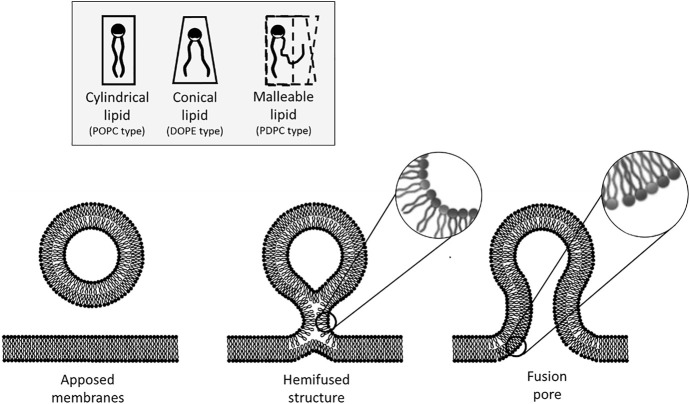
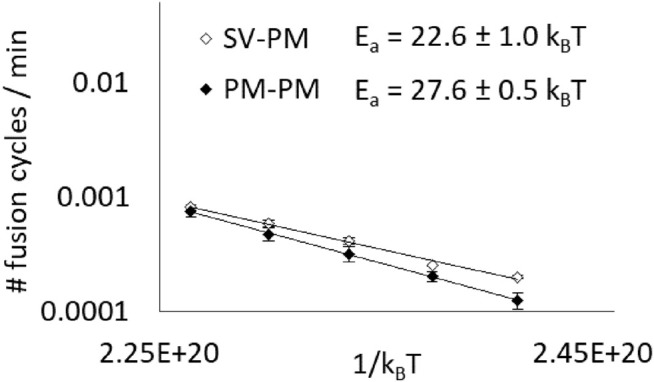
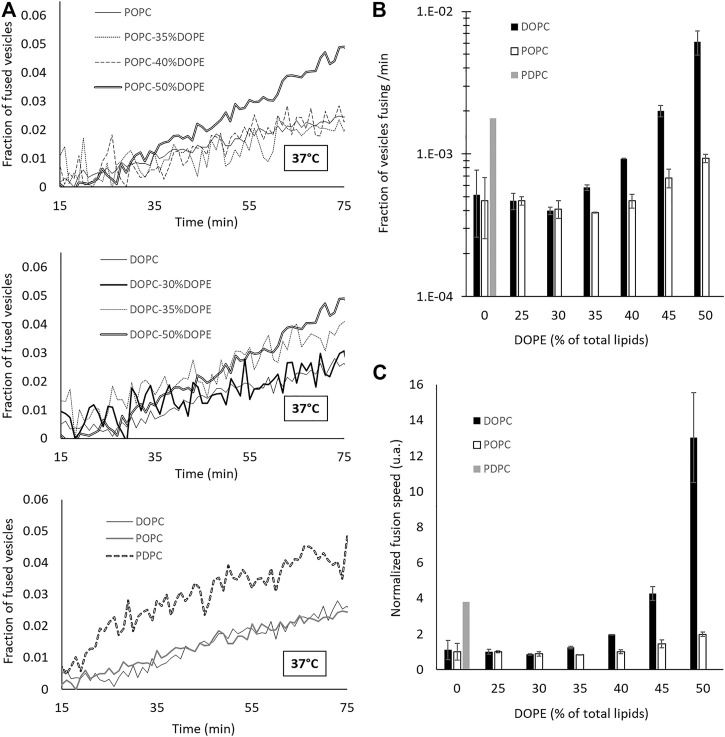
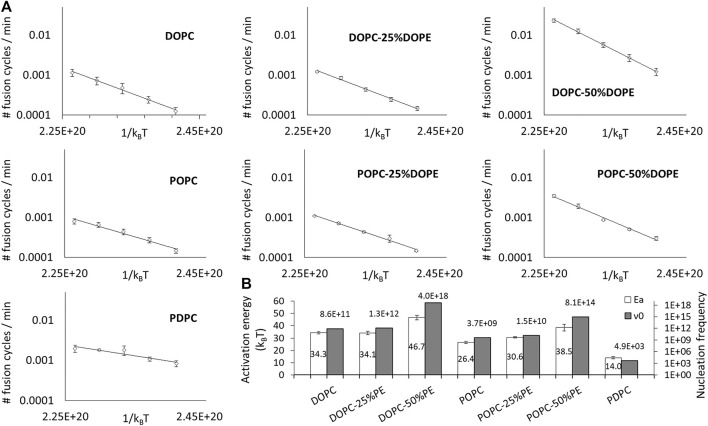
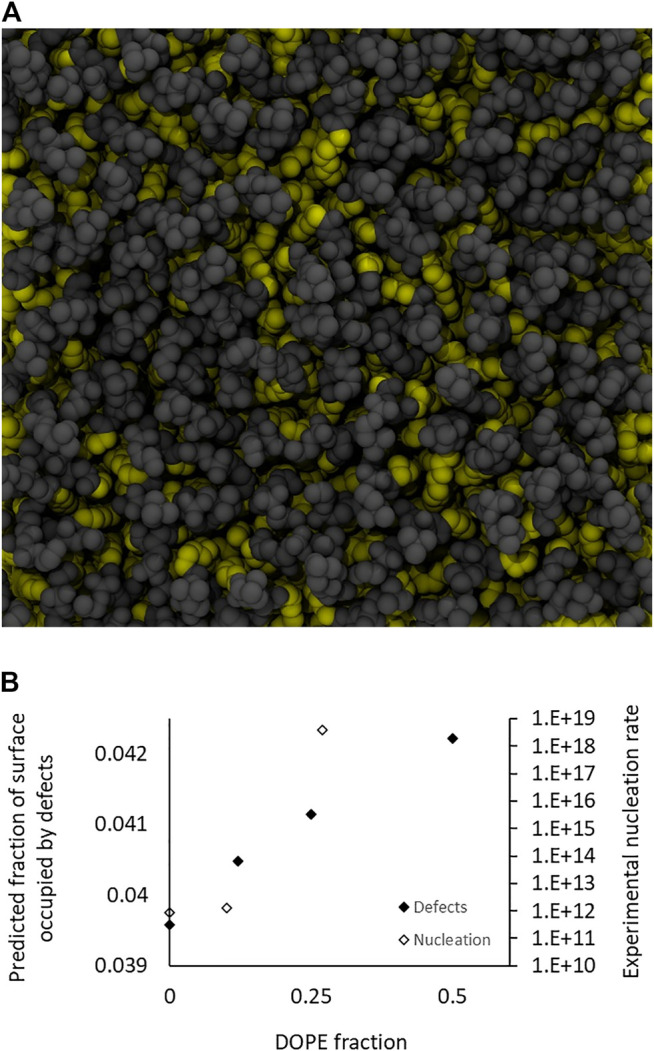
The shape of lipids has long been suspected to be a critical determinant for the control of membrane fusion. To experimentally test this assertion, we used conical and malleable lipids and measured their influence on the fusion kinetics. We found that, as previously suspected, both types of lipids accelerate fusion. However, the implicated molecular mechanisms are strikingly different. Malleable lipids, with their ability to change shape with low energy cost, favor fusion by decreasing the overall activation energy. On the other hand, conical lipids, with their small polar head relative to the area occupied by the hydrophobic chains, tend to make fusion less energetically advantageous because they tend to migrate towards the most favorable lipid leaflet, hindering fusion pore opening. They could however facilitate fusion by generating hydrophobic defects on the membranes; this is suggested by the similar trend observed between the experimental rate of fusion nucleation and the surface occupied by hydrophobic defects obtained by molecular simulations. The synergy of dual-process, activation energy and nucleation kinetics, could facilitate membrane fusion regulation .
长期以来,人们一直怀疑脂质的形状是控制膜融合的关键决定因素。为了通过实验验证这一观点,我们使用了锥形且具有可塑性的脂质,并测量了它们对融合动力学的影响。我们发现,正如之前所怀疑的那样,这两种类型的脂质都会加速融合。然而,其中涉及的分子机制却截然不同。具有可塑性的脂质能够以较低的能量成本改变形状,通过降低整体活化能来促进融合。另一方面,锥形脂质相对于疏水链占据的面积而言,其极性头部较小,由于它们倾向于迁移到最有利的脂质单层,从而阻碍融合孔的打开,使得融合在能量上变得不那么有利。然而,它们可以通过在膜上产生疏水缺陷来促进融合;这一点从融合成核的实验速率与分子模拟得到的疏水缺陷所占表面积之间观察到的相似趋势中可以得到暗示。双过程、活化能和成核动力学的协同作用可以促进膜融合的调控。