Zebin Tahmina, Rezvy Shahadate
School of Computing Sciences, University of East Anglia, Norwich, UK.
School of Science and Technology, Middlesex University London, London, UK.
Appl Intell (Dordr). 2021;51(2):1010-1021. doi: 10.1007/s10489-020-01867-1. Epub 2020 Sep 12.
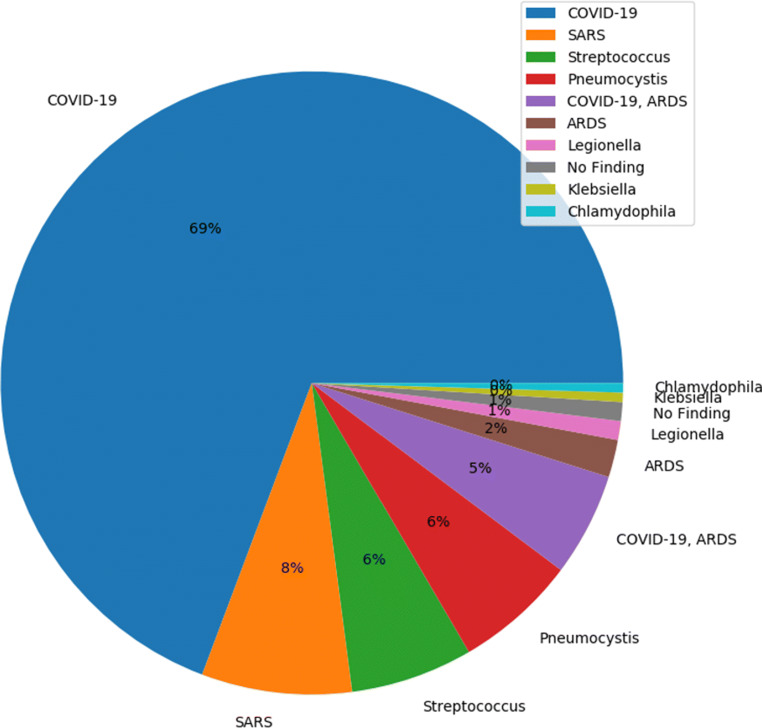
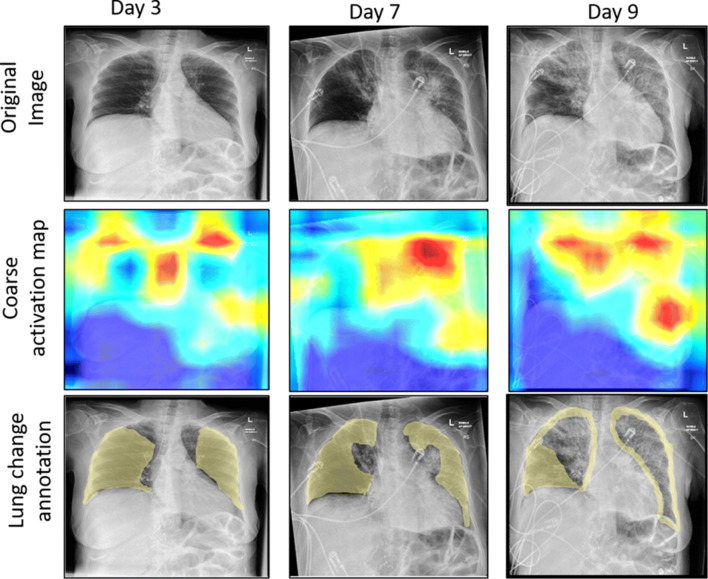
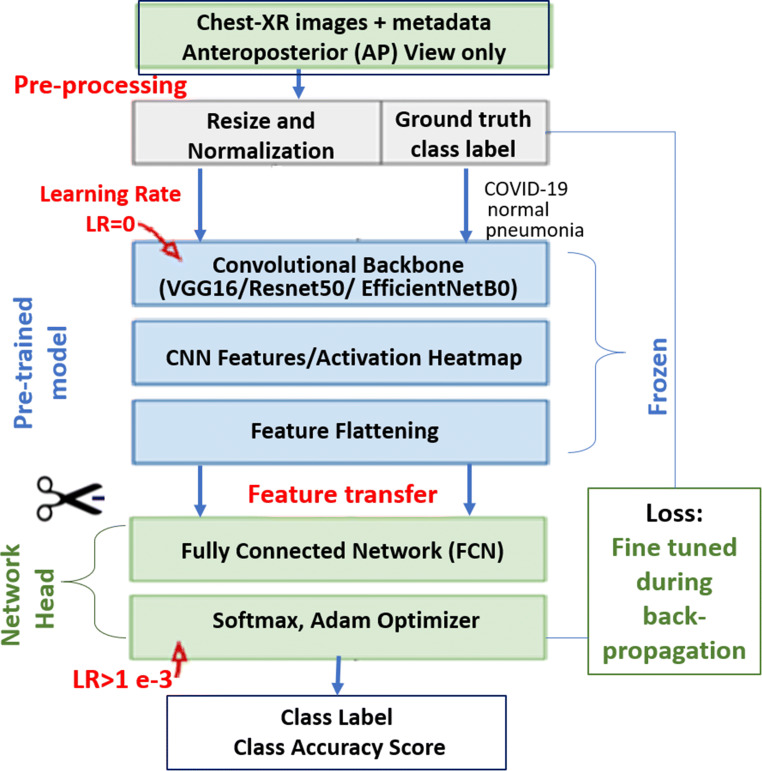
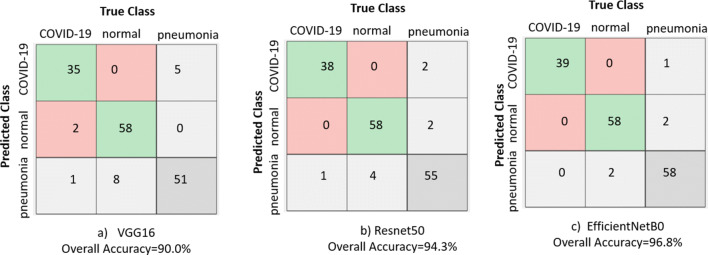
Chest X-rays are playing an important role in the testing and diagnosis of COVID-19 disease in the recent pandemic. However, due to the limited amount of labelled medical images, automated classification of these images for positive and negative cases remains the biggest challenge in their reliable use in diagnosis and disease progression. We implemented a transfer learning pipeline for classifying COVID-19 chest X-ray images from two publicly available chest X-ray datasets. The classifier effectively distinguishes inflammation in lungs due to COVID-19 and Pneumonia from the ones with no infection (normal). We have used multiple pre-trained convolutional backbones as the feature extractor and achieved an overall detection accuracy of 90%, 94.3%, and 96.8% for the VGG16, ResNet50, and EfficientNetB0 backbones respectively. Additionally, we trained a generative adversarial framework (a CycleGAN) to generate and augment the minority COVID-19 class in our approach. For visual explanations and interpretation purposes, we implemented a gradient class activation mapping technique to highlight the regions of the input image that are important for predictions. Additionally, these visualizations can be used to monitor the affected lung regions during disease progression and severity stages.
在最近的疫情大流行中,胸部X光在新冠病毒疾病的检测和诊断中发挥着重要作用。然而,由于标记的医学图像数量有限,对这些图像进行阳性和阴性病例的自动分类仍然是其在诊断和疾病进展中可靠使用的最大挑战。我们实施了一个迁移学习管道,用于对来自两个公开可用胸部X光数据集的新冠病毒胸部X光图像进行分类。该分类器能够有效地将新冠病毒和肺炎引起的肺部炎症与无感染(正常)的情况区分开来。我们使用了多个预训练的卷积骨干网络作为特征提取器,对于VGG16、ResNet50和EfficientNetB0骨干网络,分别实现了90%、94.3%和96.8%的总体检测准确率。此外,我们训练了一个生成对抗框架(循环生成对抗网络),以在我们的方法中生成和扩充少数类的新冠病毒图像。为了进行视觉解释和说明,我们实施了一种梯度类激活映射技术,以突出输入图像中对预测重要的区域。此外,这些可视化可用于在疾病进展和严重程度阶段监测受影响的肺部区域。