Department of Statistics, Federal University of Bahia (UFBA), Salvador, Brazil.
Department of Statistics, Federal University of Bahia (UFBA), Salvador, Brazil.
Spat Spatiotemporal Epidemiol. 2021 Nov;39:100461. doi: 10.1016/j.sste.2021.100461. Epub 2021 Oct 25.
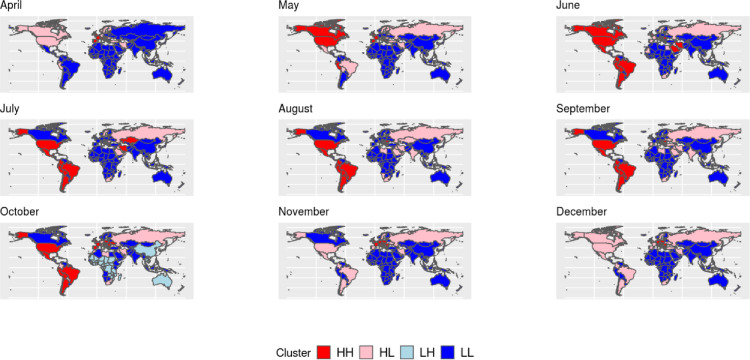
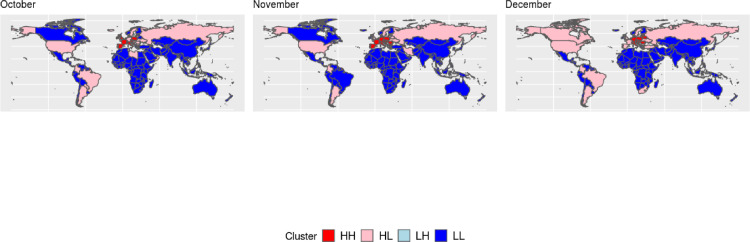
With the whole world being affected by the pandemic, it is a matter of great importance that studies about spatial and spatio-temporal aspects of the COVID-19 (Sars-Cov-2) pandemic should be conducted, therefore the main goal of this paper is to present the Global Moran's I and the Local Moran's I used to evaluate spatial association in the number of deaths and infections by COVID-19, and a spatio-temporal Poisson scan statistic used to identify emerging or "alive" clusters of infections by Sars-Cov-2 in space and time. As of January 2021 vaccination against COVID-19 already started, since the use of spatial clustering methods to identify non-vaccinated populations is not new among studies on vaccination coverage strategies, this paper also aims to discuss the implementation of spatial and spatio-temporal clustering methods in early vaccination.
由于全球都受到疫情的影响,因此对 COVID-19(Sars-Cov-2)大流行的空间和时空方面进行研究非常重要。因此,本文的主要目的是展示全局 Moran's I 和局部 Moran's I,以评估 COVID-19 死亡和感染人数的空间相关性,以及时空泊松扫描统计量,以识别 Sars-Cov-2 在空间和时间上出现或“活跃”的感染簇。截至 2021 年 1 月,COVID-19 疫苗接种已经开始,由于在疫苗接种覆盖策略的研究中,使用空间聚类方法来识别未接种人群并不是什么新鲜事,因此本文还旨在讨论早期接种中的空间和时空聚类方法的实施。