Department of Microbiology and Cell Biology, Montana State University, Bozeman, MT, USA.
Department of Epidemiology, Johns Hopkins Bloomberg School of Public Health, Baltimore, MD, USA.
Nat Rev Microbiol. 2022 May;20(5):299-314. doi: 10.1038/s41579-021-00652-2. Epub 2021 Nov 19.
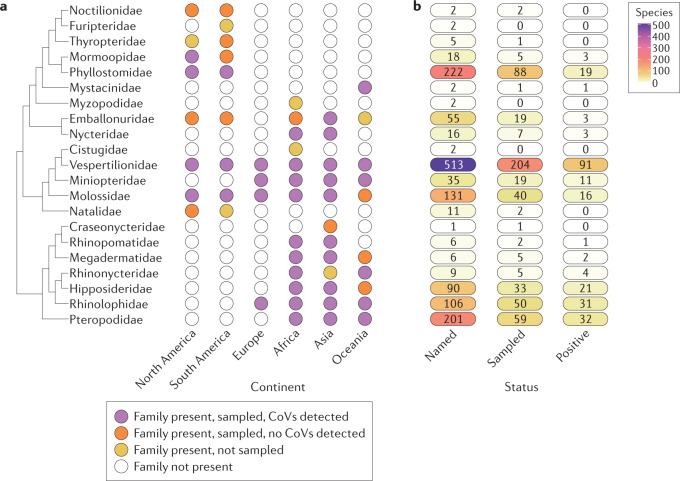
In the past two decades, three coronaviruses with ancestral origins in bats have emerged and caused widespread outbreaks in humans, including severe acute respiratory syndrome coronavirus 2 (SARS-CoV-2). Since the first SARS epidemic in 2002-2003, the appreciation of bats as key hosts of zoonotic coronaviruses has advanced rapidly. More than 4,000 coronavirus sequences from 14 bat families have been identified, yet the true diversity of bat coronaviruses is probably much greater. Given that bats are the likely evolutionary source for several human coronaviruses, including strains that cause mild upper respiratory tract disease, their role in historic and future pandemics requires ongoing investigation. We review and integrate information on bat-coronavirus interactions at the molecular, tissue, host and population levels. We identify critical gaps in knowledge of bat coronaviruses, which relate to spillover and pandemic risk, including the pathways to zoonotic spillover, the infection dynamics within bat reservoir hosts, the role of prior adaptation in intermediate hosts for zoonotic transmission and the viral genotypes or traits that predict zoonotic capacity and pandemic potential. Filling these knowledge gaps may help prevent the next pandemic.
在过去的二十年中,三种起源于蝙蝠的冠状病毒已经出现,并在人类中引起了广泛的爆发,包括严重急性呼吸系统综合症冠状病毒 2(SARS-CoV-2)。自 2002-2003 年首次出现 SARS 疫情以来,人们对蝙蝠作为人畜共患冠状病毒关键宿主的认识迅速提高。已经鉴定出来自 14 个蝙蝠科的超过 4000 种冠状病毒序列,但蝙蝠冠状病毒的真实多样性可能要大得多。鉴于蝙蝠可能是几种人类冠状病毒的进化来源,包括引起轻度上呼吸道疾病的毒株,它们在历史和未来大流行中的作用需要持续调查。我们回顾并整合了有关蝙蝠-冠状病毒在分子、组织、宿主和种群水平上相互作用的信息。我们确定了有关蝙蝠冠状病毒的知识空白,这些空白涉及溢出和大流行风险,包括人畜共溢出的途径、蝙蝠宿主中感染动态、中间宿主中先前适应的作用对于人畜共传播以及预测人畜共患病能力和大流行潜力的病毒基因型或特征。填补这些知识空白可能有助于预防下一次大流行。