Jovanovski Elena, Smircic-Duvnjak Lea, Komishon Allison, Au-Yeung Fei Rodney, Sievenpiper John L, Zurbau Andreea, Jenkins Alexandra L, Sung Mi-Kyung, Josse Robert, Li Dandan, Vuksan Vladimir
Clinical Nutrition and Risk Factor Modification Centre, St. Michael's Hospital, Toronto, Canada.
Department of Nutritional Sciences, Faculty of Medicine, University of Toronto, Toronto, Canada.
J Ginseng Res. 2021 Sep;45(5):546-554. doi: 10.1016/j.jgr.2019.11.005. Epub 2019 Nov 14.
Diabetes mellitus and hypertension often occur together, amplifying cardiovascular disease (CVD) risk and emphasizing the need for a multitargeted treatment approach. American ginseng (AG) and Korean Red Ginseng (KRG) species could improve glycemic control via complementary mechanisms. Additionally, a KRG-inherent component, ginsenoside Rg3, may moderate blood pressure (BP). Our objective was to investigate the therapeutic potential of coadministration of Rg3-enriched Korean Red Ginseng (Rg3-KRG) and AG, added to standard of care therapy, in the management of hypertension and cardiometabolic risk factors in type-2 diabetes.
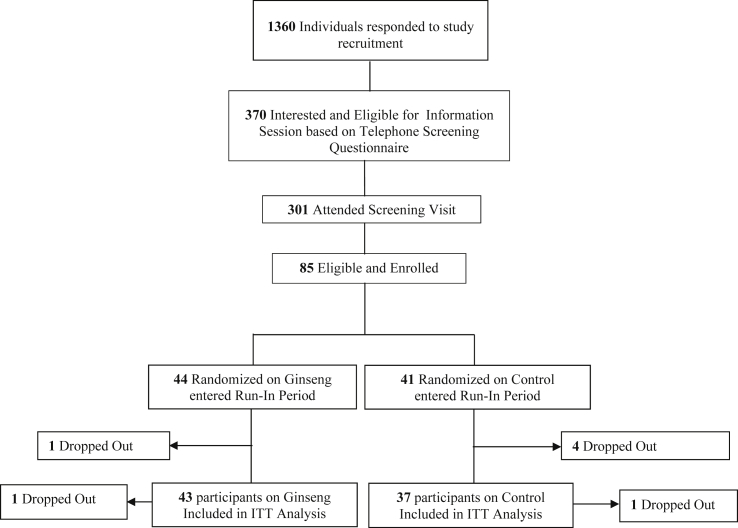
Within a randomized controlled, parallel design of 80 participants with type-2 diabetes (HbA1c: 6.5-8%) and hypertension (systolic BP: 140-160 mmHg or treated), supplementation with either 2.25 g/day of combined Rg3-KRG + AG or wheat-bran control was assessed over a 12-wk intervention period. The primary endpoint was ambulatory 24-h systolic BP. Additional endpoints included further hemodynamic assessment, glycemic control, plasma lipids and safety monitoring.
Combined ginseng intervention generated a mean ± SE decrease in primary endpoint of 24-h systolic BP (-3.98 ± 2.0 mmHg, p = 0.04). Additionally, there was a greater reduction in HbA1c (-0.35 ± 0.1% [-3.8 ± 1.1 mmol/mol], p = 0.02), and change in blood lipids: total cholesterol (-0.50 ± 0.2 mmol/l, p = 0.01), non-HDL-C (-0.54 ± 0.2 mmol/l, p = 0.01), triglycerides (-0.40 ± 0.2 mmol/l, p = 0.02) and LDL-C (-0.35 ± 0.2 mmol/l, p = 0.06) at 12 wks, relative to control. No adverse safety outcomes were observed.
Coadministration of Rg3-KRG + AG is an effective addon for improving BP along with attaining favorable cardiometabolic outcomes in individuals with type 2 diabetes. Ginseng derivatives may offer clinical utility when included in the polypharmacy and lifestyle treatment of diabetes.
Clinicaltrials.gov identifier, NCT01578837.
糖尿病和高血压常同时出现,增加了心血管疾病(CVD)风险,凸显了采取多靶点治疗方法的必要性。西洋参(AG)和高丽参(KRG)可通过互补机制改善血糖控制。此外,KRG的固有成分人参皂苷Rg3可能会降低血压(BP)。我们的目标是研究在2型糖尿病患者的高血压和心脏代谢危险因素管理中,将富含Rg3的高丽参(Rg3-KRG)和AG联合应用于标准护理治疗的治疗潜力。
在一项随机对照平行设计中,纳入80名2型糖尿病(糖化血红蛋白:6.5-8%)和高血压(收缩压:140-160 mmHg或正在接受治疗)患者,在12周的干预期内评估每日补充2.25 g联合Rg3-KRG + AG或麦麸对照物的效果。主要终点是24小时动态收缩压。其他终点包括进一步的血流动力学评估、血糖控制、血脂和安全性监测。
联合人参干预使主要终点24小时收缩压平均±标准误下降(-3.98±2.0 mmHg,p = 0.04)。此外,糖化血红蛋白下降幅度更大(-0.35±0.1%[-3.8±1.1 mmol/mol],p = 0.02),血脂也有变化:12周时总胆固醇(-0.50±0.2 mmol/l,p = 0.01)、非高密度脂蛋白胆固醇(-0.54±0.2 mmol/l,p = 0.01)、甘油三酯(-0.40±0.2 mmol/l,p = 0.02)和低密度脂蛋白胆固醇(-0.35±0.2 mmol/l,p = 0.06),相对于对照组。未观察到不良安全结局。
Rg3-KRG + AG联合应用是改善血压以及使2型糖尿病患者获得良好心脏代谢结局的有效附加治疗。人参衍生物在糖尿病的联合药物治疗和生活方式治疗中可能具有临床应用价值。
Clinicaltrials.gov标识符,NCT01578837。