Maynard Stephanie A, Winter Charles W, Cunnane Eoghan M, Stevens Molly M
Department of Materials, Department of Bioengineering and Institute for Biomedical Engineering, Imperial College London, London, SW7 2AZ, UK.
Regen Eng Transl Med. 2021 Dec;7(4):553-547. doi: 10.1007/s40883-020-00180-0. Epub 2020 Nov 20.
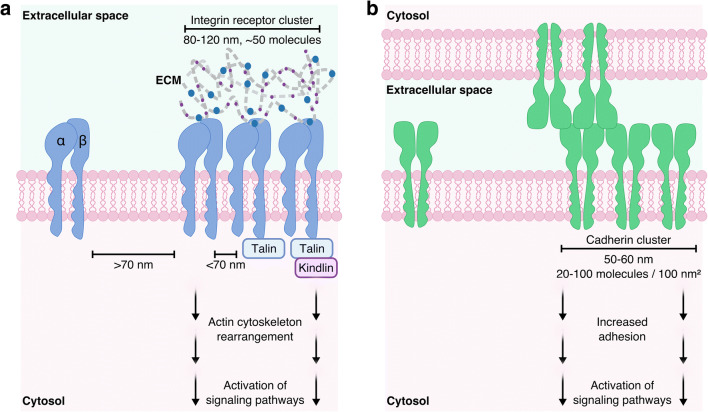
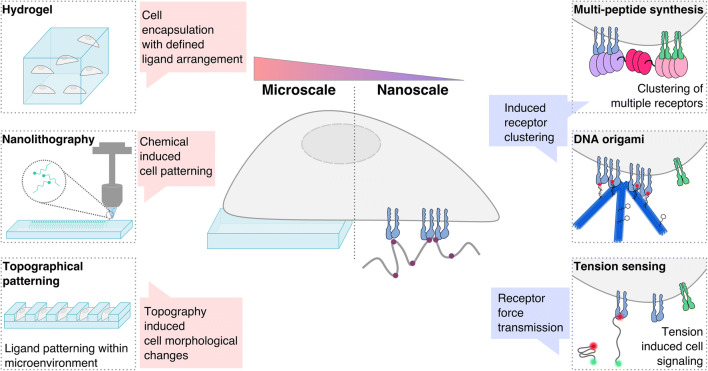
Regenerative medicine is aimed at restoring normal tissue function and can benefit from the application of tissue engineering and nano-therapeutics. In order for regenerative therapies to be effective, the spatiotemporal integration of tissue engineered scaffolds by the native tissue, and the binding/release of therapeutic payloads by nano-materials, must be tightly controlled at the nanoscale in order to direct cell fate. However, due to a lack of insight regarding cell-material interactions at the nanoscale and subsequent downstream signaling, the clinical translation of many regenerative therapies is limited due to poor material integration, rapid clearance and complications such as graft-versus-host disease. This review paper is intended to outline our current understanding of cell-material interactions with the aim of highlighting potential areas for knowledge advancement or application in the field of regenerative medicine. This is achieved by reviewing the nanoscale organization of key cell surface receptors, the current techniques used to control the presentation of cell-interactive molecules on material surfaces, as well as the most advanced techniques for characterizing the interactions that occur between cell surface receptors and materials intended for use in regenerative medicine.
再生医学旨在恢复正常组织功能,并能从组织工程和纳米治疗学的应用中受益。为了使再生疗法有效,天然组织对组织工程支架的时空整合以及纳米材料对治疗载荷的结合/释放,必须在纳米尺度上得到严格控制,以引导细胞命运。然而,由于对纳米尺度上的细胞-材料相互作用以及随后的下游信号缺乏深入了解,许多再生疗法的临床转化受到限制,原因包括材料整合不佳、快速清除以及移植物抗宿主病等并发症。这篇综述文章旨在概述我们目前对细胞-材料相互作用的理解,以突出再生医学领域知识进步或应用的潜在领域。这是通过回顾关键细胞表面受体的纳米尺度组织、用于控制细胞相互作用分子在材料表面呈现的当前技术,以及用于表征细胞表面受体与再生医学所用材料之间相互作用的最先进技术来实现的。