
质子交换膜燃料电池催化剂层的制备、性能及挑战
Preparation, Performance and Challenges of Catalyst Layer for Proton Exchange Membrane Fuel Cell.
作者信息
Xie Meng, Chu Tiankuo, Wang Tiantian, Wan Kechuang, Yang Daijun, Li Bing, Ming Pingwen, Zhang Cunman
机构信息
School of Automotive Studies, Tongji University (Jiading Campus), 4800 Cao'an Road, Shanghai 201804, China.
Clean Energy Automotive Engineering Center, Tongji University (Jiading Campus), 4800 Cao'an Road, Shanghai 201804, China.
出版信息
Membranes (Basel). 2021 Nov 15;11(11):879. doi: 10.3390/membranes11110879.
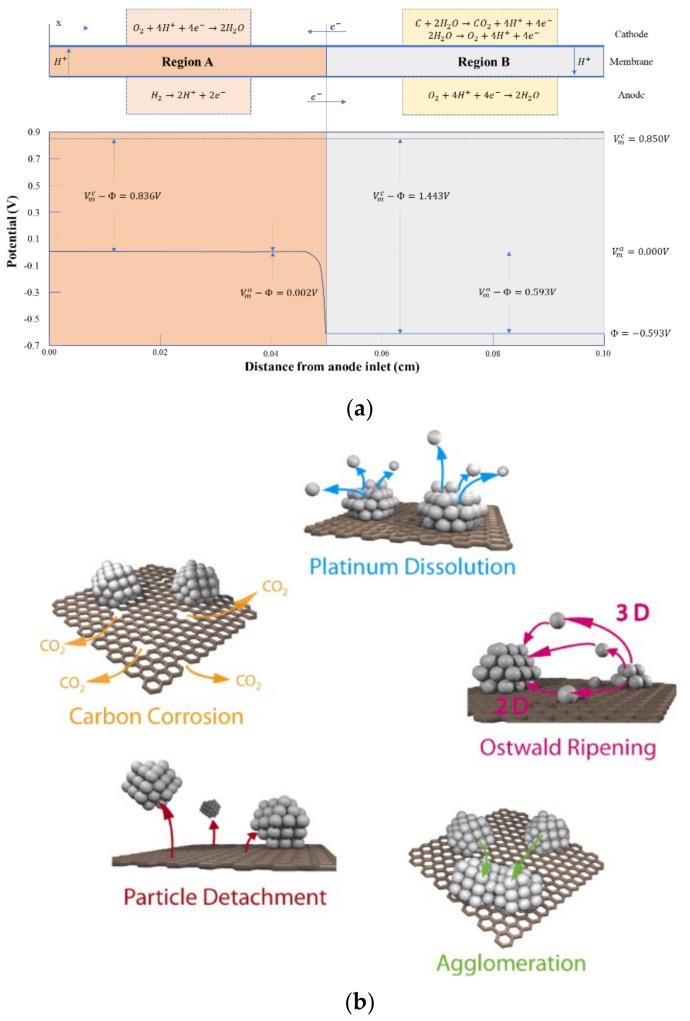
In this paper, the composition, function and structure of the catalyst layer (CL) of a proton exchange membrane fuel cell (PEMFC) are summarized. The hydrogen reduction reaction (HOR) and oxygen reduction reaction (ORR) processes and their mechanisms and the main interfaces of CL (PEM|CL and CL|MPL) are described briefly. The process of mass transfer (hydrogen, oxygen and water), proton and electron transfer in MEA are described in detail, including their influencing factors. The failure mechanism of CL (Pt particles, CL crack, CL flooding, etc.) and the degradation mechanism of the main components in CL are studied. On the basis of the existing problems, a structure optimization strategy for a high-performance CL is proposed. The commonly used preparation processes of CL are introduced. Based on the classical drying theory, the drying process of a wet CL is explained. Finally, the research direction and future challenges of CL are pointed out, hoping to provide a new perspective for the design and selection of CL materials and preparation equipment.
本文总结了质子交换膜燃料电池(PEMFC)催化剂层(CL)的组成、功能和结构。简要描述了氢还原反应(HOR)和氧还原反应(ORR)过程及其机理以及CL的主要界面(PEM|CL和CL|MPL)。详细描述了MEA中的传质(氢气、氧气和水)、质子和电子转移过程,包括它们的影响因素。研究了CL的失效机理(Pt颗粒、CL裂纹、CL水淹等)以及CL中主要成分的降解机理。基于存在的问题,提出了高性能CL的结构优化策略。介绍了CL常用的制备工艺。基于经典干燥理论,解释了湿CL的干燥过程。最后指出了CL的研究方向和未来挑战,希望为CL材料的设计与选择以及制备设备提供新的视角。




 Zotero 插件