Montefusco Anna, Durante Miriana, Migoni Danilo, De Caroli Monica, Ilahy Riadh, Pék Zoltán, Helyes Lajos, Fanizzi Francesco Paolo, Mita Giovanni, Piro Gabriella, Lenucci Marcello Salvatore
Dipartimento di Scienze e Tecnologie Biologiche ed Ambientali (Di.S.Te.B.A.), Università del Salento, Via Prov.le Lecce Monteroni, 73100 Lecce, Italy.
Istituto di Scienze delle Produzioni Alimentari (ISPA)-CNR, Via Prov.le Lecce-Monteroni, 73100 Lecce, Italy.
Plants (Basel). 2021 Nov 19;10(11):2521. doi: 10.3390/plants10112521.
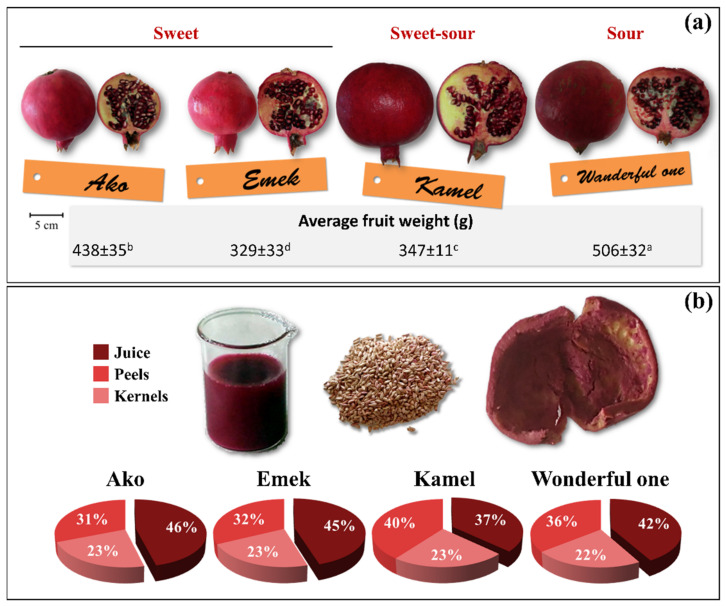
The increasing popularity of pomegranate ( L.), driven by the awareness of its nutraceutical properties and excellent environmental adaptability, is promoting a global expansion of its production area. This investigation reports the variability in the weight, moisture, pH, total soluble solids, carbohydrates, organic acids, phenolic compounds, fatty acids, antioxidant activities, and element composition of different fruit parts (juices, peels, and kernels) from four (Ako, Emek, Kamel, and Wonderful One) of the most widely cultivated Israeli pomegranate varieties in Salento (South Italy). To the best of our knowledge, this is the first systematic characterization of different fruit parts from pomegranate cultivars grown simultaneously in the same orchard and subjected to identical agronomic and environmental conditions. Significant genotype-dependent variability was observed for many of the investigated parameters, though without any correlation among fruit parts. The levels of phenols, flavonoids, anthocyanins, and ascorbic and dehydroascorbic acids of all samples were higher than the literature-reported data, as was the antioxidant activity. This is likely due to positive interactions among genotypes, the environment, and good agricultural practices. This study also confirms that pomegranate kernels and peels are, respectively, rich sources of punicic acid and phenols together, with several other bioactive molecules. However, the variability in their levels emphasizes the need for further research to better exploit their agro-industrial potential and thereby increase juice-production chain sustainability. This study will help to assist breeders and growers to respond to consumer and industrial preferences and encourage the development of biorefinery strategies for the utilization of pomegranate by-products as nutraceuticals or value-added ingredients for custom-tailored supplemented foods.
由于人们对石榴(L.)营养特性的认识以及其出色的环境适应性,石榴越来越受欢迎,这推动了其种植面积在全球范围内的扩大。本调查报道了来自萨伦托(意大利南部)种植最广泛的四个以色列石榴品种(阿科、埃梅克、卡梅尔和奇妙一号)不同果实部位(果汁、果皮和果仁)的重量、水分、pH值、总可溶性固形物、碳水化合物、有机酸、酚类化合物、脂肪酸、抗氧化活性和元素组成的变异性。据我们所知,这是首次对在同一果园同时种植且处于相同农艺和环境条件下的石榴品种不同果实部位进行系统表征。尽管果实部位之间没有任何相关性,但在许多研究参数中观察到了显著的基因型依赖性变异性。所有样品中的酚类、黄酮类、花青素以及抗坏血酸和脱氢抗坏血酸的含量均高于文献报道的数据,抗氧化活性也是如此。这可能是由于基因型、环境和良好农业实践之间的积极相互作用。本研究还证实,石榴果仁分别富含石榴酸,果皮富含酚类物质,以及其他几种生物活性分子。然而,它们含量的变异性强调了需要进一步研究,以更好地开发其农业工业潜力,从而提高果汁生产链的可持续性。这项研究将有助于协助育种者和种植者满足消费者和工业的偏好,并鼓励开发生物精炼策略,以将石榴副产品用作营养保健品或定制补充食品的增值成分。