Freie Universität Berlin, Department of Physics, Experimental Molecular Biophysics, Arnimallee 14, 14195, Berlin, Germany.
Freie Universität Berlin, Department of Physics, Experimental Biophysics and Space Sciences, Arnimallee 14, 14195, Berlin, Germany.
Commun Biol. 2021 Nov 30;4(1):1341. doi: 10.1038/s42003-021-02876-7.
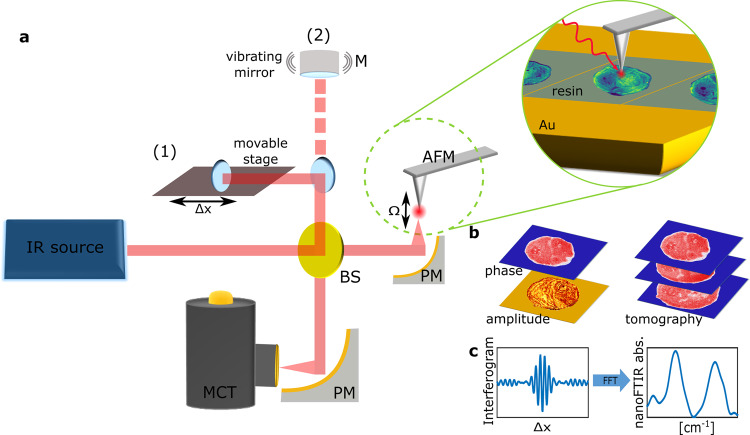
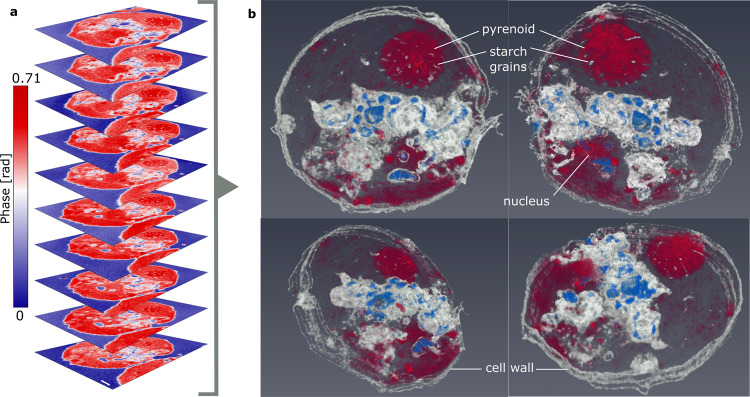
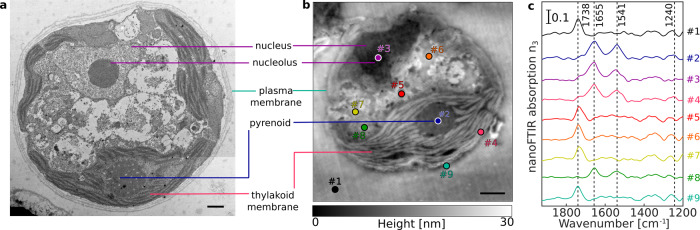
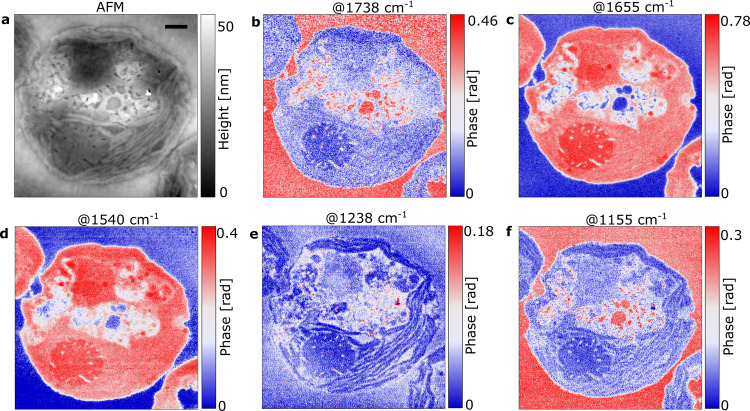
Although techniques such as fluorescence-based super-resolution imaging or confocal microscopy simultaneously gather both morphological and chemical data, these techniques often rely on the use of localized and chemically specific markers. To eliminate this flaw, we have developed a method of examining cellular cross sections using the imaging power of scattering-type scanning near-field optical microscopy and Fourier-transform infrared spectroscopy at a spatial resolution far beyond the diffraction limit. Herewith, nanoscale surface and volumetric chemical imaging is performed using the intrinsic contrast generated by the characteristic absorption of mid-infrared radiation by the covalent bonds. We employ infrared nanoscopy to study the subcellular structures of eukaryotic (Chlamydomonas reinhardtii) and prokaryotic (Escherichia coli) species, revealing chemically distinct regions within each cell such as the microtubular structure of the flagellum. Serial 100 nm-thick cellular cross-sections were compiled into a tomogram yielding a three-dimensional infrared image of subcellular structure distribution at 20 nm resolution. The presented methodology is able to image biological samples complementing current fluorescence nanoscopy but at less interference due to the low energy of infrared radiation and the absence of labeling.
尽管荧光超分辨率成像或共聚焦显微镜等技术可以同时收集形态和化学数据,但这些技术通常依赖于使用局部和化学特异性标记物。为了消除这一缺陷,我们开发了一种使用散射型近场光学显微镜和傅里叶变换红外光谱的成像能力来检查细胞切片的方法,其空间分辨率远远超过衍射极限。在此,使用共价键对中红外辐射的特征吸收产生的固有对比度来进行纳米级表面和体积化学成像。我们采用红外纳米显微镜研究真核(莱茵衣藻)和原核(大肠杆菌)生物的亚细胞结构,揭示每个细胞内化学性质不同的区域,如鞭毛的微管结构。100nm 厚的细胞连续切片被汇编成一个体素,生成亚细胞结构分布的三维红外图像,分辨率为 20nm。所提出的方法能够对生物样本进行成像,补充当前的荧光纳米显微镜,但由于红外辐射能量低且无需标记,因此干扰较小。