Berends Jared, Bendita da Costa Jong Joanita, Cooper Tarni Louisa, Dizyee Kanar, Morais Olavio, Pereira Abrão, Smith Dominic, Rich Karl M
The New Zealand Institute for Plant & Food Research Limited, Auckland, New Zealand.
International Livestock Research Institute, West Africa Regional Office, Dakar, Senegal.
Front Vet Sci. 2021 Nov 18;8:687708. doi: 10.3389/fvets.2021.687708. eCollection 2021.
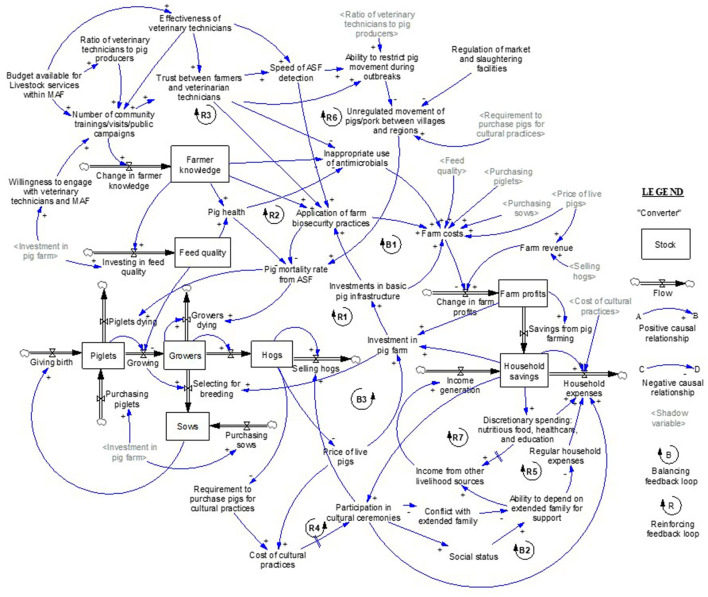
Small-scale pig farming is highly important to the economic and social status of households in Timor-Leste. The presence of an African Swine Fever (ASF) outbreak in Timor-Leste was confirmed in 2019, a major concern given that around 70% of agricultural households practice pig farming. This research used a virtual spatial group model building process to construct a concept model to better understand the main feedback loops that determine the socio-economic and livelihood impacts of the ASF outbreak. After discussing the interaction of reinforcing and balancing feedback loops in the concept model, potential leverage points for intervention are suggested that could reduce the impacts of ASF within socio-economic spheres. These include building trust between small-scale farmers and veterinary technicians, strengthening government veterinary services, and the provision of credit conditional on biosecurity investments to help restock the industry. This conceptual model serves as a starting point for further research and the future development of a quantitative system dynamics (SD) model which would allow scenario-testing of various policy and technical mitigation strategies of ASF outbreaks in Timor-Leste and beyond. Lessons learned from the blended offline/online approach to training and workshop facilitation are also explored in the paper.
小规模养猪对东帝汶家庭的经济和社会地位至关重要。2019年,东帝汶确认爆发了非洲猪瘟(ASF)疫情,鉴于约70%的农业家庭从事养猪业,这一情况令人高度担忧。本研究采用虚拟空间群体模型构建过程来构建一个概念模型,以更好地理解决定非洲猪瘟疫情对社会经济和生计影响的主要反馈回路。在讨论了概念模型中增强和平衡反馈回路的相互作用之后,提出了可能的干预杠杆点,这些杠杆点可以减少非洲猪瘟在社会经济领域的影响。这些措施包括在小规模养殖户和兽医技术人员之间建立信任、加强政府兽医服务,以及提供以生物安全投资为条件的信贷,以帮助该行业重新补栏。这个概念模型是进一步研究以及未来开发定量系统动力学(SD)模型的起点,该模型将允许对东帝汶及其他地区非洲猪瘟疫情的各种政策和技术缓解策略进行情景测试。本文还探讨了从线下/线上混合培训和研讨会促进方法中学到的经验教训。