Department of Machine Learning, H. Lee Moffitt Cancer Center and Research Institute, Tampa, FL, 33612, USA.
Department of Nuclear Engineering and Radiological Sciences, University of Michigan, Ann Arbor, MI, 48109, USA.
Sci Rep. 2021 Dec 7;11(1):23545. doi: 10.1038/s41598-021-02910-y.
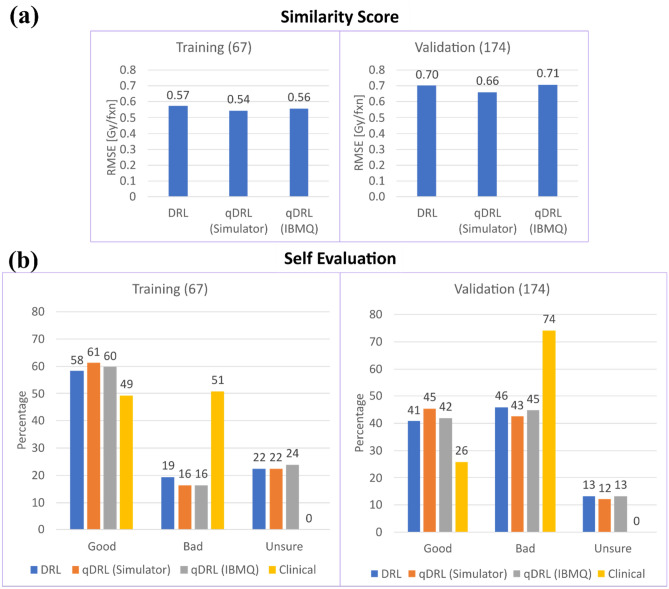
Subtle differences in a patient's genetics and physiology may alter radiotherapy (RT) treatment responses, motivating the need for a more personalized treatment plan. Accordingly, we have developed a novel quantum deep reinforcement learning (qDRL) framework for clinical decision support that can estimate an individual patient's dose response mid-treatment and recommend an optimal dose adjustment. Our framework considers patients' specific information including biological, physical, genetic, clinical, and dosimetric factors. Recognizing that physicians must make decisions amidst uncertainty in RT treatment outcomes, we employed indeterministic quantum states to represent human decision making in a real-life scenario. We paired quantum decision states with a model-based deep q-learning algorithm to optimize the clinical decision-making process in RT. We trained our proposed qDRL framework on an institutional dataset of 67 stage III non-small cell lung cancer (NSCLC) patients treated on prospective adaptive protocols and independently validated our framework in an external multi-institutional dataset of 174 NSCLC patients. For a comprehensive evaluation, we compared three frameworks: DRL, qDRL trained in a Qiskit quantum computing simulator, and qDRL trained in an IBM quantum computer. Two metrics were considered to evaluate our framework: (1) similarity score, defined as the root mean square error between retrospective clinical decisions and the AI recommendations, and (2) self-evaluation scheme that compares retrospective clinical decisions and AI recommendations based on the improvement in the observed clinical outcomes. Our analysis shows that our framework, which takes into consideration individual patient dose response in its decision-making, can potentially improve clinical RT decision-making by at least about 10% compared to unaided clinical practice. Further validation of our novel quantitative approach in a prospective study will provide a necessary framework for improving the standard of care in personalized RT.
患者遗传学和生理学上的细微差异可能会改变放射治疗 (RT) 的治疗反应,这促使我们需要制定更个性化的治疗计划。因此,我们开发了一种新的量子深度学习 (qDRL) 框架,用于临床决策支持,可以在治疗过程中估计个体患者的剂量反应,并建议进行最佳剂量调整。我们的框架考虑了患者的特定信息,包括生物学、物理学、遗传学、临床和剂量学因素。我们认识到,在 RT 治疗结果中,医生必须在不确定性中做出决策,因此我们采用了不确定的量子态来代表现实生活中的人类决策。我们将量子决策状态与基于模型的深度 q 学习算法相结合,以优化 RT 中的临床决策过程。我们在机构内的 67 例 III 期非小细胞肺癌 (NSCLC) 前瞻性自适应治疗方案患者数据集上对我们提出的 qDRL 框架进行了训练,并在外部多机构 NSCLC 患者数据集上对框架进行了独立验证。为了进行全面评估,我们比较了三个框架:DRL、在 Qiskit 量子计算模拟器中训练的 qDRL 和在 IBM 量子计算机中训练的 qDRL。我们使用了两个指标来评估我们的框架:(1) 相似度得分,定义为回顾性临床决策和人工智能建议之间的均方根误差;(2) 自我评估方案,该方案根据观察到的临床结果的改善来比较回顾性临床决策和人工智能建议。我们的分析表明,与未经辅助的临床实践相比,我们的框架在决策中考虑了个体患者的剂量反应,有可能将临床 RT 决策提高至少 10%。在前瞻性研究中进一步验证我们新颖的定量方法,将为改善个性化 RT 的护理标准提供必要的框架。