Warneford Hospital, Department of Psychiatry, University of Oxford, Oxford, UK.
Department of Medical Epidemiology and Biostatistics, Karolinska Institutet, Stockholm, Sweden.
Sci Rep. 2021 Dec 14;11(1):23402. doi: 10.1038/s41598-021-02710-4.
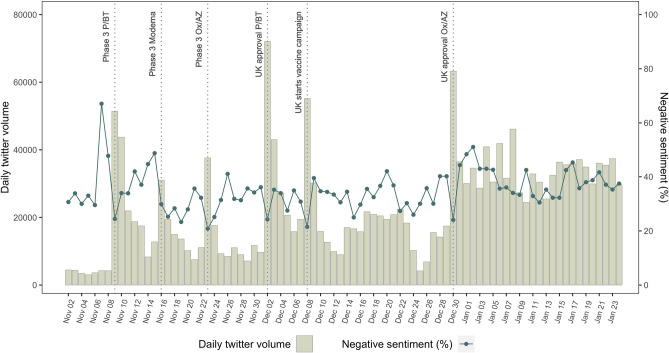
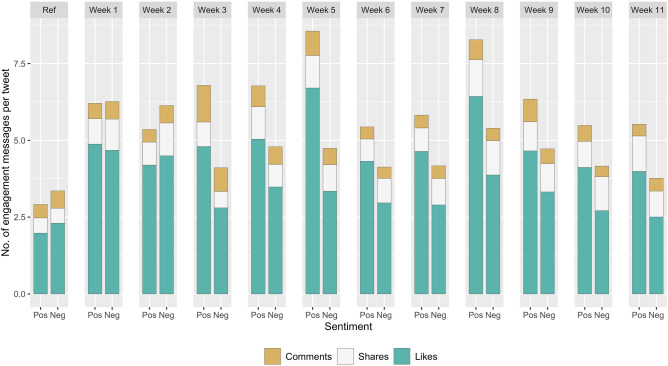
Attitudes to COVID-19 vaccination vary considerably within and between countries. Although the contribution of socio-demographic factors to these attitudes has been studied, the role of social media and how it interacts with news about vaccine development and efficacy is uncertain. We examined around 2 million tweets from 522,893 persons in the UK from November 2020 to January 2021 to evaluate links between Twitter content about vaccines and major scientific news announcements about vaccines. The proportion of tweets with negative vaccine content varied, with reductions of 20-24% on the same day as major news announcement. However, the proportion of negative tweets reverted back to an average of around 40% within a few days. Engagement rates were higher for negative tweets. Public health messaging could consider the dynamics of Twitter-related traffic and the potential contribution of more targeted social media campaigns to address vaccine hesitancy.
人们对接种 COVID-19 疫苗的态度在各国国内和国家之间存在很大差异。尽管已经研究了社会人口因素对这些态度的影响,但社交媒体的作用以及它与疫苗开发和功效相关新闻的相互作用尚不确定。我们分析了 2020 年 11 月至 2021 年 1 月期间英国 522893 人发布的约 200 万条推文,以评估关于疫苗的推文内容与关于疫苗的重大科学新闻公告之间的联系。带有负面疫苗内容的推文比例有所不同,在重大新闻发布的同一天减少了 20-24%。然而,几天后,负面推文的比例又恢复到平均约 40%左右。负面推文的参与率更高。公共卫生信息传播可以考虑与 Twitter 相关的流量动态,以及更有针对性的社交媒体活动在解决疫苗犹豫方面的潜在贡献。