Ouergui Ibrahim, Delleli Slaheddine, Bouassida Anissa, Bouhlel Ezdine, Chaabene Helmi, Ardigò Luca Paolo, Franchini Emerson
High Institute of Sport and Physical Education of Kef, Kef, University of Jendouba, Jendouba, Tunisia.
Laboratory of Cardio-Circulatory, Respiratory, Metabolic and Hormonal Adaptations to Muscular Exercise, Faculty of Medicine Ibn El Jazzar, University of Sousse, Sousse, Tunisia.
BMC Sports Sci Med Rehabil. 2021 Dec 17;13(1):158. doi: 10.1186/s13102-021-00391-0.
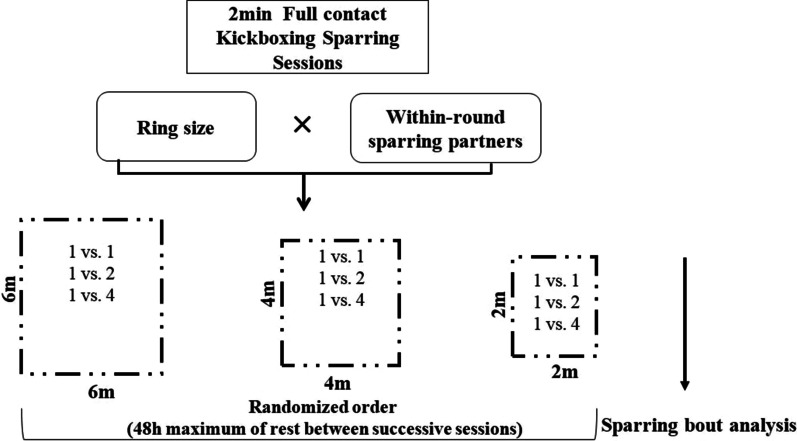
To handle the competition demands, sparring drills are used for specific technical-tactical training as well as physical-physiological conditioning in combat sports. While the effects of different area sizes and number of within-round sparring partners on physiological and perceptive responses in combats sports were examined in previous studies, technical and tactical aspects were not investigated. This study investigated the effect of different within-round sparring partners number (i.e., at a time; 1 vs. 1, 1 vs. 2, and 1 vs. 4) and area sizes (2 m × 2 m, 4 m × 4 m, and 6 m × 6 m) variation on the technical-tactical aspects of small combat games in kickboxing.
Twenty male kickboxers (mean ± standard deviation, age: 20.3 ± 0.9 years), regularly competing in regional and national events randomly performed nine different kickboxing combats, lasting 2 min each. All combats were video recorded and analyzed using the software Dartfish.
Results showed that the total number of punches was significantly higher in 1 versus 4 compared with 1 versus 1 (p = 0.011, d = 0.83). Further, the total number of kicks was significantly higher in 1 versus 4 compared with 1 versus 1 and 1 versus 2 (p < 0.001; d = 0.99 and d = 0.83, respectively). Moreover, the total number of kick combinations was significantly higher in 1 versus 4 compared with 1 versus 1 and 1 versus 2 (p < 0.001; d = 1.05 and d = 0.95, respectively). The same outcome was significantly lower in 2 m × 2 m compared with 4 m × 4 m and 6 m × 6 m areas (p = 0.010 and d = - 0.45; p < 0.001 and d = - 0.6, respectively). The number of block-and-parry was significantly higher in 1 versus 4 compared with 1 versus 1 (p < 0.001, d = 1.45) and 1 versus 2 (p = 0.046, d = 0.61) and in 2 m × 2 m compared with 4 m × 4 m and 6 × 6 m areas (p < 0.001; d = 0.47 and d = 0.66, respectively). Backwards lean actions occurred more often in 2 m × 2 m compared with 4 m × 4 m (p = 0.009, d = 0.53) and 6 m × 6 m (p = 0.003, d = 0.60). However, the number of foot defenses was significantly lower in 2 m × 2 m compared with 6 m × 6 m (p < 0.001, d = 1.04) and 4 m × 4 m (p = 0.004, d = 0.63). Additionally, the number of clinches was significantly higher in 1 versus 1 compared with 1 versus 2 (p = 0.002, d = 0.7) and 1 versus 4 (p = 0.034, d = 0.45).
This study provides practical insights into how to manipulate within-round sparring partners' number and/or area size to train specific kickboxing technical-tactical fundamentals.
This study does not report results related to health care interventions using human participants and therefore it was not prospectively registered.
为应对比赛需求,实战演练用于格斗运动中的特定技术战术训练以及身体生理调节。虽然以往研究考察了不同场地面积和每轮实战对手数量对格斗运动中生理和感知反应的影响,但未对技术和战术方面进行研究。本研究调查了不同的每轮实战对手数量(即一次;1对1、1对2和1对4)和场地面积(2米×2米、4米×4米和6米×6米)变化对踢拳中小型格斗比赛技术战术方面的影响。
20名男性踢拳手(平均±标准差,年龄:20.3±0.9岁),经常参加地区和全国赛事,随机进行9场不同的踢拳比赛,每场持续2分钟。所有比赛均进行视频录制,并使用Dartfish软件进行分析。
结果显示,1对4时的总拳数显著高于1对1(p = 0.011,d = 0.83)。此外,1对4时的总踢数显著高于1对1和1对2(p < 0.001;d分别为0.99和0.83)。而且,1对4时的踢组合总数显著高于1对1和1对2(p < 0.001;d分别为1.05和0.95)。与4米×4米和6米×6米场地相比,2米×2米场地的相同结果显著更低(p = 0.010,d = -0.45;p < 0.001,d = -0.6)。1对4时的格挡和招架次数显著高于1对1(p < 0.001,d = 1.45)和1对2(p = 0.046,d = 0.61),且与4米×4米和6×6米场地相比,2米×2米场地的格挡和招架次数显著更高(p < 0.001;d分别为0.47和0.66)。与4米×4米场地(p = 0.009,d = 0.53)和6米×6米场地(p = 0.003,d = 0.60)相比,2米×2米场地的向后倾斜动作更频繁。然而,与6米×6米场地(p < 0.001,d = 1.04)和4米×4米场地(p = 0.004,d = 0.63)相比,2米×2米场地的足部防御次数显著更低。此外,1对1时的搂抱次数显著高于1对2(p = 0.002,d = 0.7)和1对4(p = 0.034,d = 0.45)。
本研究为如何通过操控每轮实战对手数量和/或场地面积来训练特定的踢拳技术战术基础提供了实用见解。
本研究未报告与使用人类参与者的医疗保健干预相关的结果,因此未进行前瞻性注册。