University of Groningen, University Medical Center Groningen, Department of Biomedical Engineering, Antonius Deusinglaan 1, 9713 AV Groningen, The Netherlands.
University of Groningen, Department of Molecular Immunology, Groningen Biomolecular Sciences and Biotechnology Institute, Antonius Deusinglaan 1, 9713 AV Groningen, The Netherlands.
Nano Lett. 2022 Feb 23;22(4):1818-1825. doi: 10.1021/acs.nanolett.1c03021. Epub 2021 Dec 20.
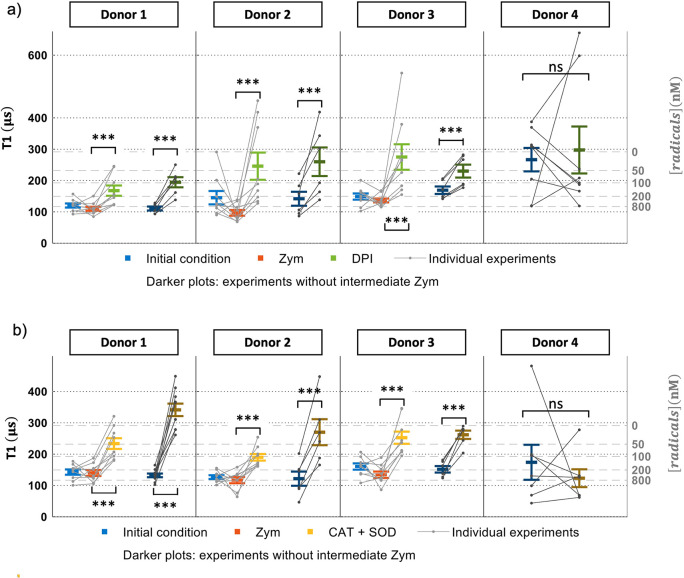
Free radicals are crucial indicators for stress and appear in all kinds of pathogenic conditions, including cancer, cardiovascular diseases, and infection. However, they are difficult to detect due to their reactivity and low abundance. We use relaxometry for the detection of radicals with subcellular resolution. This method is based on a fluorescent defect in a diamond, which changes its optical properties on the basis of the magnetic surroundings. This technique allows nanoscale MRI with unprecedented sensitivity and spatial resolution. Recently, this technique was used inside living cells from a cell line. Cell lines differ in terms of endocytic capability and radical production from primary cells derived from patients. Here we provide the first measurements of phagocytic radical production by the NADPH oxidase (NOX2) in primary dendritic cells from healthy donors. The radical production of these cells differs greatly between donors. We investigated the cell response to stimulation or inhibition.
自由基是应激的关键指标,存在于各种致病条件中,包括癌症、心血管疾病和感染。然而,由于它们的反应性和低丰度,很难检测到。我们使用弛豫测量法来检测具有亚细胞分辨率的自由基。该方法基于钻石中的荧光缺陷,其光学性质会根据磁环境发生变化。该技术允许具有前所未有的灵敏度和空间分辨率的纳米级 MRI。最近,这项技术在来自细胞系的活细胞内得到了应用。细胞系在吞噬作用能力和自由基产生方面与源自患者的原代细胞不同。在这里,我们首次测量了来自健康供体的原代树突状细胞中 NADPH 氧化酶 (NOX2) 的吞噬自由基产生。这些细胞的自由基产生在供体之间差异很大。我们研究了细胞对刺激或抑制的反应。