Lu Miaolong, Zhan Hailun, Liu Bolong, Li Dongyang, Li Wenbiao, Chen Xuelian, Zhou Xiangfu
Department of Urology, The Third Affiliated Hospital of Sun Yat-Sen University, 600 W Tianhe Rd, Guangzhou, Guangdong 510630 People's Republic of China.
EPMA J. 2021 Oct 21;12(4):589-604. doi: 10.1007/s13167-021-00259-w. eCollection 2021 Dec.
Bladder cancer (BC) is a commonly occurring malignant tumor of the urinary system, demonstrating high global morbidity and mortality rates. BC currently lacks widely accepted biomarkers and its predictive, preventive, and personalized medicine (PPPM) is still unsatisfactory. N6-methyladenosine (mA) modification and non-coding RNAs (ncRNAs) have been shown to be effective prognostic and immunotherapeutic responsiveness biomarkers and contribute to PPPM for various tumors. However, their role in BC remains unclear.
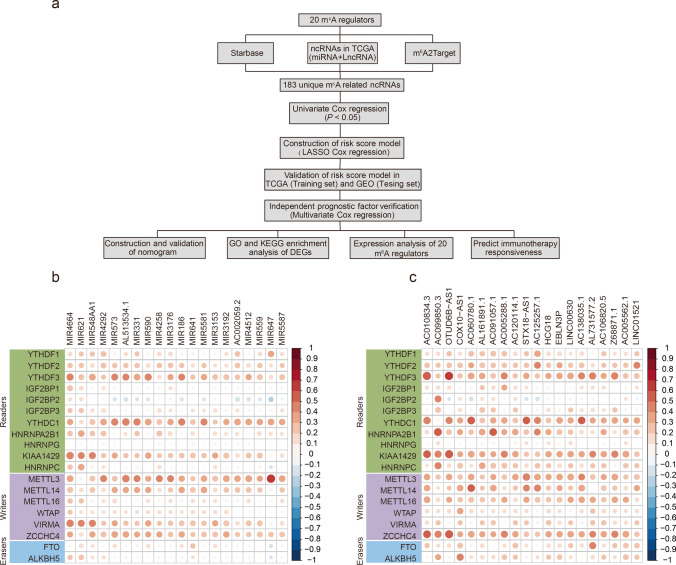
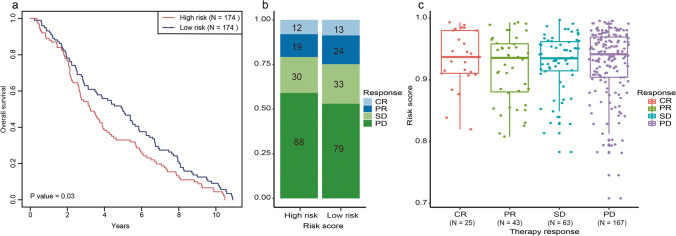
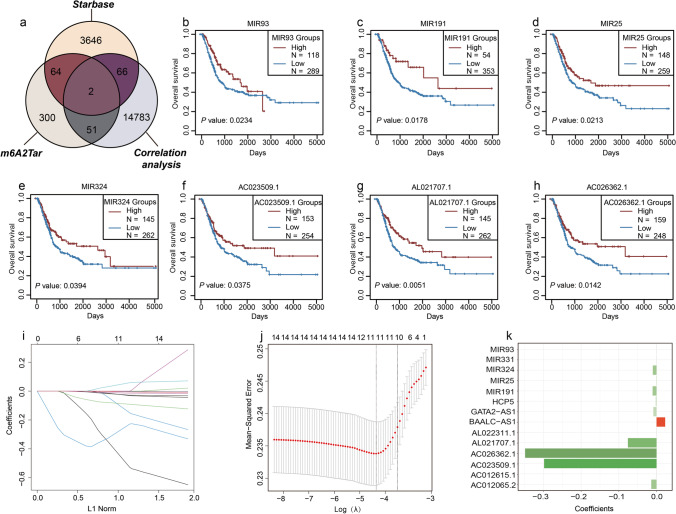
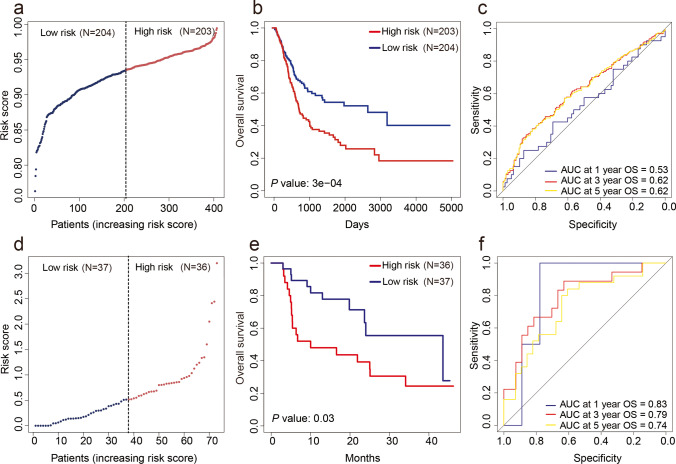
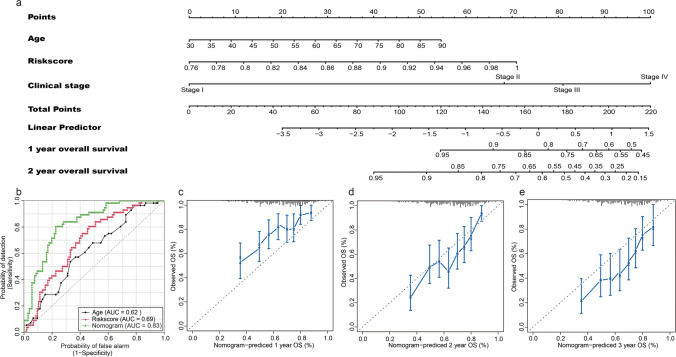
mA-related ncRNAs (lncRNAs and miRNAs) were identified through a comprehensive analysis of TCGA, starBase, and m6A2Target databases. Using TCGA dataset (training set), univariate and least absolute shrinkage and selection operator (LASSO) regression analyses were performed to develop an mA-related ncRNA-based prognostic risk model. Kaplan-Meier analysis of overall survival (OS) and receiver operating characteristic (ROC) curves were used to verify the prognostic evaluation power of the risk model in the GSE154261 dataset (testing set) from Gene Expression Omnibus (GEO). A nomogram containing independent prognostic factors was developed. Differences in BC clinical characteristics, mA regulators, mA-related ncRNAs, gene expression patterns, and differentially expressed genes (DEGs)-associated molecular networks between the high- and low-risk groups in TCGA dataset were also analyzed. Additionally, the potential applicability of the risk model in the prediction of immunotherapeutic responsiveness was evaluated based on the "IMvigor210CoreBiologies" data set.
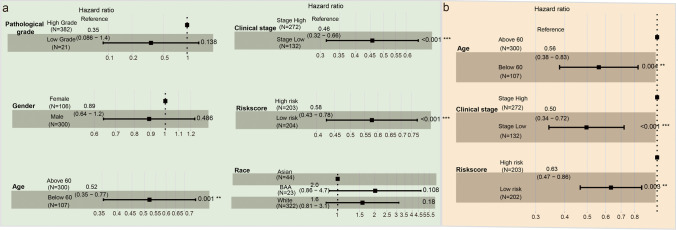
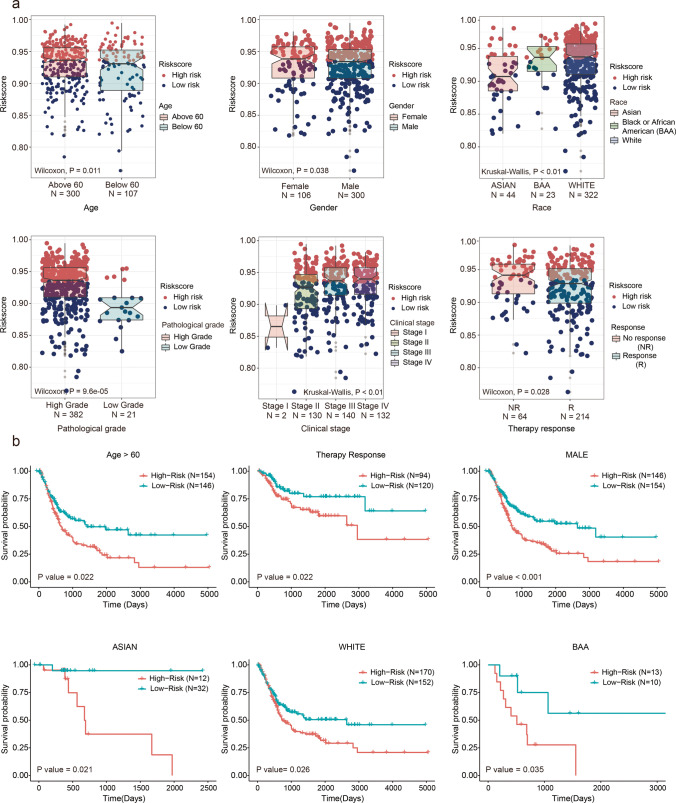
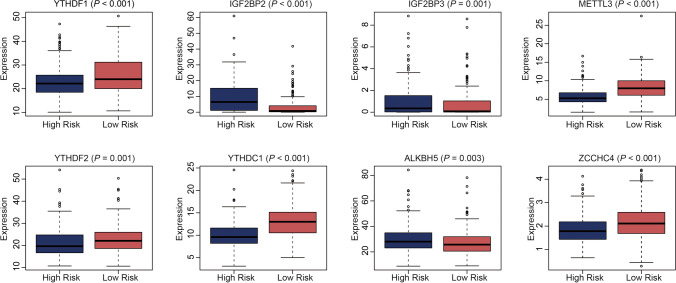
We identified 183 mA-related ncRNAs, of which 14 were related to OS. LASSO regression analysis was further used to develop a prognostic risk model that included 10 mA-related ncRNAs (BAALC-AS1, MIR324, MIR191, MIR25, AC023509.1, AL021707.1, AC026362.1, GATA2-AS1, AC012065.2, and HCP5). The risk model showed an excellent prognostic evaluation performance in both TCGA and GSE154261 datasets, with ROC curve areas under the curve (AUC) of 0.62 and 0.83, respectively. A nomogram containing 3 independent prognostic factors (risk score, age, and clinical stage) was developed and was found to demonstrate high prognostic prediction accuracy (AUC = 0.83). Moreover, the risk model could also predict BC progression. A higher risk score indicated a higher pathological grade and clinical stage. We identified 1058 DEGs between the high- and low-risk groups in TCGA dataset; these DEGs were involved in 3 molecular network systems, i.e., cellular immune response, cell adhesion, and cellular biological metabolism. Furthermore, the expression levels of 8 mA regulators and 12 mA-related ncRNAs were significantly different between the two groups. Finally, this risk model could be used to predict immunotherapeutic responses.
Our study is the first to explore the potential application value of mA-related ncRNAs in BC. The mA-related ncRNA-based risk model demonstrated excellent performance in predicting prognosis and immunotherapeutic responsiveness. Based on this model, in addition to identifying high-risk patients early to provide them with focused attention and targeted prevention, we can also select beneficiaries of immunotherapy to deliver personalized medical services. Furthermore, the mA-related ncRNAs could elucidate the molecular mechanisms of BC and lead to a new direction for the improvement of PPPM for BC.
The online version contains supplementary material available at 10.1007/s13167-021-00259-w.
膀胱癌(BC)是泌尿系统常见的恶性肿瘤,全球发病率和死亡率都很高。目前BC缺乏广泛认可的生物标志物,其预测、预防和个性化医疗(PPPM)仍不尽人意。N6-甲基腺苷(m⁶A)修饰和非编码RNA(ncRNAs)已被证明是有效的预后和免疫治疗反应生物标志物,并有助于各种肿瘤的PPPM。然而,它们在BC中的作用仍不清楚。
通过对TCGA、starBase和m6A2Target数据库的综合分析,鉴定了与m⁶A相关的ncRNAs(lncRNAs和miRNAs)。使用TCGA数据集(训练集),进行单因素和最小绝对收缩和选择算子(LASSO)回归分析,以建立基于m⁶A相关ncRNA的预后风险模型。采用Kaplan-Meier总生存(OS)分析和受试者工作特征(ROC)曲线,验证风险模型在基因表达综合数据库(GEO)的GSE154261数据集(测试集)中的预后评估能力。开发了一个包含独立预后因素的列线图。还分析了TCGA数据集中高风险组和低风险组之间BC临床特征、m⁶A调节剂、m⁶A相关ncRNAs、基因表达模式和差异表达基因(DEGs)相关分子网络的差异。此外,基于“IMvigor210CoreBiologies”数据集评估了风险模型在预测免疫治疗反应中的潜在适用性。
我们鉴定了18³个与m⁶A相关的ncRNAs,其中14个与OS相关。进一步使用LASSO回归分析建立了一个预后风险模型,该模型包括10个与m⁶A相关的ncRNAs(BAALC-AS1、MIR324、MIR191、MIR25、AC023509.1、AL021707.1、AC026362.1、GATA2-AS1、AC01²⁰⁶⁵.²和HCP5)。风险模型在TCGA和GSE154261数据集中均表现出优异的预后评估性能,ROC曲线下面积(AUC)分别为0.62和0.83。开发了一个包含3个独立预后因素(风险评分、年龄和临床分期)的列线图,发现其具有较高的预后预测准确性(AUC = 0.83)。此外,风险模型还可以预测BC的进展。较高的风险评分表明较高的病理分级和临床分期。我们在TCGA数据集中的高风险组和低风险组之间鉴定了1058个DEGs;这些DEGs参与了3个分子网络系统,即细胞免疫反应、细胞粘附和细胞生物代谢。此外,两组之间8个m⁶A调节剂和12个m⁶A相关ncRNAs的表达水平存在显著差异。最后,该风险模型可用于预测免疫治疗反应。
我们的研究首次探讨了与m⁶A相关的ncRNAs在BC中的潜在应用价值。基于m⁶A相关ncRNA的风险模型在预测预后和免疫治疗反应方面表现出优异的性能。基于该模型,除了早期识别高危患者以给予他们重点关注和针对性预防外,我们还可以选择免疫治疗的受益者,提供个性化医疗服务。此外,与m⁶A相关的ncRNAs可以阐明BC的分子机制,并为改善BC的PPPM带来新的方向。
在线版本包含可在10.1007/s13167-021-00259-w获取的补充材料。