Hensel Lukas, Witte Marc, Caria A Stefano, Fetzer Thiemo, Fiorin Stefano, Götz Friedrich M, Gomez Margarita, Haushofer Johannes, Ivchenko Andriy, Kraft-Todd Gordon, Reutskaja Elena, Roth Christopher, Yoeli Erez, Jachimowicz Jon M
Guanghua School of Management, Peking University, China.
IZA - Institute of Labor Economics, Bonn, Germany.
J Econ Behav Organ. 2022 Jan;193:473-496. doi: 10.1016/j.jebo.2021.11.015. Epub 2021 Nov 19.
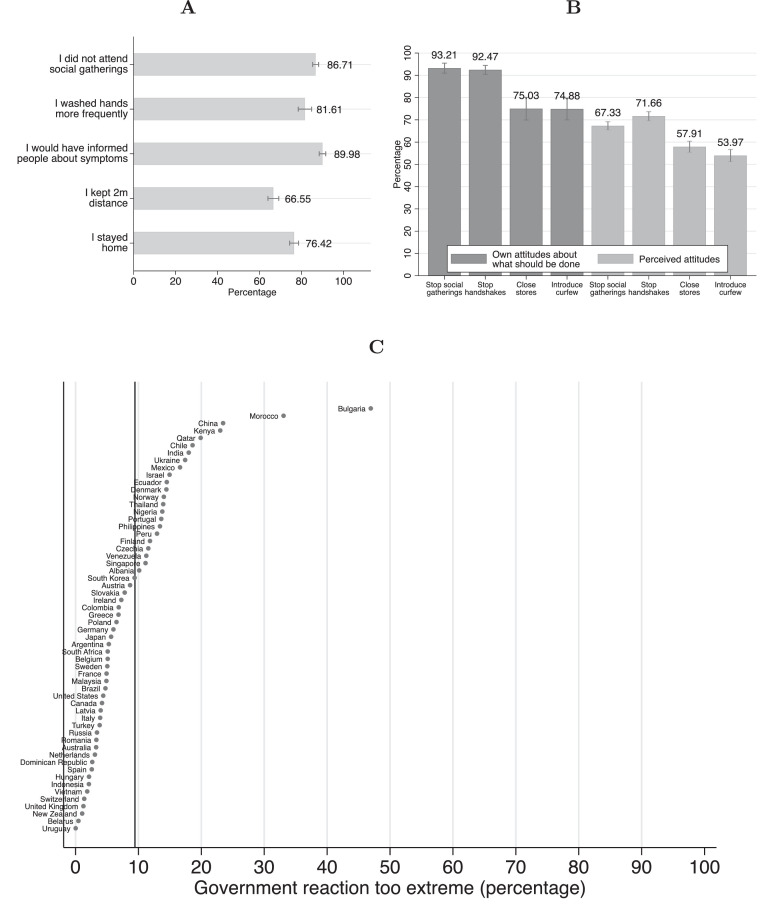
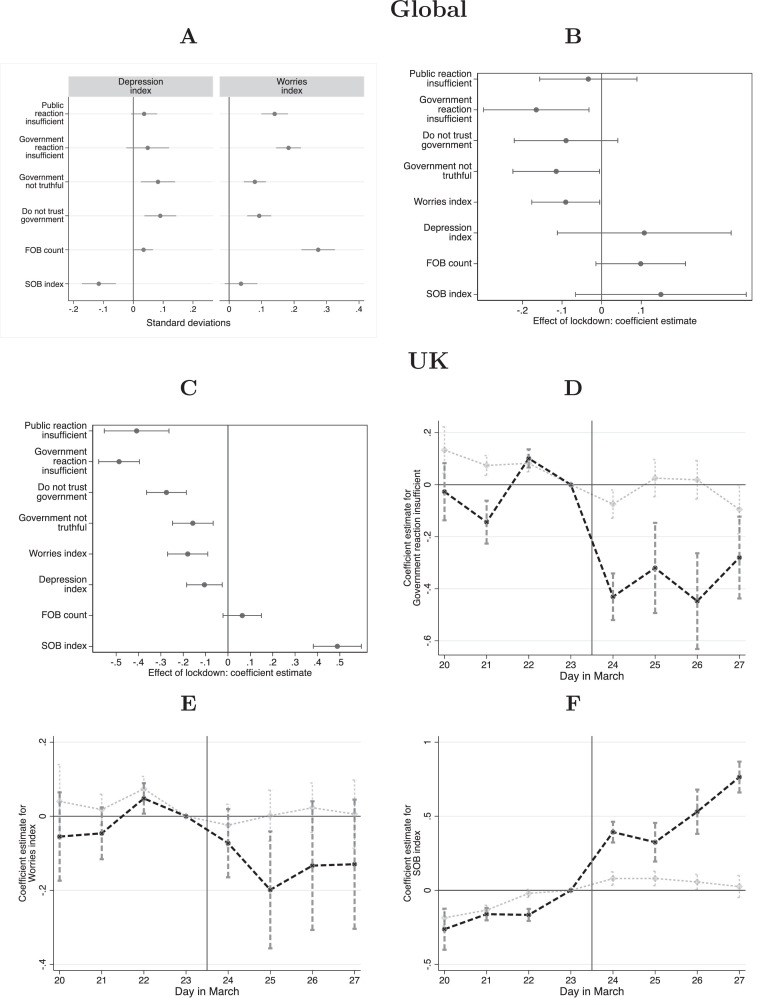
We conducted a large-scale survey covering 58 countries and over 100,000 respondents between late March and early April 2020 to study beliefs and attitudes towards citizens' and governments' responses at the onset of the COVID-19 pandemic. Most respondents reported holding normative beliefs in support of COVID-19 containment measures, as well as high rates of adherence to these measures. They also believed that their government and their country's citizens were not doing enough and underestimated the degree to which others in their country supported strong behavioral and policy responses to the pandemic. Normative beliefs were strongly associated with adherence, as well as beliefs about others' and the government's response. Lockdowns were associated with greater optimism about others' and the government's response, and improvements in measures of perceived mental well-being; these effects tended to be larger for those with stronger normative beliefs. Our findings highlight how social norms can arise quickly and effectively to support cooperation at a global scale.
2020年3月下旬至4月初,我们开展了一项大规模调查,覆盖58个国家,超过10万名受访者,以研究在新冠疫情初期人们对公民和政府应对措施的看法与态度。大多数受访者表示持有支持新冠疫情防控措施的规范性信念,并且对这些措施的遵守率很高。他们还认为自己的政府和本国公民做得不够,并低估了本国其他人支持对疫情采取强有力行为和政策应对措施的程度。规范性信念与遵守情况以及对他人和政府应对措施的看法密切相关。封锁措施与对他人和政府应对措施的更大乐观情绪以及感知心理健康指标的改善有关;对于规范性信念更强的人来说,这些影响往往更大。我们的研究结果凸显了社会规范如何能够迅速有效地形成,以支持全球范围内的合作。