Vellema Piet, Santman-Berends Inge, Dijkstra Frederika, van Engelen Erik, Aalberts Marian, Ter Bogt-Kappert Carlijn, van den Brom René
Department of Small Ruminant Health, Royal GD, P.O. Box 9, 7400 AA Deventer, The Netherlands.
Department of Research and Development, Royal GD, P.O. Box 9, 7400 AA Deventer, The Netherlands.
Pathogens. 2021 Dec 3;10(12):1579. doi: 10.3390/pathogens10121579.
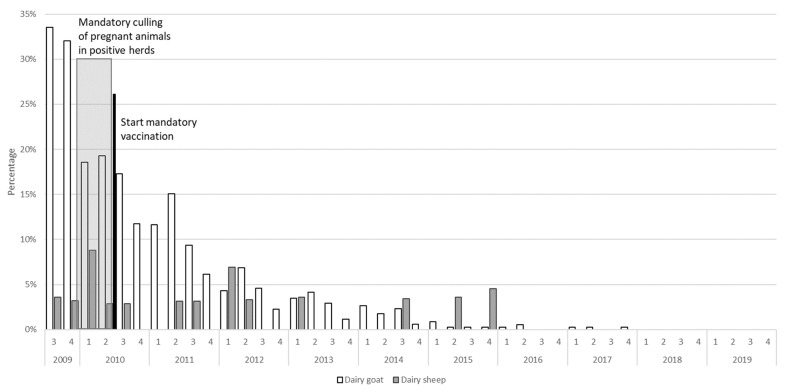
Q fever is an almost ubiquitous zoonosis caused by . This organism infects several animal species, as well as humans, and domestic ruminants like cattle, sheep and goats are an important animal reservoir of . In 2007, a sudden rise in notified human Q fever cases occurred in The Netherlands, and by the end of 2009, more than 3500 human Q fever patients had been notified. Dairy sheep and dairy goats were suspected to play a causal role in this human Q fever outbreak, and several measures were taken, aiming at a reduction of shedding by infected small ruminants, in order to reduce environmental contamination and thus human exposure. One of the first measures was compulsory notification of more than five percent abortion within thirty days for dairy sheep and dairy goat farms, starting 12 June 2008. After notification, an official farm inspection took place, and laboratory investigations were performed aiming at ruling out or demonstrating a causal role of . These measures were effective, and the number of human Q fever cases decreased; levels are currently the same as they were prior to 2007. The effect of these measures was monitored using a bulk tank milk (BTM) PCR and an antibody ELISA. The percentage PCR positive dairy herds and flocks decreased over time, and dairy sheep flocks tested PCR positive significantly less often and became PCR negative earlier compared to dairy goat herds. Although there was no difference in the percentage of dairy goat and dairy sheep farms with a abortion outbreak, the total number of shedding dairy sheep was much lower than the number of shedding dairy goats. Combined with the fact that Q fever patients lived mainly in the proximity of infected dairy goat farms and that no Q fever patients could be linked directly to dairy sheep farms, although this may have happened in individual cases, we conclude that dairy sheep did not play a major role in the Dutch Q fever outbreak. BTM monitoring using both a PCR and an ELISA is essential to determine a potential risk, not only for The Netherlands but for other countries with small ruminant dairy industries.
Q热是一种几乎无处不在的人畜共患病,由……引起。这种病原体感染多种动物物种以及人类,牛、羊和山羊等家养反刍动物是……的重要动物宿主。2007年,荷兰报告的人类Q热病例突然增加,到2009年底,已报告了3500多名人类Q热患者。奶羊和奶山羊被怀疑在这次人类Q热疫情中起了因果作用,因此采取了多项措施,旨在减少受感染小反刍动物的……排放,以减少环境污染,从而减少人类接触。首批措施之一是自2008年6月12日起,强制要求奶羊和奶山羊养殖场在30天内报告超过5%的流产情况。报告后,进行了官方农场检查,并开展了实验室调查,旨在排除或证明……的因果作用。这些措施是有效的,人类Q热病例数量减少;目前的水平与2007年之前相同。使用大容量罐奶(BTM)PCR和抗体ELISA对这些措施的效果进行了监测。随着时间的推移,PCR检测呈阳性的奶牛群和羊群百分比下降,与奶山羊群相比,奶羊群PCR检测呈阳性的频率显著更低,且更早转为PCR阴性。尽管发生流产疫情的奶山羊场和奶羊场的百分比没有差异,但排菌奶羊的总数远低于排菌奶山羊的数量。再加上Q热患者主要居住在受感染奶山羊场附近,而且虽然个别情况下可能有Q热患者与奶羊场有直接关联,但总体而言没有Q热患者能直接与奶羊场联系起来,我们得出结论,奶羊在荷兰Q热疫情中没有起主要作用。使用PCR和ELISA进行BTM监测对于确定潜在的……风险至关重要,不仅对荷兰如此,对其他有小反刍动物奶业的国家也是如此。