Latin American Brain Health Institute (BrainLat), Universidad Adolfo Ibáñez, Santiago de Chile, Chile.
Latin American Brain Health Institute (BrainLat), Universidad Adolfo Ibáñez, Santiago de Chile, Chile; Cognitive Neuroscience Center (CNC), Universidad de San Andrés, Buenos Aires, Argentina; National Scientific and Technical Research Council (CONICET), Buenos Aires, Argentina.
Int J Psychophysiol. 2022 Feb;172:24-38. doi: 10.1016/j.ijpsycho.2021.12.008. Epub 2021 Dec 27.
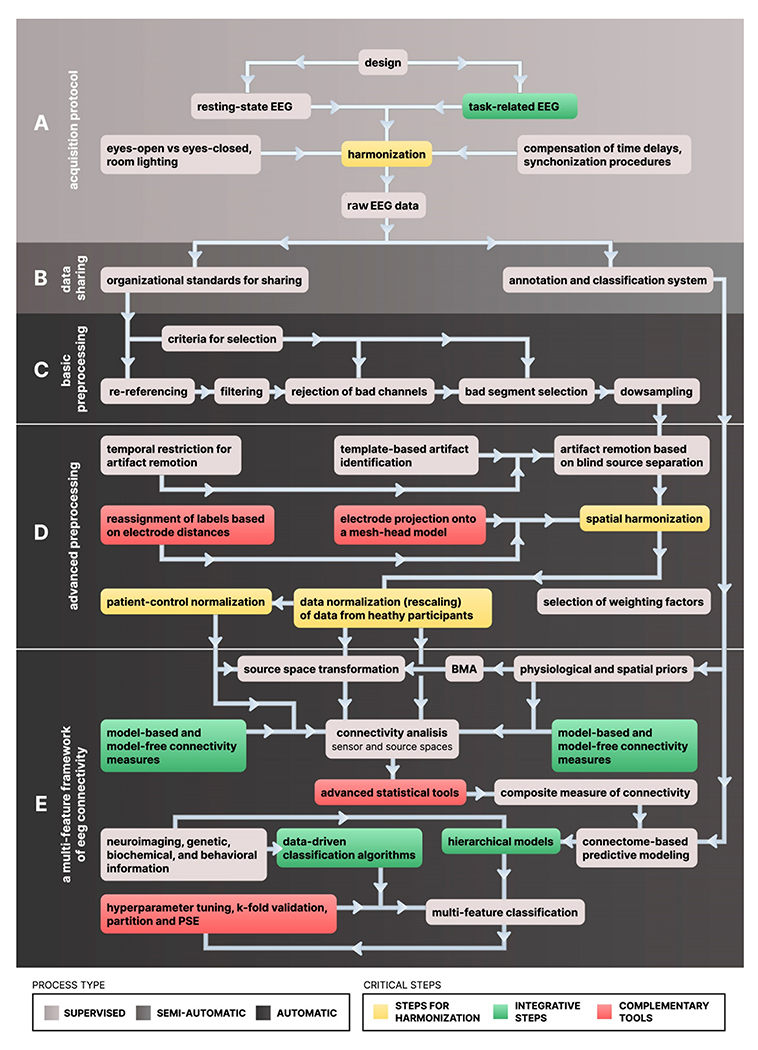
The proposal to use brain connectivity as a biomarker for dementia phenotyping can be potentiated by conducting large-scale multicentric studies using high-density electroencephalography (hd- EEG). Nevertheless, several barriers preclude the development of a systematic "ConnEEGtome" in dementia research. Here we review critical sources of variability in EEG connectivity studies, and provide general guidelines for multicentric protocol harmonization. We describe how results can be impacted by the choice for data acquisition, and signal processing workflows. The implementation of a particular processing pipeline is conditional upon assumptions made by researchers about the nature of EEG. Due to these assumptions, EEG connectivity metrics are typically applicable to restricted scenarios, e.g., to a particular neurocognitive disorder. "Ground truths" for the choice of processing workflow and connectivity analysis are impractical. Consequently, efforts should be directed to harmonizing experimental procedures, data acquisition, and the first steps of the preprocessing pipeline. Conducting multiple analyses of the same data and a proper integration of the results need to be considered in additional processing steps. Furthermore, instead of using a single connectivity measure, using a composite metric combining different connectivity measures brings a powerful strategy to scale up the replicability of multicentric EEG connectivity studies. These composite metrics can boost the predictive strength of diagnostic tools for dementia. Moreover, the implementation of multi-feature machine learning classification systems that include EEG-based connectivity analyses may help to exploit the potential of multicentric studies combining clinical-cognitive, molecular, genetics, and neuroimaging data towards a multi-dimensional characterization of the dementia.
使用大脑连接作为痴呆表型的生物标志物的建议可以通过使用高密度脑电图 (hd-EEG) 进行大规模多中心研究来增强。然而,有几个障碍阻止了在痴呆症研究中开发系统的“ConnEEGtome”。在这里,我们回顾了脑电图连接研究中变异性的关键来源,并为多中心协议协调提供了一般指南。我们描述了数据采集和信号处理工作流程的选择如何影响结果。特定处理管道的实施取决于研究人员对 EEG 性质的假设。由于这些假设,脑电图连接性指标通常适用于受限的情况,例如特定的神经认知障碍。处理工作流程和连接分析选择的“真实情况”是不切实际的。因此,应努力协调实验程序、数据采集以及预处理管道的第一步。在附加处理步骤中,需要考虑对同一数据进行多次分析以及正确整合结果。此外,使用单一连接性度量而不是使用组合不同连接性度量的组合度量是一种强大的策略,可以提高多中心脑电图连接性研究的可重复性。这些组合指标可以提高用于痴呆症诊断工具的预测强度。此外,实现包括脑电图连接性分析在内的多特征机器学习分类系统可能有助于利用多中心研究的潜力,将临床认知、分子、遗传学和神经影像学数据结合起来,对痴呆症进行多维特征描述。