Moros Maria, Fergola Eugenio, Marchesano Valentina, Mutarelli Margherita, Tommasini Giuseppina, Miedziak Beata, Palumbo Giuliana, Ambrosone Alfredo, Tino Angela, Tortiglione Claudia
Instituto de Nanociencia y Materiales de Aragón(INMA), CSIC-Universidad de Zaragoza, Zaragoza, Spain.
Istituto di Scienze Applicate e Sistemi Intelligenti "E. Caianiello", Consiglio Nazionale Delle Ricerche, Pozzuoli, Italy.
Front Cell Dev Biol. 2021 Dec 20;9:788117. doi: 10.3389/fcell.2021.788117. eCollection 2021.
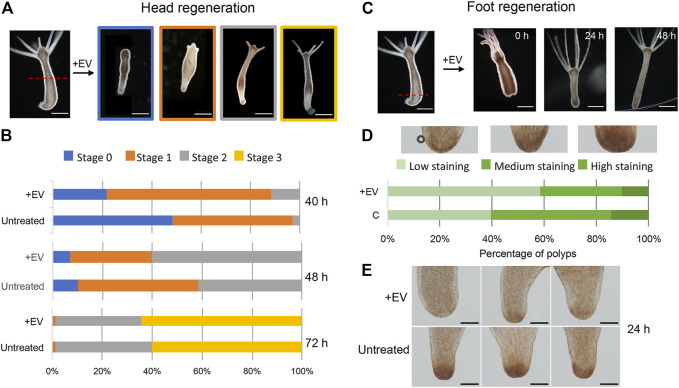
Recent body of evidence demonstrates that extracellular vesicles (EVs) represent the first language of cell-cell communication emerged during evolution. In aquatic environments, transferring signals between cells by EVs offers protection against degradation, allowing delivering of chemical information in high local concentrations to the target cells. The packaging of multiple signals, including those of hydrophobic nature, ensures target cells to receive the same EV-conveyed messages, and the coordination of a variety of physiological processes across cells of a single organisms, or at the population level, i.e., mediating the population's response to changing environmental conditions. Here, we purified EVs from the medium of the freshwater invertebrate , and the molecular profiling by proteomic and transcriptomic analyses revealed multiple markers of the exosome EV subtype, from structural proteins to stress induced messages promoting cell survival. Moreover, positive and negative regulators of the Wnt/β-catenin signaling pathway, the major developmental pathway acting in body axial patterning, were identified. Functional analysis on amputated polyps revealed EV ability to modulate both head and foot regeneration, suggesting bioactivity of the EV cargo and opening new perspectives on the mechanisms of developmental signalling. Our results open the path to unravel EV biogenesis and function in all cnidarian species, tracing back the origin of the cell-cell, cross-species or cross-kingdom communication in aquatic ecosystems.
最近的证据表明,细胞外囊泡(EVs)代表了进化过程中出现的细胞间通讯的第一种语言。在水生环境中,通过EVs在细胞间传递信号可防止信号降解,使化学信息能够以高局部浓度传递给靶细胞。多种信号(包括疏水性信号)的包装确保靶细胞接收相同的EV传递信息,并协调单个生物体细胞间或群体水平上的各种生理过程,即介导群体对不断变化的环境条件的反应。在这里,我们从淡水无脊椎动物的培养基中纯化了EVs,蛋白质组学和转录组学分析的分子谱分析揭示了外泌体EV亚型的多个标志物,从结构蛋白到促进细胞存活的应激诱导信息。此外,还鉴定了Wnt/β-连环蛋白信号通路(在身体轴向模式形成中起主要作用的主要发育通路)的正负调节因子。对截肢息肉的功能分析表明,EVs能够调节头部和足部再生,这表明EVs货物具有生物活性,并为发育信号传导机制开辟了新的视角。我们的结果为揭示所有刺胞动物物种中EVs的生物发生和功能开辟了道路,追溯了水生生态系统中细胞间、跨物种或跨界通讯的起源。