Guo Xiaoyu, Gao Jian, Meng Xing, Wang Jiemei, Zhang Ziwei, Song Qingrao, Hu Ke, Sun Changhao, Li Ying
National Key Discipline, Department of Nutrition and Food Hygiene, School of Public Health, Harbin Medical University, Harbin, China.
Front Nutr. 2021 Dec 24;8:683918. doi: 10.3389/fnut.2021.683918. eCollection 2021.
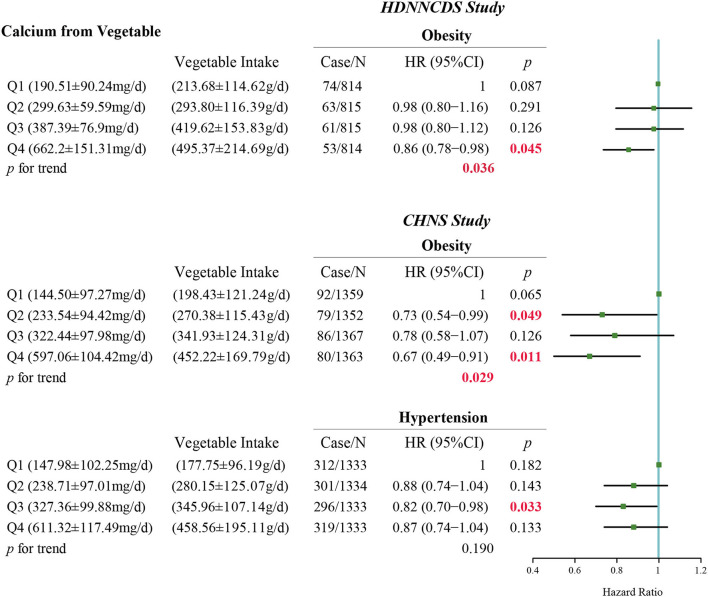
Calcium is an essential element in our diet and the most abundant mineral in the body. A high proportion of Chinese residents are not meeting dietary calcium recommendations. The purpose of this study was to investigate the relationship between calcium intake and the health of residents in two longitudinal studies of Chinese residents. This study used nationally representative data from the Harbin Cohort Study on Diet, Nutrition, and Chronic Non-communicable Disease Study (HDNNCDS) and China Health Nutrition Survey (CHNS), including 6,499 and 8,140 Chinese adults, respectively, who were free of chronic diseases at recruitment, with mean values of 4.2- and 5.3-year follow-up. Cox's proportional-hazards regression was conducted to explore the relationship between dietary calcium intake and the incidence of obesity, type 2 diabetes, hypertension, and cardiovascular disease (CVD) with adjustment for covariates. Calcium intakes were 451.35 ± 203.56 and 484.32 ± 198.61 (mean ± SD) mg/day in HDNNCDS and CHNS. After adjusting the covariates, the relationship between dietary calcium intake and bone mineral density (BMD) was not statistically significant ( = 0.110). In the multivariate-adjusted Cox's proportional-hazards regression model, dietary calcium intakes were inversely associated with obesity incidence in both cohorts (HR [95% CI]: 0.61 [0.48-0.77] and trend < 0.001 in fixed-effects model); nevertheless, there was no correlation between dietary calcium intake and the risk of type 2 diabetes ( trend = 0.442 and 0.759) and CVD ( trend = 0.826 and 0.072). The relationship between dietary calcium intake and the risk of hypertension in the two cohorts was inconsistent ( trend = 0.012 and 0.559). Additionally, after further adjusting the vegetable intake in the original multivariate model, both cohorts found no association between dietary calcium intake and the risk of developing obesity ( trend = 0.084 and 0.444). Our data suggest that the current calcium intake of Chinese residents was inversely associated with obesity, which may be related to consumption of vegetables. Meanwhile, the current calcium intake does not increase the risk of type 2 diabetes, CVD, and bone health burden. This research suggested that the Chinese current calcium intake level may have met the needs of the body.
钙是我们饮食中的必需元素,也是人体中含量最丰富的矿物质。很大一部分中国居民未达到膳食钙推荐摄入量。本研究旨在通过两项中国居民纵向研究,探讨钙摄入量与居民健康之间的关系。本研究使用了哈尔滨饮食、营养与慢性非传染性疾病队列研究(HDNNCDS)和中国健康与营养调查(CHNS)的全国代表性数据,分别包括6499名和8140名中国成年人,这些人在招募时无慢性病,平均随访时间分别为4.2年和5.3年。采用Cox比例风险回归分析,在调整协变量的情况下,探讨膳食钙摄入量与肥胖、2型糖尿病、高血压和心血管疾病(CVD)发病率之间的关系。HDNNCDS和CHNS中的钙摄入量分别为451.35±203.56和484.32±198.61(均值±标准差)mg/天。调整协变量后,膳食钙摄入量与骨密度(BMD)之间的关系无统计学意义(P = 0.110)。在多变量调整的Cox比例风险回归模型中,两个队列中膳食钙摄入量均与肥胖发病率呈负相关(HR [95%CI]:0.61 [0.48 - 0.77],固定效应模型中P趋势<0.001);然而,膳食钙摄入量与2型糖尿病风险(P趋势 = 0.442和0.759)以及CVD风险(P趋势 = 0.826和0.072)之间无相关性。两个队列中膳食钙摄入量与高血压风险之间的关系不一致(P趋势 = 0.012和0.559)。此外,在原多变量模型中进一步调整蔬菜摄入量后,两个队列均发现膳食钙摄入量与肥胖发生风险之间无关联(P趋势 = 0.084和0.444)。我们的数据表明,中国居民目前的钙摄入量与肥胖呈负相关,这可能与蔬菜摄入量有关。同时,目前的钙摄入量不会增加2型糖尿病、CVD和骨骼健康负担的风险。本研究表明,中国目前的钙摄入量水平可能已满足身体需求。