RAND Corporation, 1776 Main St., Santa Monica, CA, 90401, USA.
Argonne National Laboratory, Building 221, 9700 South Cass Avenue, Argonne, IL, 60439, USA.
BMC Med Inform Decis Mak. 2022 Jan 12;22(1):12. doi: 10.1186/s12911-021-01726-0.
Microsimulation models are mathematical models that simulate event histories for individual members of a population. They are useful for policy decisions because they simulate a large number of individuals from an idealized population, with features that change over time, and the resulting event histories can be summarized to describe key population-level outcomes. Model calibration is the process of incorporating evidence into the model. Calibrated models can be used to make predictions about population trends in disease outcomes and effectiveness of interventions, but calibration can be challenging and computationally expensive.
This paper develops a technique for sequentially updating models to take full advantage of earlier calibration results, to ultimately speed up the calibration process. A Bayesian approach to calibration is used because it combines different sources of evidence and enables uncertainty quantification which is appealing for decision-making. We develop this method in order to re-calibrate a microsimulation model for the natural history of colorectal cancer to include new targets that better inform the time from initiation of preclinical cancer to presentation with clinical cancer (sojourn time), because model exploration and validation revealed that more information was needed on sojourn time, and that the predicted percentage of patients with cancers detected via colonoscopy screening was too low.
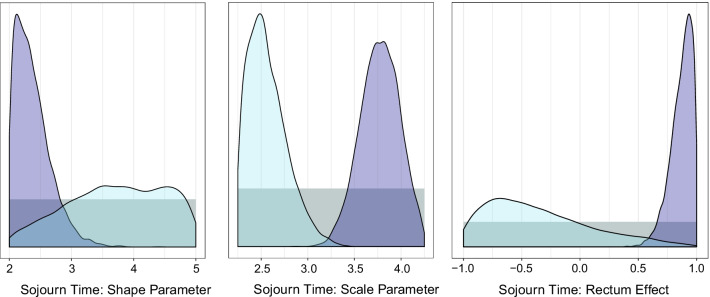
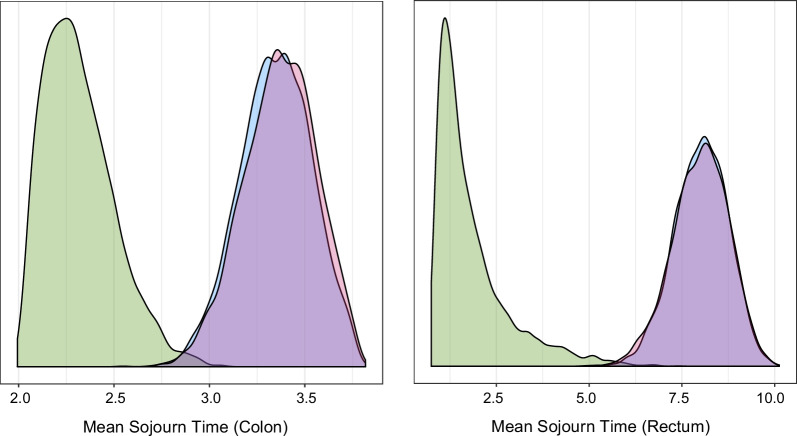
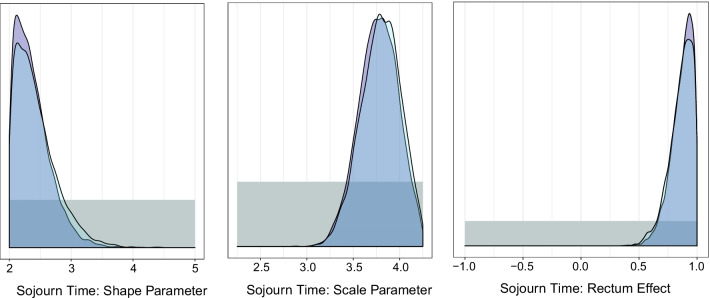
The sequential approach to calibration was more efficient than recalibrating the model from scratch. Incorporating new information on the percentage of patients with cancers detected upon screening changed the estimated sojourn time parameters significantly, increasing the estimated mean sojourn time for cancers in the colon and rectum, providing results with more validity.
A sequential approach to recalibration can be used to efficiently recalibrate a microsimulation model when new information becomes available that requires the original targets to be supplemented with additional targets.
微模拟模型是一种对人群中个体的事件历史进行模拟的数学模型。它们对于政策决策很有用,因为它们可以从理想化的人群中模拟大量个体,这些个体具有随时间变化的特征,并且可以总结得到的事件历史来描述关键的人群水平结果。模型校准是将证据纳入模型的过程。校准后的模型可用于对疾病结果和干预措施效果的人群趋势进行预测,但校准可能具有挑战性且计算成本高。
本文开发了一种技术,用于顺序更新模型,以充分利用早期的校准结果,最终加快校准过程。使用贝叶斯校准方法,因为它结合了不同的证据来源,并能够进行不确定性量化,这对于决策制定很有吸引力。我们开发这种方法是为了重新校准用于结直肠癌自然史的微模拟模型,以纳入更好地告知从临床前癌症开始到出现临床癌症(停留时间)的新目标,因为模型探索和验证表明需要更多关于停留时间的信息,并且预测通过结肠镜筛查检测到的癌症患者的百分比太低。
校准的顺序方法比从头开始重新校准模型更有效。纳入有关通过筛查检测到的癌症患者百分比的新信息显著改变了估计的停留时间参数,增加了结肠和直肠癌症的估计平均停留时间,提供了更有效的结果。
当有新信息需要用其他目标补充原始目标时,可以使用顺序重新校准方法来有效地重新校准微模拟模型。