Tsai Jeng-Yuan, Pan Jinbo, Lin Hsin, Bansil Arun, Yan Qimin
Department of Physics, Temple University, Philadelphia, PA, 19122, USA.
Institute of Physics, Academia Sinica, Taipei, Taiwan.
Nat Commun. 2022 Jan 25;13(1):492. doi: 10.1038/s41467-022-28133-x.
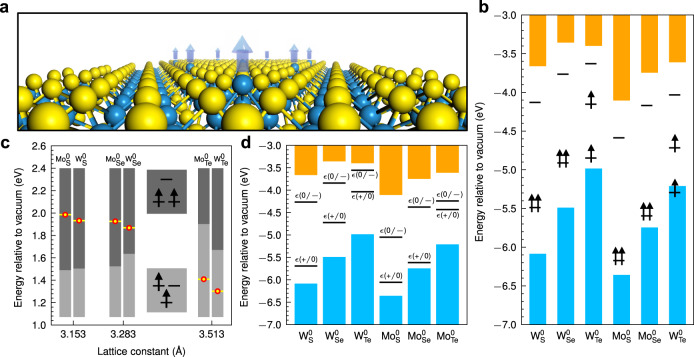
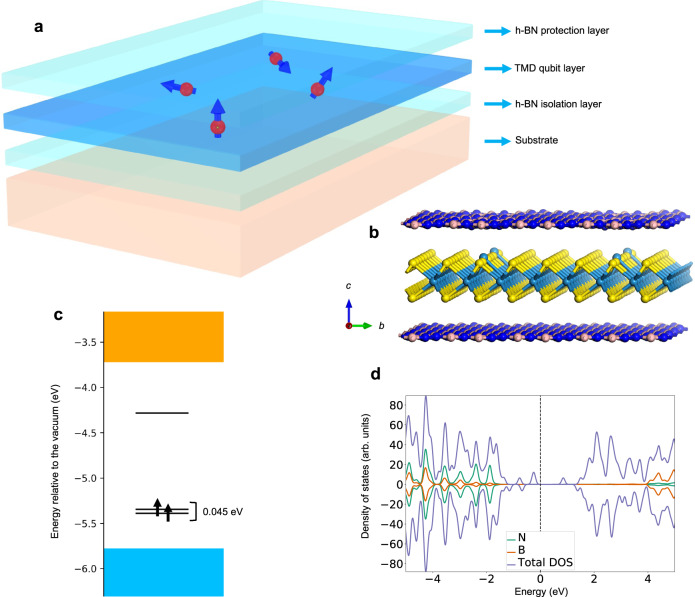
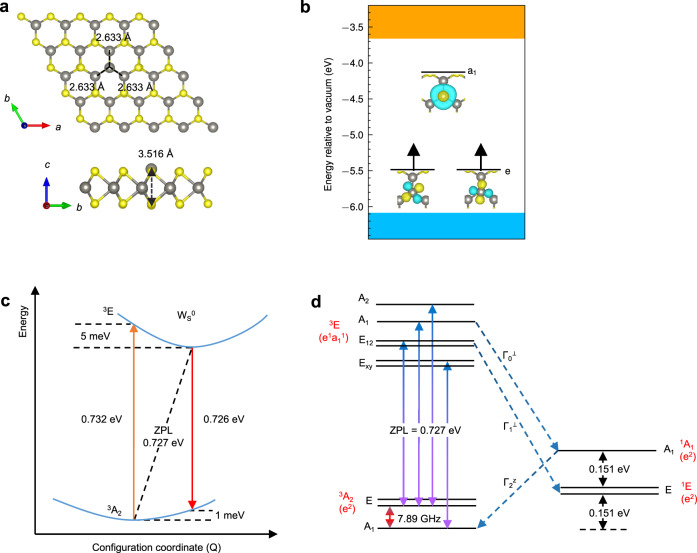
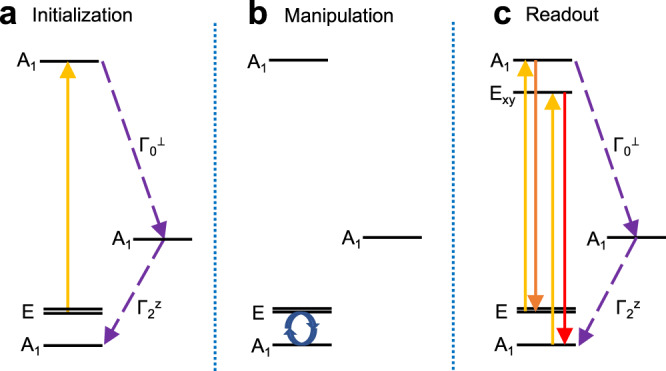
Being atomically thin and amenable to external controls, two-dimensional (2D) materials offer a new paradigm for the realization of patterned qubit fabrication and operation at room temperature for quantum information sciences applications. Here we show that the antisite defect in 2D transition metal dichalcogenides (TMDs) can provide a controllable solid-state spin qubit system. Using high-throughput atomistic simulations, we identify several neutral antisite defects in TMDs that lie deep in the bulk band gap and host a paramagnetic triplet ground state. Our in-depth analysis reveals the presence of optical transitions and triplet-singlet intersystem crossing processes for fingerprinting these defect qubits. As an illustrative example, we discuss the initialization and readout principles of an antisite qubit in WS, which is expected to be stable against interlayer interactions in a multilayer structure for qubit isolation and protection in future qubit-based devices. Our study opens a new pathway for creating scalable, room-temperature spin qubits in 2D TMDs.
二维(2D)材料由于具有原子级的薄度且易于外部控制,为量子信息科学应用中实现室温下的图案化量子比特制造和操作提供了一种新的范例。在此,我们展示了二维过渡金属二硫属化物(TMD)中的反位缺陷能够提供一个可控的固态自旋量子比特系统。通过高通量原子模拟,我们在TMD中识别出了几个位于体能带隙深处且具有顺磁三重态基态的中性反位缺陷。我们的深入分析揭示了用于指纹识别这些缺陷量子比特的光学跃迁和三重态 - 单重态系间窜越过程的存在。作为一个示例,我们讨论了WS₂中反位量子比特的初始化和读出原理,预计该量子比特在多层结构中对于层间相互作用具有稳定性,可用于未来基于量子比特的器件中的量子比特隔离和保护。我们的研究为在二维TMD中创建可扩展的室温自旋量子比特开辟了一条新途径。