Kim Sang Hoon, Kearns Fiona L, Rosenfeld Mia A, Casalino Lorenzo, Papanikolas Micah J, Simmerling Carlos, Amaro Rommie E, Freeman Ronit
University of North Carolina-Chapel Hill, Department of Applied Physical Sciences, 1112 Murray Hall, CB#3050, Chapel Hill, North Carolina 27599-2100, United States.
University of California-San Diego, Department of Chemistry and Biochemistry, 3234 Urey Hall, MC-0340, La Jolla, California 92093-0340, United States.
ACS Cent Sci. 2022 Jan 26;8(1):22-42. doi: 10.1021/acscentsci.1c01080. Epub 2021 Dec 15.
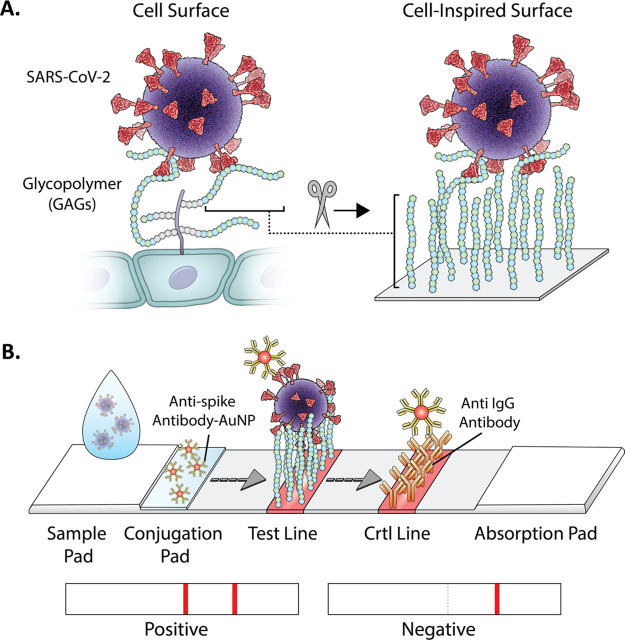
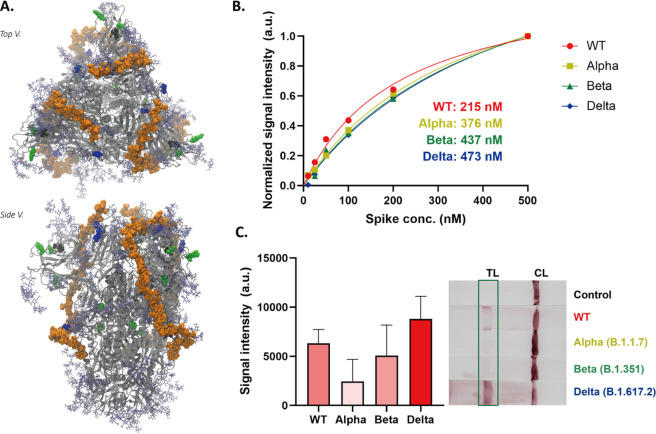
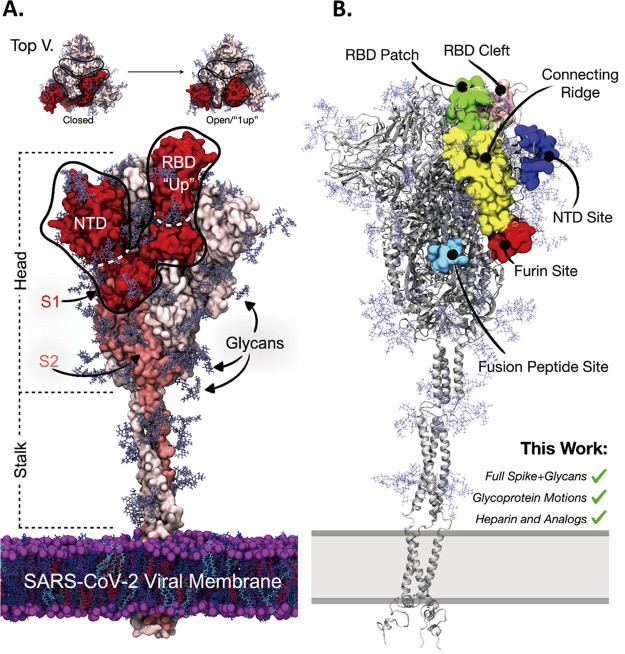
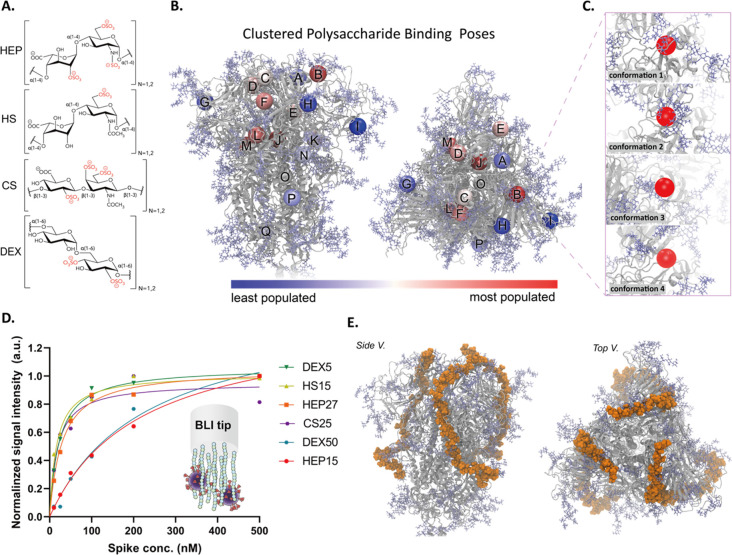
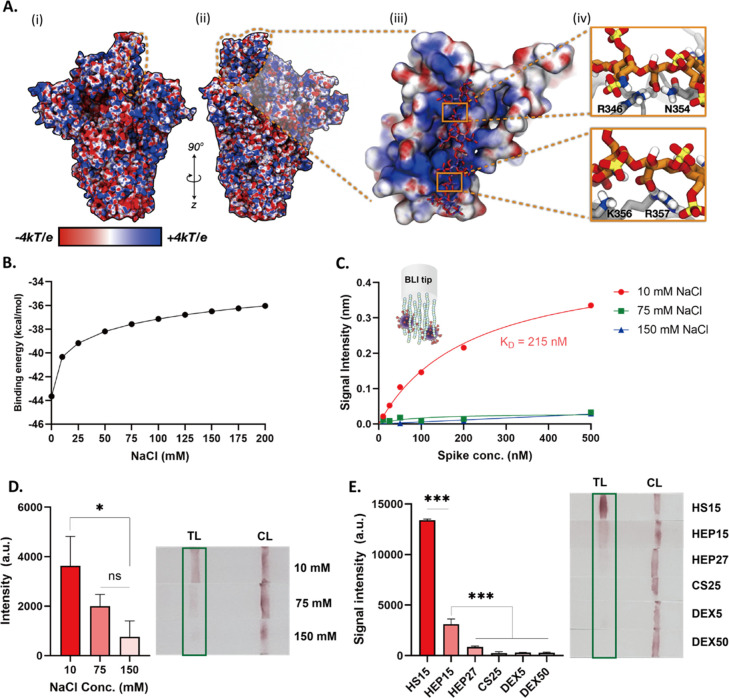
Inspired by the role of cell-surface glycoproteins as coreceptors for pathogens, we report the development of : a glycopolymer-based lateral flow assay for detecting SARS-CoV-2 and its variants. utilizes glycopolymers for primary capture and antispike antibodies labeled with gold nanoparticles for signal-generating detection. A lock-step integration between experiment and computation has enabled efficient optimization of test strips which can selectively, sensitively, and rapidly detect SARS-CoV-2 and its variants in biofluids. Employing the power of the glycocalyx in a diagnostic assay has distinct advantages over conventional immunoassays as glycopolymers can bind to antigens in a multivalent capacity and are highly adaptable for mutated strains. As new variants of SARS-CoV-2 are identified, will serve as a highly reconfigurable biosensor for their detection. Additionally, via extensive ensemble-based docking simulations which incorporate protein and glycan motion, we have elucidated important clues as to how heparan sulfate and other glycocalyx components may bind the spike glycoprotein during SARS-CoV-2 host-cell infection. is a promising and generalizable alternative to costly, labor-intensive RT-PCR, and we envision it will be broadly useful, including for rural or low-income populations that are historically undertested and under-reported in infection statistics.
受细胞表面糖蛋白作为病原体共受体作用的启发,我们报告了一种基于糖聚合物的侧向流动分析法的开发,用于检测严重急性呼吸综合征冠状病毒2(SARS-CoV-2)及其变体。该方法利用糖聚合物进行初次捕获,并使用金纳米颗粒标记的抗刺突抗体进行信号生成检测。实验与计算之间的同步整合实现了对测试条的高效优化,该测试条能够选择性、灵敏且快速地检测生物流体中的SARS-CoV-2及其变体。在诊断分析中利用糖萼的作用相较于传统免疫分析具有明显优势,因为糖聚合物能够以多价能力结合抗原,并且对突变株具有高度适应性。随着SARS-CoV-2新变体的出现,该方法将作为一种高度可重构的生物传感器用于其检测。此外,通过结合蛋白质和聚糖运动的广泛的基于系综的对接模拟,我们阐明了硫酸乙酰肝素和其他糖萼成分在SARS-CoV-2宿主细胞感染过程中可能如何结合刺突糖蛋白的重要线索。该方法是昂贵且劳动密集型的逆转录聚合酶链反应(RT-PCR)的一种有前景且可推广的替代方法,我们预计它将具有广泛用途,包括对感染统计中历来检测不足和报告不足的农村或低收入人群。