Pfizer, Pearl River, New York, USA.
Icahn School of Medicine at Mount Sinai, New York, New York, USA.
Toxicol Pathol. 2022 Apr;50(3):280-293. doi: 10.1177/01926233211072767. Epub 2022 Feb 5.
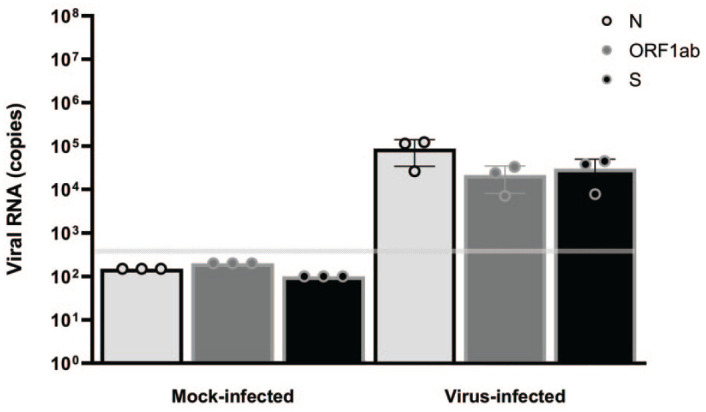
Coronavirus disease 2019 (COVID-19) in humans has a wide range of presentations, ranging from asymptomatic or mild symptoms to severe illness. Suitable animal models mimicking varying degrees of clinical disease manifestations could expedite development of therapeutics and vaccines for COVID-19. Here we demonstrate that severe acute respiratory syndrome coronavirus 2 (SARS-CoV-2) infection resulted in subclinical disease in rhesus macaques with mild pneumonia and clinical disease in Syrian hamsters with severe pneumonia. SARS-CoV-2 infection was confirmed by formalin-fixed, paraffin-embedded (FFPE) polymerase chain reaction (PCR), immunohistochemistry, or in situ hybridization. Replicating virus in the lungs was identified using in situ hybridization or virus plaque forming assays. Viral encephalitis, reported in some COVID-19 patients, was identified in one macaque and was confirmed with immunohistochemistry. There was no evidence of encephalitis in hamsters. Severity and distribution of lung inflammation were substantially more in hamsters compared with macaques and exhibited vascular changes and virus-induced cytopathic changes as seen in COVID-19 patients. Neither the hamster nor macaque models demonstrated evidence for multisystemic inflammatory syndrome (MIS). Data presented here demonstrate that macaques may be appropriate for mechanistic studies of mild asymptomatic COVID-19 pneumonia and COVID-19-associated encephalitis, whereas Syrian hamsters may be more suited to study severe COVID-19 pneumonia.
人类 2019 年冠状病毒病(COVID-19)的表现范围广泛,从无症状或轻度症状到重病不等。适合的动物模型可以模拟不同程度的临床疾病表现,从而加速 COVID-19 治疗方法和疫苗的开发。在这里,我们证明了严重急性呼吸综合征冠状病毒 2(SARS-CoV-2)感染导致恒河猴出现亚临床疾病,表现为轻度肺炎,而叙利亚仓鼠出现临床疾病,表现为严重肺炎。通过福尔马林固定、石蜡包埋(FFPE)聚合酶链反应(PCR)、免疫组织化学或原位杂交证实了 SARS-CoV-2 感染。通过原位杂交或病毒噬斑形成测定鉴定了肺部复制的病毒。据报道,一些 COVID-19 患者存在病毒性脑炎,在一只猕猴中发现了这种情况,并通过免疫组织化学证实了这一点。在仓鼠中没有发现脑炎的证据。与恒河猴相比,仓鼠肺部炎症的严重程度和分布明显更高,表现出血管变化和 COVID-19 患者中所见的病毒诱导的细胞病变。仓鼠和猕猴模型均未显示出多系统炎症综合征(MIS)的证据。这里呈现的数据表明,猕猴可能适合研究轻度无症状 COVID-19 肺炎和 COVID-19 相关脑炎的机制,而叙利亚仓鼠可能更适合研究严重的 COVID-19 肺炎。