Antimicrobial Resistance Action Center, Bangladesh Livestock Research Institute, Savar, Dhaka, Bangladesh.
Department of Microbiology and Hygiene, Bangladesh Agricultural University, Mymensingh, Bangladesh.
PLoS One. 2022 Feb 7;17(2):e0254465. doi: 10.1371/journal.pone.0254465. eCollection 2022.
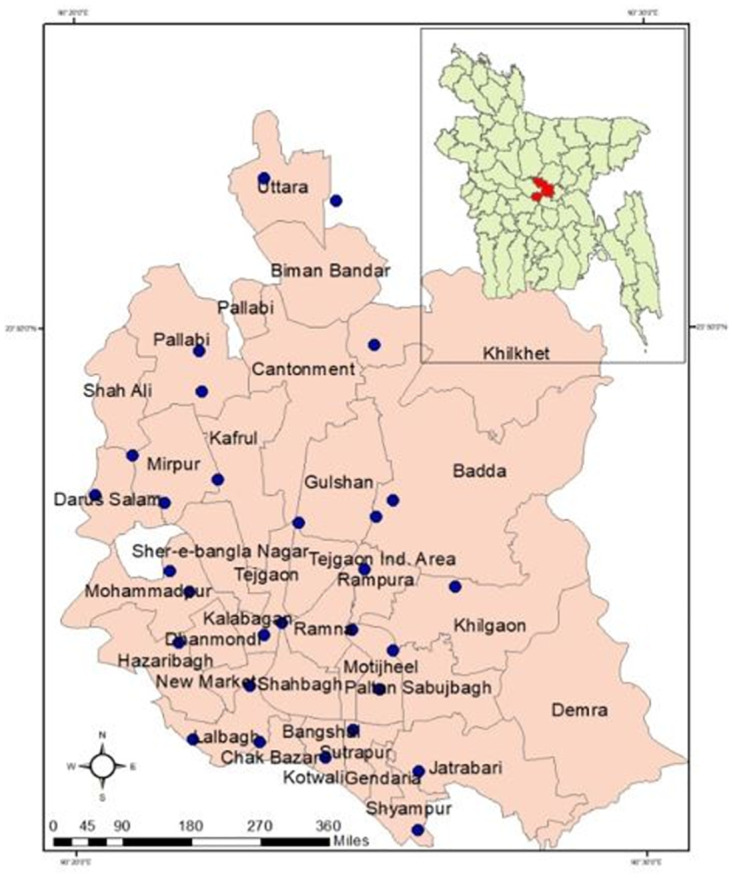
The rapid emergence of virulent and multidrug-resistant (MDR) non-typhoidal Salmonella (NTS) enterica serovars is a growing public health concern globally. The present study focused on the assessment of the pathogenicity and antimicrobial resistance (AMR) profiling of NTS enterica serovars isolated from the chicken processing environments at wet markets in Dhaka, Bangladesh. A total of 870 samples consisting of carcass dressing water (CDW), chopping board swabs (CBS), and knife swabs (KS) were collected from 29 wet markets. The prevalence of Salmonella was found to be 20% in CDW, 19.31% in CBS, and 17.58% in KS, respectively. Meanwhile, the MDR Salmonella was found to be 72.41%, 73.21%, and 68.62% in CDW, CBS, and KS, respectively. All isolates were screened by polymerase chain reaction (PCR) for eight virulence genes, namely invA, agfA, IpfA, hilA, sivH, sefA, sopE, and spvC. The S. Enteritidis and untyped Salmonella isolates harbored all virulence genes while S. Typhimurium isolates carried six virulence genes, except sefA and spvC. Phenotypic resistance revealed decreased susceptibility to ciprofloxacin, streptomycin, ampicillin, tetracycline, gentamicin, sulfamethoxazole-trimethoprim, amoxicillin-clavulanic acid, and azithromycin. Genotypic resistance showed a higher prevalence of plasmid-mediated blaTEM followed by tetA, sul1, sul2, sul3, and strA/B genes. The phenotypic and genotypic resistance profiles of the isolates showed a harmonic and symmetrical trend. According to the findings, MDR and virulent NTS enterica serovars predominate in wet market conditions and can easily enter the human food chain. The chi-square analysis showed significantly higher associations among the phenotypic resistance, genotypic resistance and virulence genes in CDW, CBS, and KS respectively (p < 0.05).
毒力和多药耐药(MDR)非伤寒沙门氏菌(NTS)肠杆菌血清型的迅速出现是一个日益严重的全球公共卫生问题。本研究重点评估了从孟加拉国达卡湿市场鸡肉加工环境中分离的 NTS 肠杆菌血清型的致病性和抗菌药物耐药性(AMR)特征。从 29 个湿市场共采集了 870 份样本,包括胴体清洗水(CDW)、砧板拭子(CBS)和刀拭子(KS)。CDW、CBS 和 KS 中沙门氏菌的检出率分别为 20%、19.31%和 17.58%。同时,CDW、CBS 和 KS 中的 MDR 沙门氏菌检出率分别为 72.41%、73.21%和 68.62%。所有分离株均通过聚合酶链反应(PCR)对 8 个毒力基因,即 invA、agfA、IpfA、hilA、sivH、sefA、sopE 和 spvC 进行了筛查。肠型沙门氏菌和未分型沙门氏菌分离株携带所有毒力基因,而鼠伤寒沙门氏菌分离株携带 6 个毒力基因,除 sefA 和 spvC 外。表型耐药性显示对环丙沙星、链霉素、氨苄西林、四环素、庆大霉素、磺胺甲噁唑-甲氧苄啶、阿莫西林-克拉维酸和阿奇霉素的敏感性降低。基因型耐药性显示出更高的质粒介导 blaTEM 基因的流行率,其次是 tetA、sul1、sul2、sul3 和 strA/B 基因。分离株的表型和基因型耐药谱显示出和谐对称的趋势。根据研究结果,多药耐药和毒力 NTS 肠杆菌血清型在湿市场条件下占主导地位,很容易进入人类食物链。卡方分析显示,CDW、CBS 和 KS 中的表型耐药性、基因型耐药性和毒力基因之间存在显著的相关性(p<0.05)。