Coleman Paul C, Hanson Petra, van Rens Thijs, Oyebode Oyinlola
Warwick Medical School, University of Warwick, Gibbet Hill Campus, Coventry CV4 7AL, United Kingdom.
University Hospital Coventry and Warwickshire NHS Trust, Clifford Bridge Rd, Coventry CV2 2DX, United Kingdom.
Prev Med Rep. 2022 Jan 28;26:101717. doi: 10.1016/j.pmedr.2022.101717. eCollection 2022 Apr.
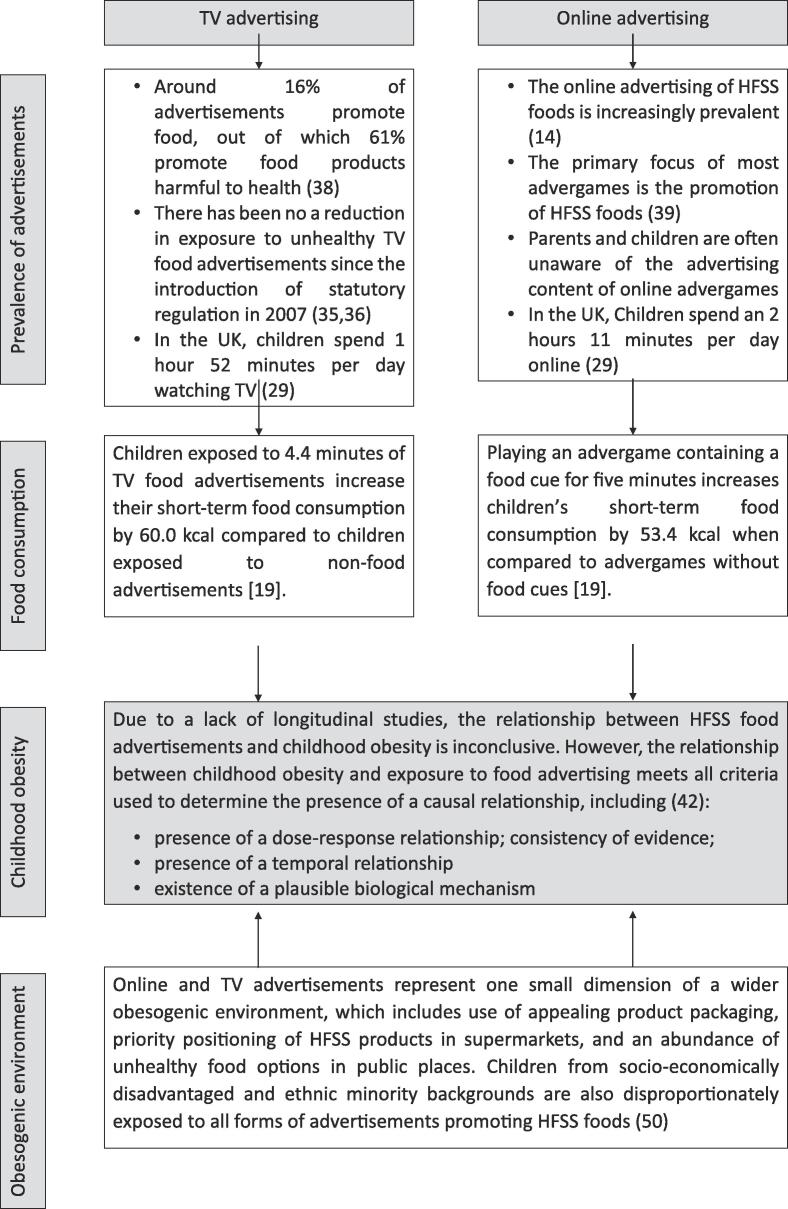
The World Health Organisation has urged all governments to address rising rates of obesity by implementing population-based interventions, such as restrictions on the marketing to children of unhealthy food and beverage items. However, the relationship between unhealthy food advertisements and childhood obesity is disputed by industry-sponsored reports, which recommend promoting physical activity and weight loss campaigns rather than policies to limit exposure to advertisements. We aimed to elucidate this debate by providing a narrative review of the evidence on the relationship between unhealthy TV and online food advertisements, short-term food consumption and childhood obesity. We also examined the impact of unhealthy food advertisements on vulnerable groups and identified which policy interventions are supported by current evidence. We conducted a rapid overview of reviews published since 2006. From a synthesis of 18 reviews meeting the inclusion criteria, we conclude that exposure to unhealthy TV and online food advertising is a contributing factor to childhood obesity. Evidence of a relationship between exposure to unhealthy food advertisements and childhood obesity was evident at all stages of the causal pathway, including a clear dose-response relationship. The evidence base was particularly strong for children aged 3-12 years of age and for children from socio-economically disadvantaged and minority ethnic backgrounds. The introduction of statutory regulation is a potentially cost-effective policy option, in terms of healthcare savings outweighing the costs of implementing the policy, although voluntary codes were shown to be ineffective, with exposure to unhealthy food advertisements similar in countries before and after their introduction. Food advertising, however, is just one factor in the wider obesogenic environment and further advertising restrictions must be implemented alongside population-based interventions that aim to address systemic causes of poor diet.
世界卫生组织敦促各国政府通过实施基于人群的干预措施来应对不断上升的肥胖率,比如限制向儿童推销不健康食品和饮料。然而,行业赞助的报告对不健康食品广告与儿童肥胖之间的关系提出了质疑,这些报告建议推广体育活动和减肥运动,而非限制接触广告的政策。我们旨在通过对关于不健康电视和网络食品广告、短期食品消费与儿童肥胖之间关系的证据进行叙述性综述,来阐明这场争论。我们还研究了不健康食品广告对弱势群体的影响,并确定了当前证据支持哪些政策干预措施。我们对2006年以来发表的综述进行了快速概述。通过对符合纳入标准的18篇综述进行综合分析,我们得出结论,接触不健康电视和网络食品广告是导致儿童肥胖的一个因素。在因果关系的各个阶段,都有证据表明接触不健康食品广告与儿童肥胖之间存在关联,包括明确的剂量反应关系。对于3至12岁的儿童以及社会经济弱势和少数族裔背景的儿童,证据尤为充分。就医疗保健节省的费用超过实施该政策的成本而言,引入法定监管是一种潜在的具有成本效益的政策选择,不过事实证明自愿性守则无效,在引入前后,各国接触不健康食品广告的情况并无差异。然而,食品广告只是更广泛的致胖环境中的一个因素,必须在旨在解决不良饮食的系统性原因的基于人群的干预措施之外,进一步实施广告限制措施。