Moosburger Ramona, Barbosa Clarissa Lage, Haftenberger Marjolein, Brettschneider Anna-Kristin, Lehmann Franziska, Kroke Anja, Mensink Gert B M
Robert Koch Institute, Berlin Department of Epidemiology and Health Monitoring.
Formerly Robert Koch Institute, Berlin Department of Epidemiology and Health Monitoring.
J Health Monit. 2020 Mar 4;5(1):3-18. doi: 10.25646/6398. eCollection 2020 Mar.
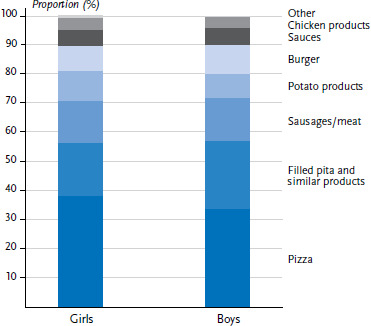
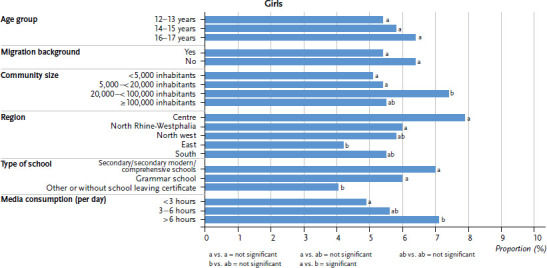
Consuming high amounts of fast food can lead to an excessive intake of energy and subsequently promote obesity. Obesity increases a person's risk for diabetes and cardiovascular diseases. The second wave of the German Health Interview and Examination Survey for Children and Adolescents (KiGGS Wave 2, 2014-2017) included the Eating study as a KiGGS Module (EsKiMo II, 2015-2017) which assessed the self-reported dietary habits of children and adolescents in Germany. The analysis of the data permits an overview of the fast food consumption of 12- to 17-year-olds (n=1,353). Girls consume 57.5 grams and boys 86.3 grams of fast food per day on average (around 400 grams and 600 grams per week, respectively). Pizza is the most consumed fast food product, followed by filled pita and sausage/meat products such as curry sausage. Adolescent girls on average get 6.5% and boys 7.8% of total daily energy intake from fast food. 23% of 12- to 17-year-olds get at least 10% of their daily energy intake from fast food (high consumers). Significant differences between the proportion of high consumers exist regarding sex, age, socioeconomic status, community size, type of school and media consumption. Compared to EsKiMo I (2006), girls' daily energy intake from fast food has remained nearly constant, whereas that of boys has dropped substantially. From a nutrition physiology perspective, the aim should be to further reduce fast food consumption.
大量食用快餐会导致能量摄入过多,进而引发肥胖。肥胖会增加一个人患糖尿病和心血管疾病的风险。德国儿童和青少年健康访谈与检查调查的第二波(KiGGS Wave 2,2014 - 2017)包括了一项作为KiGGS模块的饮食研究(EsKiMo II,2015 - 2017),该研究评估了德国儿童和青少年自我报告的饮食习惯。对数据的分析使得能够了解12至17岁青少年(n = 1353)的快餐消费情况。女孩平均每天食用57.5克快餐,男孩平均每天食用86.3克快餐(分别约为每周400克和600克)。披萨是消费最多的快餐产品,其次是夹馅皮塔饼和香肠/肉类产品,如咖喱香肠。青少年女孩从快餐中获取的能量平均占每日总能量摄入的6.5%,男孩为7.8%。12至17岁的青少年中有23%从快餐中获取至少10%的每日能量摄入(高消费者)。在高消费者比例方面,性别、年龄、社会经济地位、社区规模、学校类型和媒体消费存在显著差异。与EsKiMo I(2006)相比,女孩从快餐中获取的每日能量摄入几乎保持不变,而男孩的摄入量则大幅下降。从营养生理学角度来看,目标应该是进一步减少快餐消费。