Banović Pavle, Díaz-Sánchez Adrian A, Simin Verica, Foucault-Simonin Angélique, Galon Clemence, Wu-Chuang Alejandra, Mijatović Dragana, Obregón Dasiel, Moutailler Sara, Cabezas-Cruz Alejandro
Ambulance for Lyme Borreliosis and Other Tick-Borne Diseases, Department of Prevention of Rabies and Other Infectious Diseases, Pasteur Institute Novi Sad, Novi Sad, Serbia.
Department of Microbiology With Parasitology and Immunology, Faculty of Medicine in Novi Sad, University of Novi Sad, Novi Sad, Serbia.
Front Microbiol. 2022 Jan 26;12:797399. doi: 10.3389/fmicb.2021.797399. eCollection 2021.
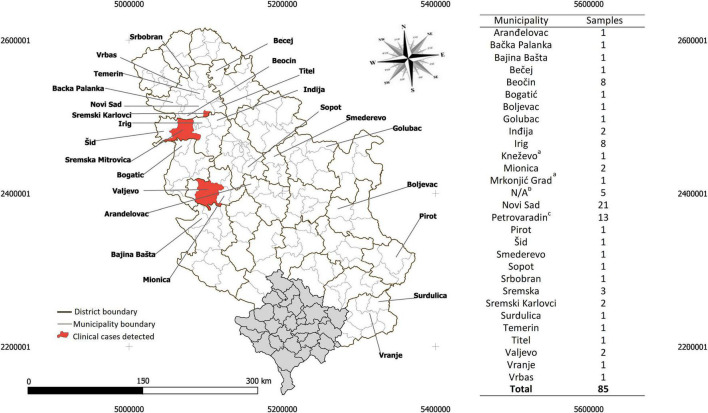
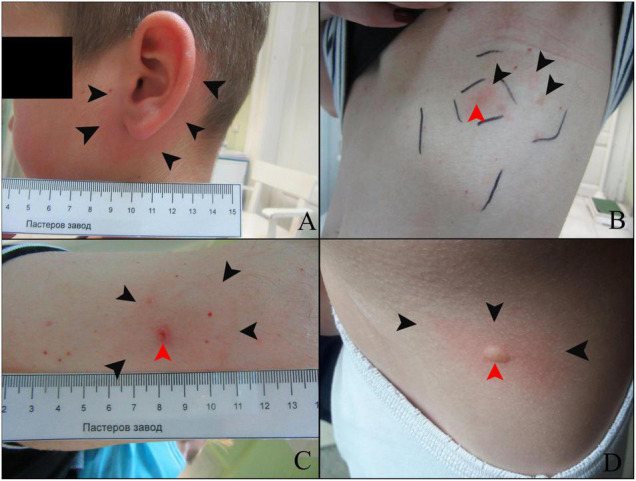
Ticks carry numerous pathogens that, if transmitted, can cause disease in susceptible humans and animals. The present study describes our approach on how to investigate clinical presentations following tick bites in humans. To this aim, the occurrence of major tick-borne pathogens (TBPs) in human blood samples ( = 85) and the ticks collected ( = 93) from the same individuals were tested using an unbiased high-throughput pathogen detection microfluidic system. The clinical symptoms were characterized in enrolled patients. In patients with suspected TBP infection, serological assays were conducted to test for the presence of antibodies against specific TBPs. A field study based on One Health tenets was further designed to identify components of a potential chain of infection resulting in infection in one of the patients. Ticks species infesting humans were identified as , sensu lato (s.l.), , and . Five patients developed local skin lesions at the site of the tick bite including erythema migrans, local non-specific reactions, and cutaneous hypersensitivity reaction. Although s.l., , , and Cryptoplasma sp. DNAs were detected in tick samples, different species were the most common TBPs identified in the ticks. The presence of TBPs such as , , , , , , and in ticks was further confirmed by DNA sequencing. Two of the patients with local skin lesions had IgG reactive against spotted fever group rickettsiae, while IgM specific to , , and were detected in the patient with erythema migrans. Although infection was detected in one human blood sample, none of the components of the potential chain of infection considered in this study tested positive to this pathogen either using direct pathogen detection in domestic dogs or xenodiagnosis in ticks collected from domestic cats. The combination of high-throughput screening of TBPs and One Health approaches might help characterize chains of infection leading to human infection by TBPs, as well as prevalence of emerging rickettsial pathogens in the Balkan region.
蜱虫携带多种病原体,一旦传播,可在易感染的人类和动物中引发疾病。本研究描述了我们关于如何调查人类被蜱虫叮咬后的临床表现的方法。为此,使用无偏差的高通量病原体检测微流控系统,对来自同一人群的人类血液样本(n = 85)和采集的蜱虫(n = 93)中主要蜱传病原体(TBP)的存在情况进行了检测。对纳入研究的患者的临床症状进行了特征描述。对于疑似TBP感染的患者,进行了血清学检测以检测针对特定TBP的抗体的存在情况。进一步设计了一项基于“同一健康”原则的现场研究,以确定导致其中一名患者感染的潜在感染链的组成部分。侵袭人类的蜱虫种类被鉴定为肩突硬蜱、狭义篦子硬蜱、血红扇头蜱和微小牛蜱。五名患者在蜱虫叮咬部位出现局部皮肤病变,包括游走性红斑、局部非特异性反应和皮肤过敏反应。虽然在蜱虫样本中检测到了狭义篦子硬蜱、血红扇头蜱、微小牛蜱和隐孢子虫属的DNA,但不同的立克次体种类是在蜱虫中鉴定出的最常见的TBP。通过DNA测序进一步证实了蜱虫中存在诸如立氏立克次体、西伯利亚立克次体、康氏立克次体、小蛛立克次体、贝氏立克次体、蒙氏立克次体和非洲立克次体等TBP。两名有局部皮肤病变的患者的IgG对斑点热群立克次体有反应,而在患有游走性红斑的患者中检测到了针对立氏立克次体、西伯利亚立克次体和康氏立克次体的IgM。虽然在一份人类血液样本中检测到了立氏立克次体感染,但在本研究中考虑的潜在感染链的组成部分中,无论是使用家犬的直接病原体检测还是从家猫采集的蜱虫的异种诊断,均未检测到该病原体呈阳性。TBP的高通量筛查与“同一健康”方法的结合可能有助于表征导致人类被TBP感染的感染链,以及巴尔干地区新兴立克次体病原体的流行情况。