Levy Brian L, Vachuska Karl, Subramanian S V, Sampson Robert J
Department of Sociology and Anthropology, George Mason University, Fairfax, VA 22030, USA.
Center for Social Science Research, George Mason University, Fairfax, VA 22030, USA.
Sci Adv. 2022 Feb 18;8(7):eabl3825. doi: 10.1126/sciadv.abl3825.
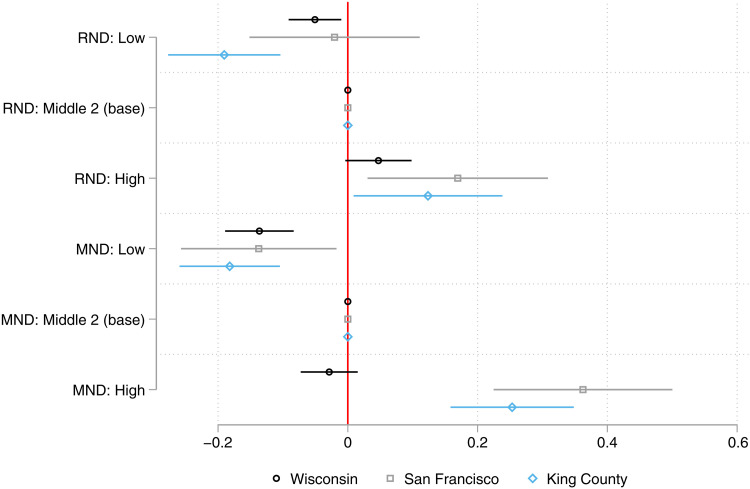
Race and class disparities in COVID-19 cases are well documented, but pathways of possible transmission by neighborhood inequality are not. This study uses administrative data on COVID-19 cases for roughly 2000 census tracts in Wisconsin, Seattle/King County, and San Francisco to analyze how neighborhood socioeconomic (dis)advantage predicts cumulative caseloads through February 2021. Unlike past research, we measure a neighborhood's disadvantage level using both its residents' demographics and the demographics of neighborhoods its residents visit and are visited by, leveraging daily mobility data from 45 million mobile devices. In all three jurisdictions, we find sizable disparities in COVID-19 caseloads. Disadvantage in a neighborhood's mobility network has greater impact than its residents' socioeconomic characteristics. We also find disparities by neighborhood racial/ethnic composition, which can be explained, in part, by residential and mobility-based disadvantage. Neighborhood conditions measured before a pandemic offer substantial predictive power for subsequent incidence, with mobility-based disadvantage playing an important role.
新冠疫情病例中的种族和阶层差异已有充分记录,但邻里不平等导致的可能传播途径却尚无相关记录。本研究使用了威斯康星州、西雅图/金县和旧金山约2000个人口普查区的新冠疫情病例管理数据,以分析邻里社会经济(不)优势如何预测截至2021年2月的累计病例数。与以往研究不同,我们利用来自4500万部移动设备的每日移动性数据,通过一个社区居民的人口统计数据以及该社区居民到访和被到访社区的人口统计数据来衡量该社区的劣势水平。在所有这三个辖区,我们都发现了新冠疫情病例数的巨大差异。一个社区移动网络中的劣势比其居民的社会经济特征影响更大。我们还发现了按邻里种族/族裔构成划分的差异,这在一定程度上可以由基于居住和移动性的劣势来解释。疫情大流行之前所衡量的邻里状况对后续发病率具有很强的预测能力,基于移动性的劣势起着重要作用。