Xiao Changhu, Guo Yuan, Zhao Kaixuan, Liu Sha, He Nongyue, He Yi, Guo Shuhong, Chen Zhu
Hunan Key Laboratory of Biomedical Nanomaterials and Devices, Hunan University of Technology, Zhuzhou 412007, China.
Department of Cardiovascular Medicine, Zhuzhou Hospital Affiliated to Xiangya School of Medicine, Central South University, Zhuzhou 412007, China.
J Cardiovasc Dev Dis. 2022 Feb 11;9(2):56. doi: 10.3390/jcdd9020056.
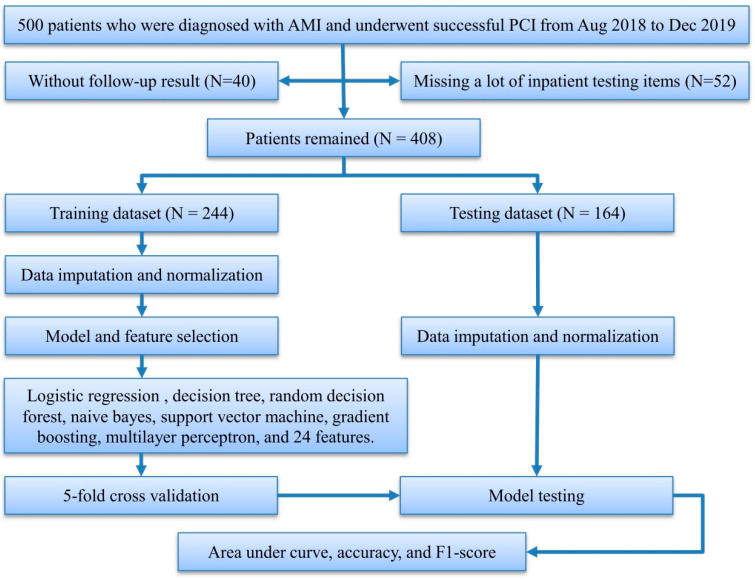
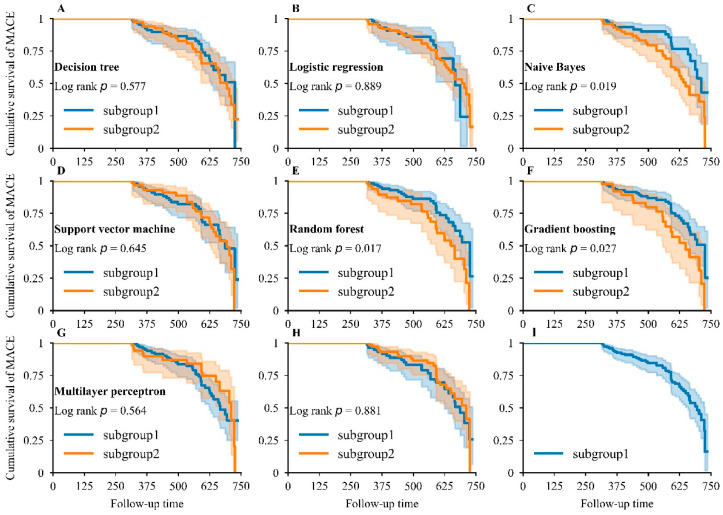
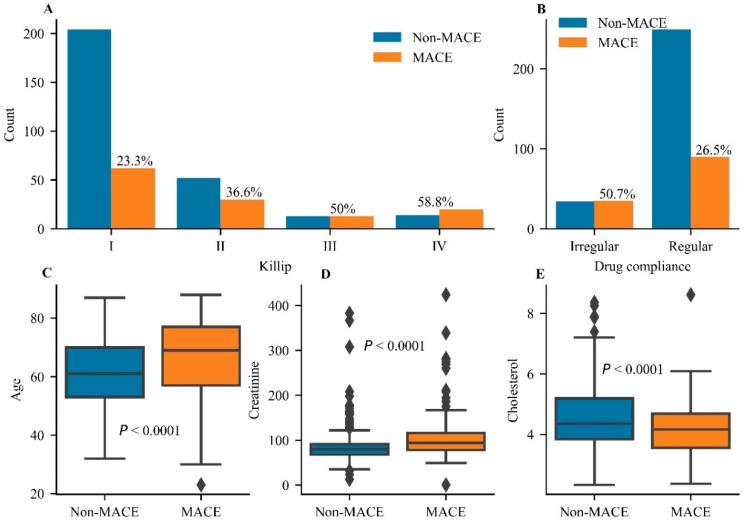
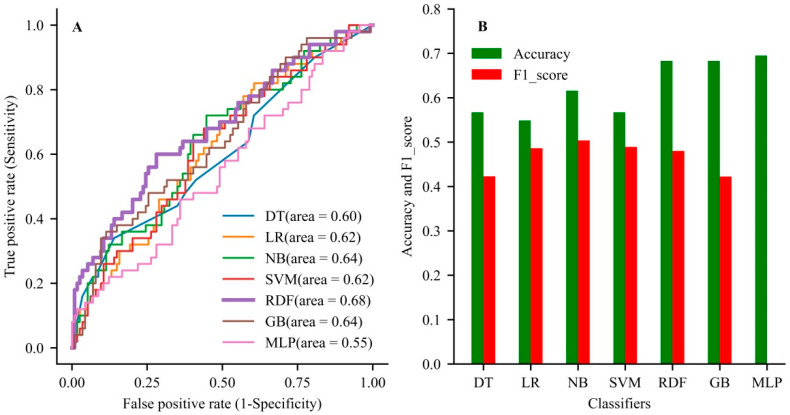
(1) Background: Patients with acute myocardial infarction (AMI) still experience many major adverse cardiovascular events (MACEs), including myocardial infarction, heart failure, kidney failure, coronary events, cerebrovascular events, and death. This retrospective study aims to assess the prognostic value of machine learning (ML) for the prediction of MACEs. (2) Methods: Five-hundred patients diagnosed with AMI and who had undergone successful percutaneous coronary intervention were included in the study. Logistic regression (LR) analysis was used to assess the relevance of MACEs and 24 selected clinical variables. Six ML models were developed with five-fold cross-validation in the training dataset and their ability to predict MACEs was compared to LR with the testing dataset. (3) Results: The MACE rate was calculated as 30.6% after a mean follow-up of 1.42 years. Killip classification (Killip IV vs. I class, odds ratio 4.386, 95% confidence interval 1.943-9.904), drug compliance (irregular vs. regular compliance, 3.06, 1.721-5.438), age (per year, 1.025, 1.006-1.044), and creatinine (1 µmol/L, 1.007, 1.002-1.012) and cholesterol levels (1 mmol/L, 0.708, 0.556-0.903) were independent predictors of MACEs. In the training dataset, the best performing model was the random forest (RDF) model with an area under the curve of (0.749, 0.644-0.853) and accuracy of (0.734, 0.647-0.820). In the testing dataset, the RDF showed the most significant survival difference (log-rank = 0.017) in distinguishing patients with and without MACEs. (4) Conclusions: The RDF model has been identified as superior to other models for MACE prediction in this study. ML methods can be promising for improving optimal predictor selection and clinical outcomes in patients with AMI.
(1) 背景:急性心肌梗死(AMI)患者仍会经历许多主要不良心血管事件(MACE),包括心肌梗死、心力衰竭、肾衰竭、冠状动脉事件、脑血管事件和死亡。本回顾性研究旨在评估机器学习(ML)对MACE预测的预后价值。(2) 方法:本研究纳入了500例诊断为AMI且已成功接受经皮冠状动脉介入治疗的患者。采用逻辑回归(LR)分析来评估MACE与24个选定临床变量的相关性。在训练数据集中使用五折交叉验证开发了六个ML模型,并将它们预测MACE的能力与测试数据集中的LR进行比较。(3) 结果:平均随访1.42年后,MACE发生率计算为30.6%。Killip分级(Killip IV级与I级,比值比4.386,95%置信区间1.943 - 9.904)、药物依从性(不规律与规律依从性,3.06,1.721 - 5.438)、年龄(每年,1.025,1.006 - 1.044)、肌酐(每1 μmol/L,1.007,1.002 - 1.012)和胆固醇水平(每1 mmol/L,0.708,0.556 - 0.903)是MACE的独立预测因素。在训练数据集中,表现最佳的模型是随机森林(RDF)模型,曲线下面积为(0.749,0.644 - 0.853),准确率为(0.734,0.647 - 0.820)。在测试数据集中,RDF在区分有和没有MACE的患者方面显示出最显著的生存差异(对数秩 = 0.017)。(4) 结论:在本研究中,RDF模型已被确定为在MACE预测方面优于其他模型。ML方法在改善AMI患者的最佳预测因素选择和临床结局方面可能很有前景。