Danouche M, El Ghachtouli N, Aasfar A, Bennis I, El Arroussi H
Green Biotechnology Center, Moroccan Foundation for Advanced Science, Innovation and Research (MAScIR), Rabat, Morocco.
Microbial Biotechnology and Bioactive Molecules Laboratory, Sciences and Technologies Faculty, Sidi Mohamed Ben Abdellah University, Fez, Morocco.
Heliyon. 2022 Feb 15;8(2):e08967. doi: 10.1016/j.heliyon.2022.e08967. eCollection 2022 Feb.
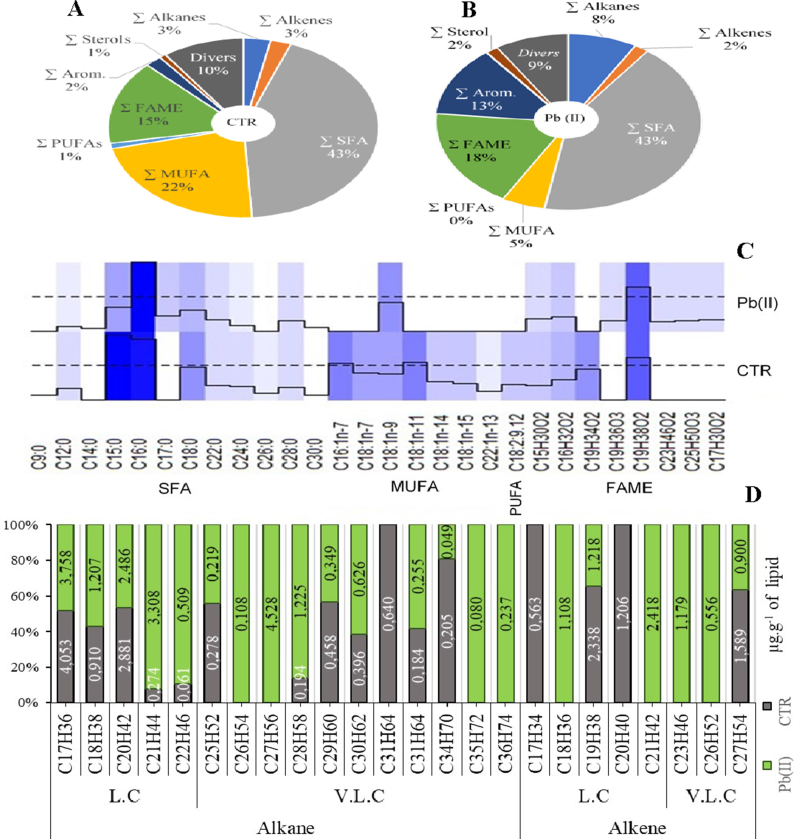
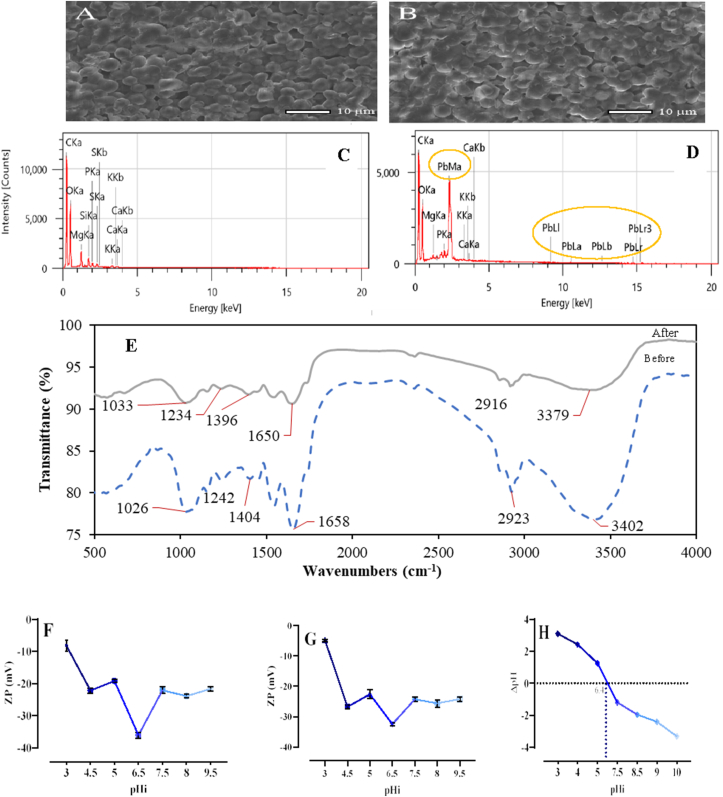
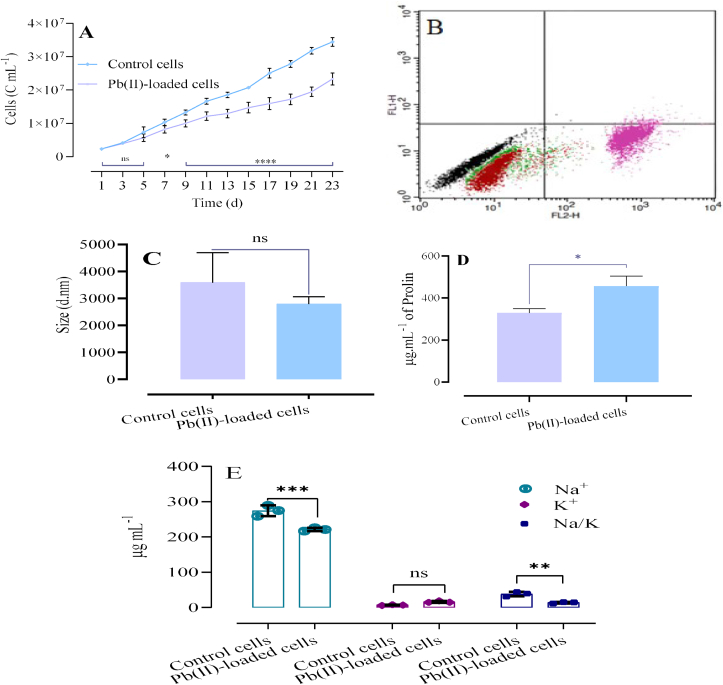
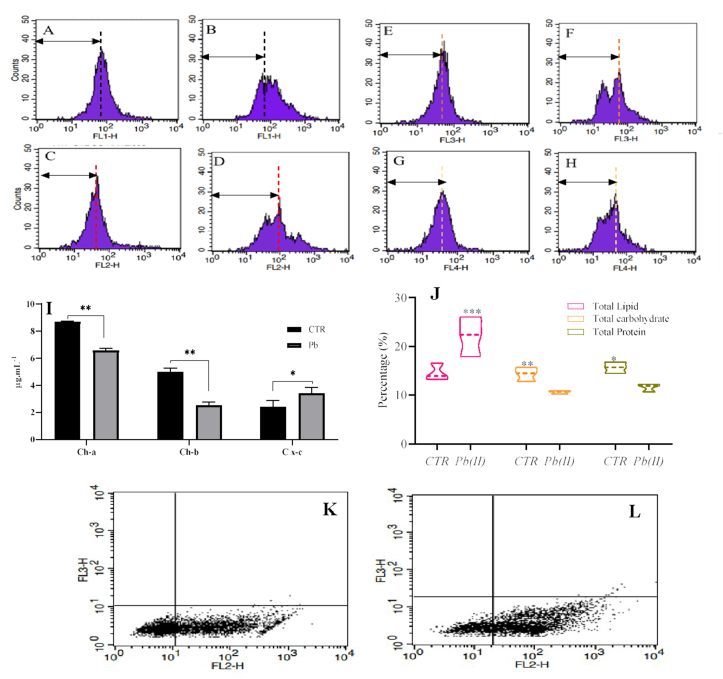
This study highlights the mechanisms of Pb(II)-phycoremediation using the Pb(II) tolerant strain of . First, monitoring of cell growth kinetics in control and Pb(II)-doped medium revealed significant growth inhibition, while the analyses through flow cytometry and Zetasizer revealed no difference in cell viability and size. Residual weights of control and Pb(II)-loaded cells assessed by thermogravimetric analysis were 31.34% and 57.8%, respectively, indicating the uptake of Pb(II) into cells. Next, the use of chemical extraction to distinguish between the intracellular and extracellular uptake indicated the involvement of both biosorption (85.5%) and bioaccumulation (14.5%) mechanisms. Biosorption interaction of Pb(II) ions and the cell wall was confirmed using SEM-EDX, FTIR, zeta potential, zero-charge pH, and contact angle analyses. Besides, the biochemical characterization of control and Pb(II)-loaded cells revealed that the bioaccumulation of Pb(II) induces significant increases in the carotenoids and lipids content, while it decreases in the chlorophyll, carbohydrates, and proteins content. Finally, the metabolomic analysis indicated an increase in the relative abundance of fatty acid methyl esters, alkanes, aromatic compounds, and sterols. However, the alkenes and monounsaturated fatty acids decreased. Such metabolic adjustment may represent an adaptive strategy that prevents high Pb(II)-bioaccumulation in cellular compartments.
本研究重点介绍了利用耐铅(II)菌株进行铅(II)藻类修复的机制。首先,对对照和掺铅(II)培养基中细胞生长动力学的监测显示出显著的生长抑制,而通过流式细胞术和动态光散射仪分析发现细胞活力和大小没有差异。通过热重分析评估的对照细胞和负载铅(II)细胞的残余重量分别为31.34%和57.8%,表明铅(II)被细胞摄取。接下来,使用化学萃取法区分细胞内和细胞外摄取,结果表明生物吸附(85.5%)和生物积累(14.5%)机制均有参与。利用扫描电子显微镜-能谱分析(SEM-EDX)、傅里叶变换红外光谱(FTIR)、zeta电位、零电荷pH值和接触角分析证实了铅(II)离子与细胞壁的生物吸附相互作用。此外,对对照细胞和负载铅(II)细胞的生化特性分析表明,铅(II)的生物积累导致类胡萝卜素和脂质含量显著增加,而叶绿素、碳水化合物和蛋白质含量则降低。最后,代谢组学分析表明脂肪酸甲酯、烷烃、芳香化合物和甾醇的相对丰度增加。然而,烯烃和单不饱和脂肪酸减少。这种代谢调整可能代表了一种适应性策略,可防止细胞内高浓度铅(II)的生物积累。