Solomon Matthew D, Tabada Grace, Allen Amanda, Sung Sue Hee, Go Alan S
Division of Research, Kaiser Permanente Northern California, Oakland, California.
Department of Cardiology, Kaiser Oakland Medical Center, Oakland, California.
Cardiovasc Digit Health J. 2021 Mar 18;2(3):156-163. doi: 10.1016/j.cvdhj.2021.03.003. eCollection 2021 Jun.
Systematic case identification is critical to improving population health, but widely used diagnosis code-based approaches for conditions like valvular heart disease are inaccurate and lack specificity.
To develop and validate natural language processing (NLP) algorithms to identify aortic stenosis (AS) cases and associated parameters from semi-structured echocardiogram reports and compare their accuracy to administrative diagnosis codes.
Using 1003 physician-adjudicated echocardiogram reports from Kaiser Permanente Northern California, a large, integrated healthcare system (>4.5 million members), NLP algorithms were developed and validated to achieve positive and negative predictive values > 95% for identifying AS and associated echocardiographic parameters. Final NLP algorithms were applied to all adult echocardiography reports performed between 2008 and 2018 and compared to ICD-9/10 diagnosis code-based definitions for AS found from 14 days before to 6 months after the procedure date.
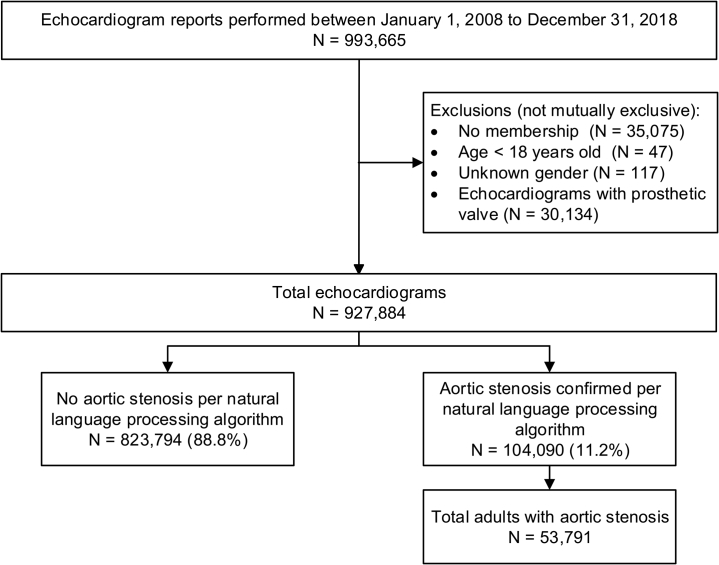
A total of 927,884 eligible echocardiograms were identified during the study period among 519,967 patients. Application of the final NLP algorithm classified 104,090 (11.2%) echocardiograms with any AS (mean age 75.2 years, 52% women), with only 67,297 (64.6%) having a diagnosis code for AS between 14 days before and up to 6 months after the associated echocardiogram. Among those without associated diagnosis codes, 19% of patients had hemodynamically significant AS (ie, greater than mild disease).
A validated NLP algorithm applied to a systemwide echocardiography database was substantially more accurate than diagnosis codes for identifying AS. Leveraging machine learning-based approaches on unstructured electronic health record data can facilitate more effective individual and population management than using administrative data alone.
系统的病例识别对于改善人群健康至关重要,但广泛使用的基于诊断编码的方法来识别诸如心脏瓣膜病等疾病并不准确且缺乏特异性。
开发并验证自然语言处理(NLP)算法,以从半结构化超声心动图报告中识别主动脉瓣狭窄(AS)病例及相关参数,并将其准确性与行政诊断编码进行比较。
利用来自北加利福尼亚州凯撒医疗集团(一个大型综合医疗系统,成员超过450万)的1003份经医生判定的超声心动图报告,开发并验证NLP算法,以实现识别AS及相关超声心动图参数的阳性和阴性预测值>95%。最终的NLP算法应用于2008年至2018年间所有成人超声心动图报告,并与基于ICD-9/10诊断编码的AS定义进行比较,该定义是从手术日期前14天至术后6个月内获取的。
在研究期间,共识别出519967例患者的927884份合格超声心动图。最终的NLP算法应用于104090份(11.2%)有任何AS的超声心动图(平均年龄75.2岁,52%为女性),其中只有67297份(64.6%)在相关超声心动图检查前14天至术后6个月内有AS的诊断编码。在那些没有相关诊断编码的患者中,19%的患者有血流动力学显著意义的AS(即大于轻度疾病)。
应用于全系统超声心动图数据库的经过验证的NLP算法在识别AS方面比诊断编码准确得多。与仅使用行政数据相比,利用基于机器学习的方法处理非结构化电子健康记录数据可以促进更有效的个体和人群管理。