Zha Kangkang, Tian Yue, Panayi Adriana C, Mi Bobin, Liu Guohui
Department of Orthopaedics, Union Hospital, Tongji Medical College, Huazhong University of Science and Technology, Wuhan, China.
Hubei Province Key Laboratory of Oral and Maxillofacial Development and Regeneration, Wuhan, China.
Front Cell Dev Biol. 2022 Feb 23;10:824812. doi: 10.3389/fcell.2022.824812. eCollection 2022.
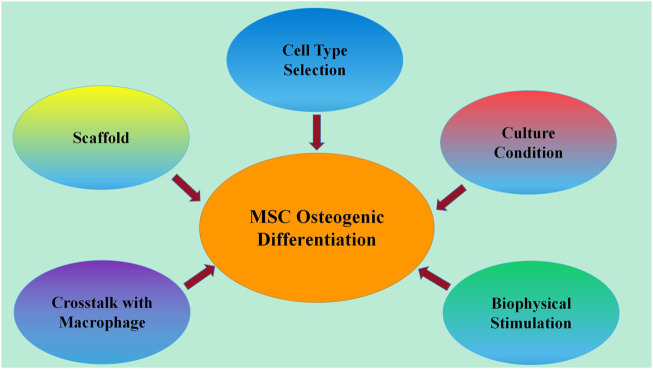
Although bone is an organ that displays potential for self-healing after damage, bone regeneration does not occur properly in some cases, and it is still a challenge to treat large bone defects. The development of bone tissue engineering provides a new approach to the treatment of bone defects. Among various cell types, mesenchymal stem cells (MSCs) represent one of the most promising seed cells in bone tissue engineering due to their functions of osteogenic differentiation, immunomodulation, and secretion of cytokines. Regulation of osteogenic differentiation of MSCs has become an area of extensive research over the past few years. This review provides an overview of recent research progress on enhancement strategies for MSC osteogenesis, including improvement in methods of cell origin selection, culture conditions, biophysical stimulation, crosstalk with macrophages and endothelial cells, and scaffolds. This is favorable for further understanding MSC osteogenesis and the development of MSC-based bone tissue engineering.
尽管骨骼是一种在受损后具有自我修复潜力的器官,但在某些情况下骨再生无法正常发生,治疗大的骨缺损仍然是一项挑战。骨组织工程的发展为骨缺损的治疗提供了一种新方法。在各种细胞类型中,间充质干细胞(MSCs)由于其成骨分化、免疫调节和细胞因子分泌功能,是骨组织工程中最有前景的种子细胞之一。在过去几年中,MSCs成骨分化的调控已成为一个广泛研究的领域。本综述概述了近年来MSCs成骨增强策略的研究进展,包括细胞来源选择方法的改进、培养条件、生物物理刺激、与巨噬细胞和内皮细胞的相互作用以及支架。这有利于进一步了解MSCs成骨作用以及基于MSCs的骨组织工程的发展。