Department of Rheumatology, Oslo University Hospital, Postbox 4959, 0424, Nydalen, Oslo, Norway.
Institute of Clinical Medicine, University of Oslo, Oslo, Norway.
Sci Rep. 2022 Mar 18;12(1):4661. doi: 10.1038/s41598-022-08815-8.
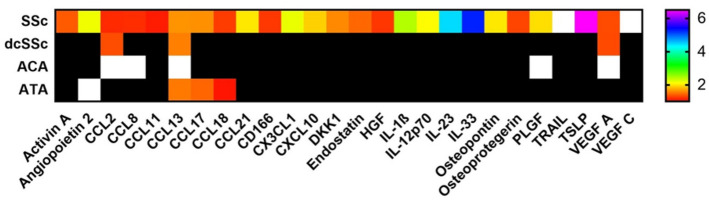
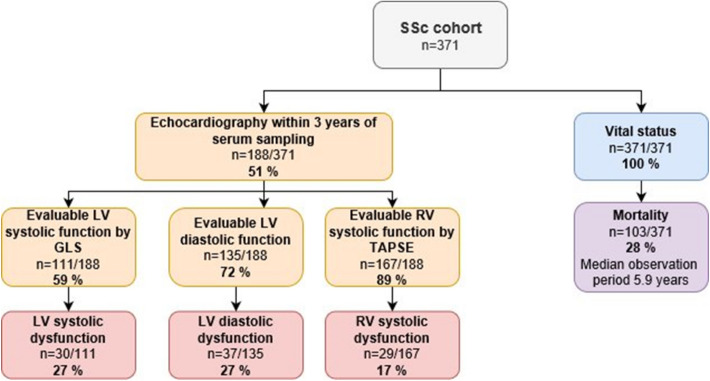
Primary cardiac involvement is one of the leading causes of mortality in systemic sclerosis (SSc), but little is known regarding circulating biomarkers for cardiac SSc. Here, we aimed to investigate potential associations between cardiac SSc and candidate serum markers. Serum samples from patients of the Oslo University SSc cohort and 100 healthy controls were screened against two custom-made candidate marker panels containing molecules deemed relevant for cardiopulmonary and/or fibrotic diseases. Left (LV) and right ventricular (RV) dysfunction was assessed by protocol echocardiography, performed within three years from serum sampling. Patients suspected of pulmonary hypertension underwent right heart catheterization. Vital status at study end was available for all patients. Descriptive analyses, logistic and Cox regressions were conducted to assess associations between cardiac SSc and candidate serum markers. The 371 patients presented an average age of 57.2 (± 13.9) years. Female sex (84%) and limited cutaneous SSc (73%) were predominant. Association between LV diastolic dysfunction and tumor necrosis factor-related apoptosis-inducing ligand (TRAIL) (OR 0.41, 95% CI 0.21-0.78, p = 0.007) was identified. LV systolic dysfunction defined by global longitudinal strain was associated with angiopoietin 2 (ANGPT2) (OR 3.42, 95% CI 1.52-7.71, p = 0.003) and osteopontin (OPN) (OR 1.95, 95% CI 1.08-3.52, p = 0.026). RV systolic dysfunction, measured by tricuspid annular plane systolic excursion, was associated to markers of LV dysfunction (ANGPT2, OPN, and TRAIL) (OR 1.67, 95% CI 1.11-2.50, p = 0.014, OR 1.86, 95% CI 1.25-2.77, p = 0.002, OR 0.32, 95% CI 0.15-0.66, p = 0.002, respectively) and endostatin (OR 1.86, 95% CI 1.22-2.84, p = 0.004). In conclusion, ANGPT2, OPN and TRAIL seem to be circulating biomarkers associated with both LV and RV dysfunction in SSc.
原发性心脏受累是系统性硬化症(SSc)患者死亡的主要原因之一,但对于心脏 SSc 的循环生物标志物知之甚少。在这里,我们旨在研究心脏 SSc 与候选血清标志物之间的潜在关联。我们对奥斯陆大学 SSc 队列的患者血清样本和 100 名健康对照者的血清样本进行了检测,检测了两个定制的候选标志物面板,这些标志物包含与心肺和/或纤维化疾病相关的分子。通过协议超声心动图评估左心室(LV)和右心室(RV)功能障碍,在血清取样后三年内进行。怀疑患有肺动脉高压的患者进行了右心导管检查。所有患者在研究结束时的生存状态均可获得。进行描述性分析、逻辑回归和 Cox 回归,以评估候选血清标志物与心脏 SSc 之间的关联。371 名患者的平均年龄为 57.2(±13.9)岁。女性(84%)和局限性皮肤 SSc(73%)为主。LV 舒张功能障碍与肿瘤坏死因子相关凋亡诱导配体(TRAIL)之间存在关联(OR 0.41,95%CI 0.21-0.78,p=0.007)。通过整体纵向应变定义的 LV 收缩功能障碍与血管生成素 2(ANGPT2)(OR 3.42,95%CI 1.52-7.71,p=0.003)和骨桥蛋白(OPN)(OR 1.95,95%CI 1.08-3.52,p=0.026)有关。通过三尖瓣环平面收缩期运动测量的 RV 收缩功能障碍与 LV 功能障碍的标志物(ANGPT2、OPN 和 TRAIL)有关(OR 1.67,95%CI 1.11-2.50,p=0.014,OR 1.86,95%CI 1.25-2.77,p=0.002,OR 0.32,95%CI 0.15-0.66,p=0.002)和内皮抑素(OR 1.86,95%CI 1.22-2.84,p=0.004)。总之,ANGPT2、OPN 和 TRAIL 似乎是与 SSc 患者 LV 和 RV 功能障碍相关的循环生物标志物。