Coratella Giuseppe, Tornatore Gianpaolo, Longo Stefano, Toninelli Nicholas, Padovan Riccardo, Esposito Fabio, Cè Emiliano
Department of Biomedical Sciences for Health, Università Degli Studi di Milano, 20133 Milan, Italy.
IRCCS Galeazzi Orthopedic Institute, 20161 Milan, Italy.
Sports (Basel). 2023 Mar 9;11(3):64. doi: 10.3390/sports11030064.
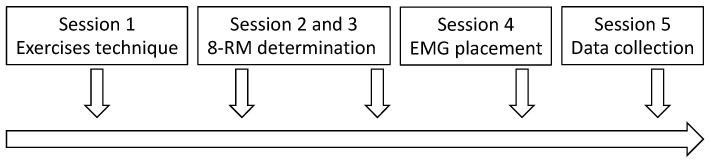
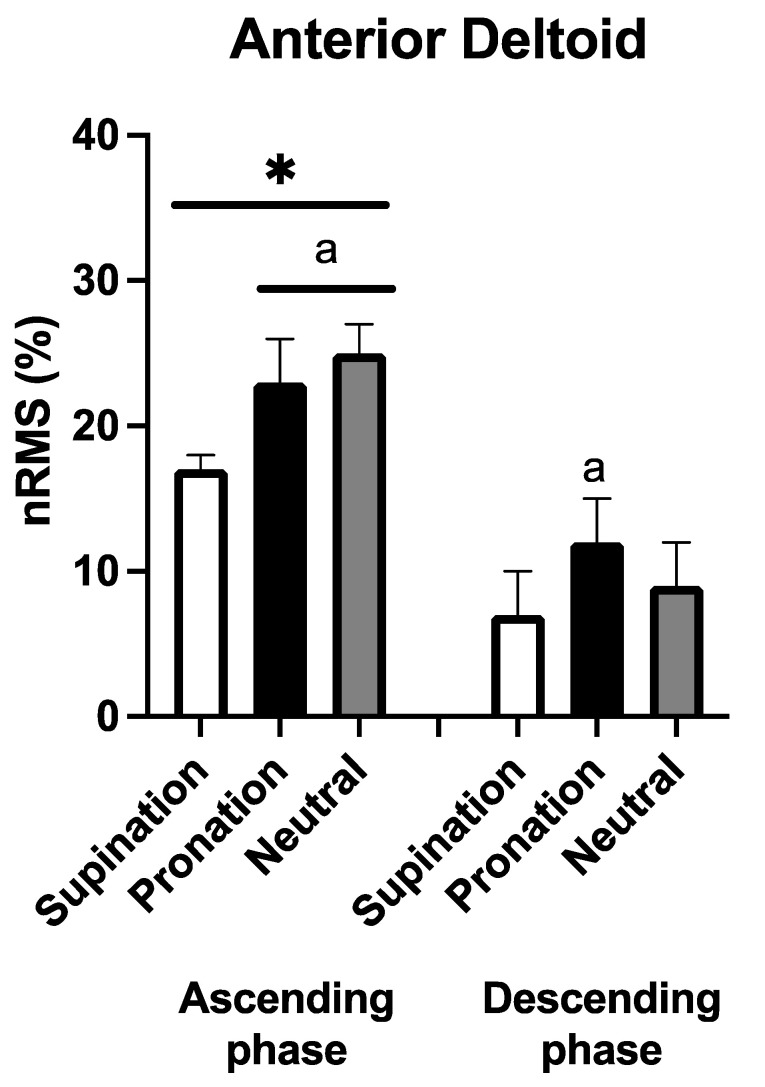
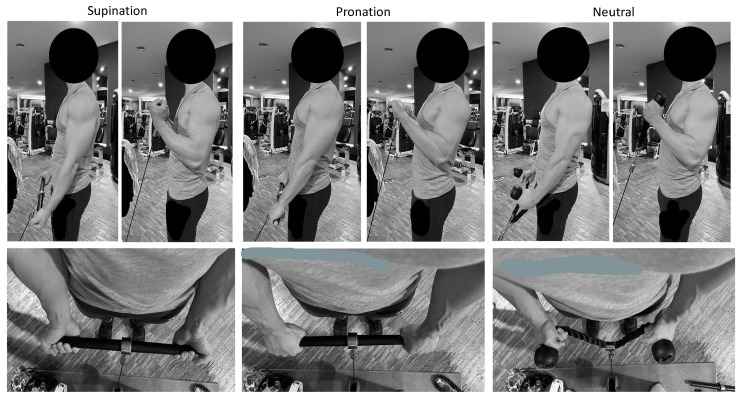
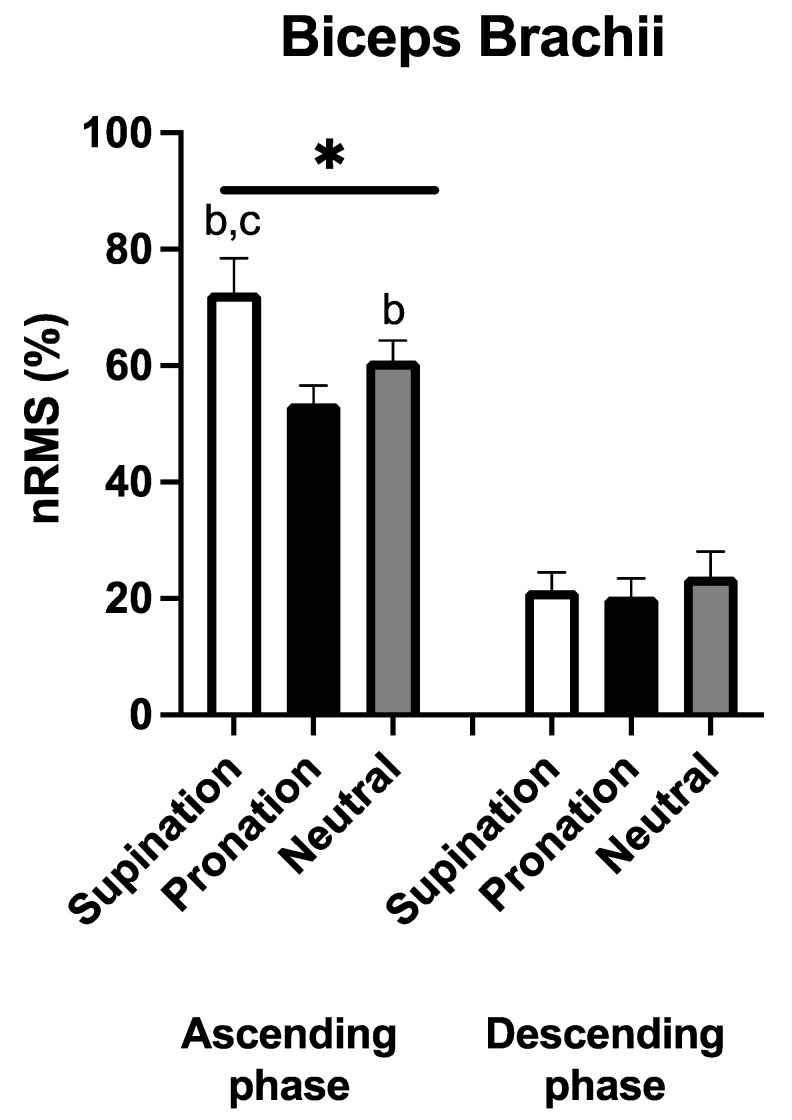
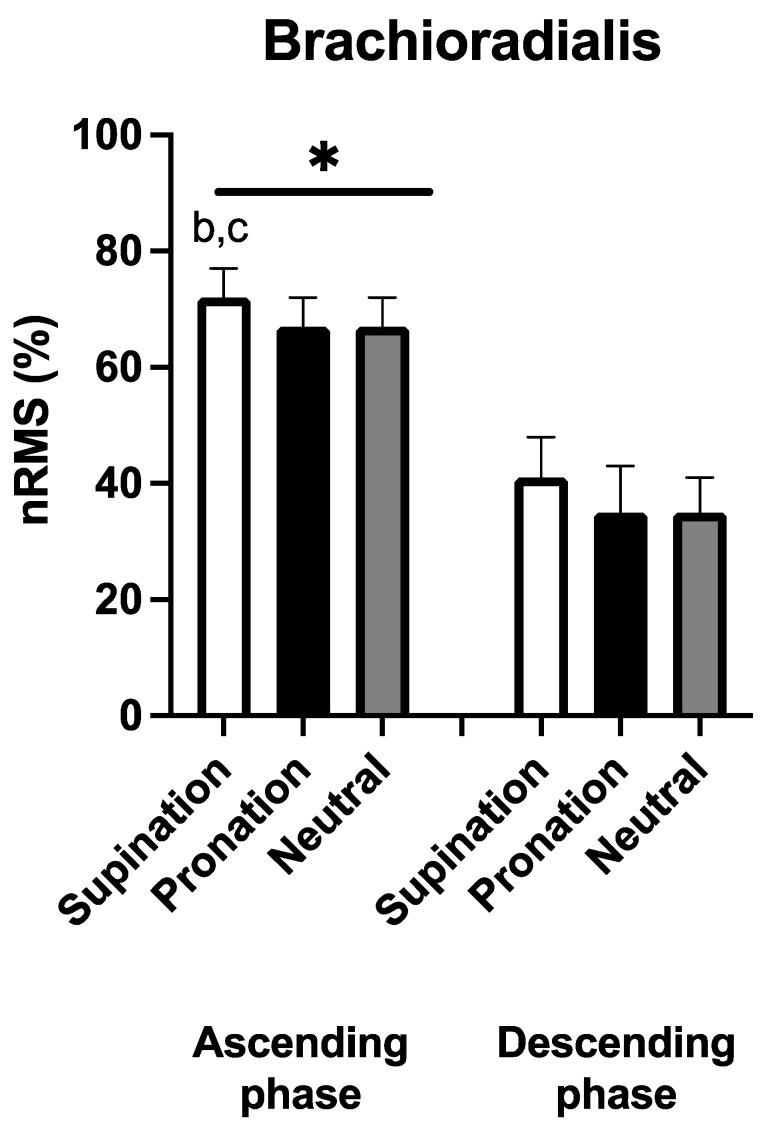
The current study analyzed the excitation of biceps brachii, brachioradialis, and anterior deltoid during bilateral biceps curl performed with different handgrips. Ten competitive bodybuilders performed bilateral biceps curl in non-exhaustive 6-rep sets using 8-RM with the forearm in supinated, pronated, and neutral positions. The ascending and descending phase of each variation was separately analyzed using the normalized root mean square collected using surface electromyography. During the ascending phase, (i) biceps brachii excitation was greater with the supinated compared to the pronated [+19(7)%, ES: 2.60] and neutral handgrip [+12(9)%, ES: 1.24], (ii) the brachioradialis showed greater excitation with the supinated compared to the pronated [+5(4)%, ES: 1.01] and neutral handgrip [+6(5)%, ES: 1.10], (iii) the anterior deltoid excitation was greater with the pronated and neutral handgrip compared to the supinated condition [+6(3)% and +9(2)%, ES: 2.07 and 3.18, respectively]. During the descending phase, the anterior deltoid showed greater excitation in the pronated compared to the supinated handgrip [+5(4)%, ES: 1.02]. Changing the handgrips when performing biceps curl induces specific variations in biceps brachii and brachioradialis excitation and requires different anterior deltoid interventions for stabilizing the humeral head. Practitioners should consider including different handgrips in the biceps curl routine to vary the neural and mechanical stimuli.
本研究分析了在使用不同握法进行双侧二头肌弯举时肱二头肌、肱桡肌和三角肌前束的兴奋情况。10名职业健美运动员在前臂旋后、旋前和中立位使用8-RM进行非疲劳性6次重复的双侧二头肌弯举。使用表面肌电图收集的标准化均方根分别分析每个变式的上升和下降阶段。在上升阶段,(i)与旋前握法[+19(7)%,效应量:2.60]和中立握法[+12(9)%,效应量:1.24]相比,旋后握法时肱二头肌的兴奋程度更高;(ii)与旋前握法[+5(4)%,效应量:1.01]和中立握法[+6(5)%,效应量:1.10]相比,旋后握法时肱桡肌的兴奋程度更高;(iii)与旋后状态相比,旋前和中立握法时三角肌前束的兴奋程度更高[+6(3)%和+9(2)%,效应量分别为2.07和3.18]。在下降阶段,与旋后握法相比,旋前握法时三角肌前束的兴奋程度更高[+5(4)%,效应量:1.02]。进行二头肌弯举时改变握法会引起肱二头肌和肱桡肌兴奋的特定变化,并且需要不同的三角肌前束干预来稳定肱骨头。从业者应考虑在二头肌弯举训练中纳入不同握法,以改变神经和机械刺激。