Laboratory of Environmental Chemistry and Toxicology, Department of Environmental Health Sciences, Istituto di Ricerche Farmacologiche Mario Negri IRCCS, Via Mario Negri 2, 20156 Milan, Italy.
School of Pharmacy and Biomolecular Sciences, Liverpool John Moores University, Byrom Street, Liverpool L3 3AF, UK.
Int J Mol Sci. 2022 Mar 11;23(6):3053. doi: 10.3390/ijms23063053.
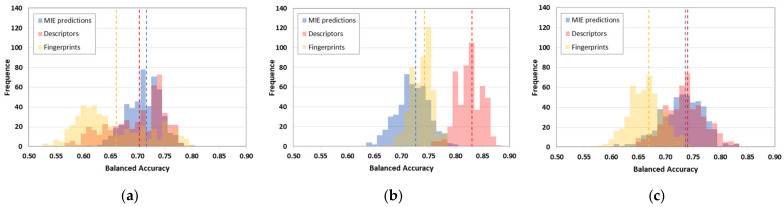
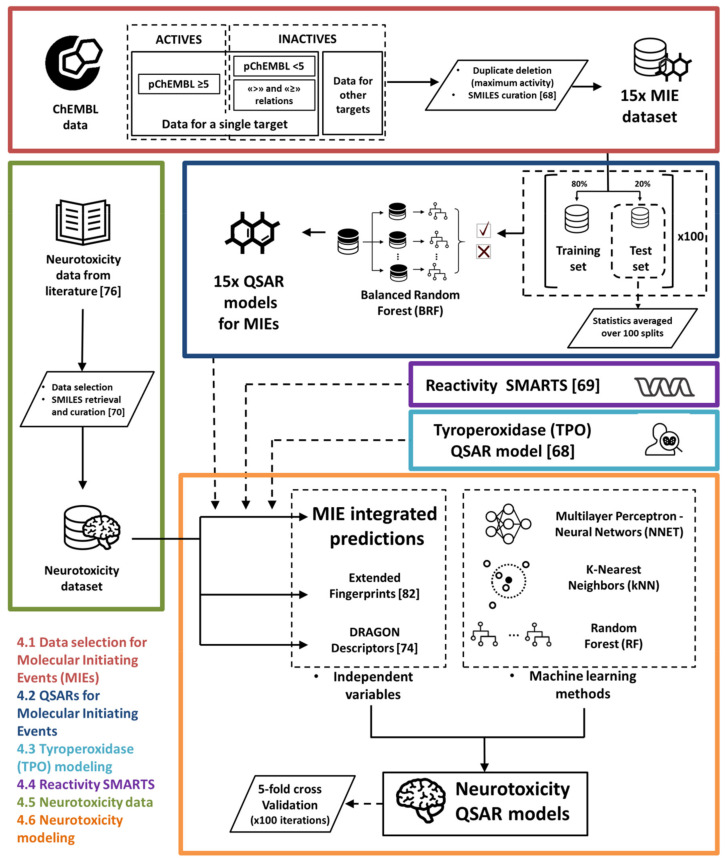
Developmental and adult/ageing neurotoxicity is an area needing alternative methods for chemical risk assessment. The formulation of a strategy to screen large numbers of chemicals is highly relevant due to potential exposure to compounds that may have long-term adverse health consequences on the nervous system, leading to neurodegeneration. Adverse Outcome Pathways (AOPs) provide information on relevant molecular initiating events (MIEs) and key events (KEs) that could inform the development of computational alternatives for these complex effects. We propose a screening method integrating multiple Quantitative Structure-Activity Relationship (QSAR) models. The MIEs of existing AOP networks of developmental and adult/ageing neurotoxicity were modelled to predict neurotoxicity. Random Forests were used to model each MIE. Predictions returned by single models were integrated and evaluated for their capability to predict neurotoxicity. Specifically, MIE predictions were used within various types of classifiers and compared with other reference standards (chemical descriptors and structural fingerprints) to benchmark their predictive capability. Overall, classifiers based on MIE predictions returned predictive performances comparable to those based on chemical descriptors and structural fingerprints. The integrated computational approach described here will be beneficial for large-scale screening and prioritisation of chemicals as a function of their potential to cause long-term neurotoxic effects.
发育和成年/老化神经毒性是一个需要替代方法进行化学风险评估的领域。由于可能接触到可能对神经系统产生长期不良健康后果导致神经退行性变的化合物,因此制定筛选大量化学物质的策略非常重要。 不良结局途径(AOP)提供了有关相关分子起始事件(MIE)和关键事件(KE)的信息,这些信息可以为这些复杂效应的计算替代方法的开发提供信息。我们提出了一种整合多种定量构效关系(QSAR)模型的筛选方法。对现有的发育和成年/老化神经毒性 AOP 网络的 MIE 进行建模以预测神经毒性。使用随机森林对每个 MIE 进行建模。整合单个模型的预测,并评估其预测神经毒性的能力。具体来说,在各种类型的分类器中使用 MIE 预测,并将其与其他参考标准(化学描述符和结构指纹)进行比较,以基准测试其预测能力。总体而言,基于 MIE 预测的分类器的预测性能与基于化学描述符和结构指纹的预测性能相当。这里描述的综合计算方法将有利于大规模筛选和优先考虑化学品,以评估其引起长期神经毒性作用的潜力。