Division of Bone Diseases, Geneva University Hospitals and Faculty of Medicine, University of Geneva, 1205 Geneva, Switzerland.
Nutrients. 2022 Mar 21;14(6):1314. doi: 10.3390/nu14061314.
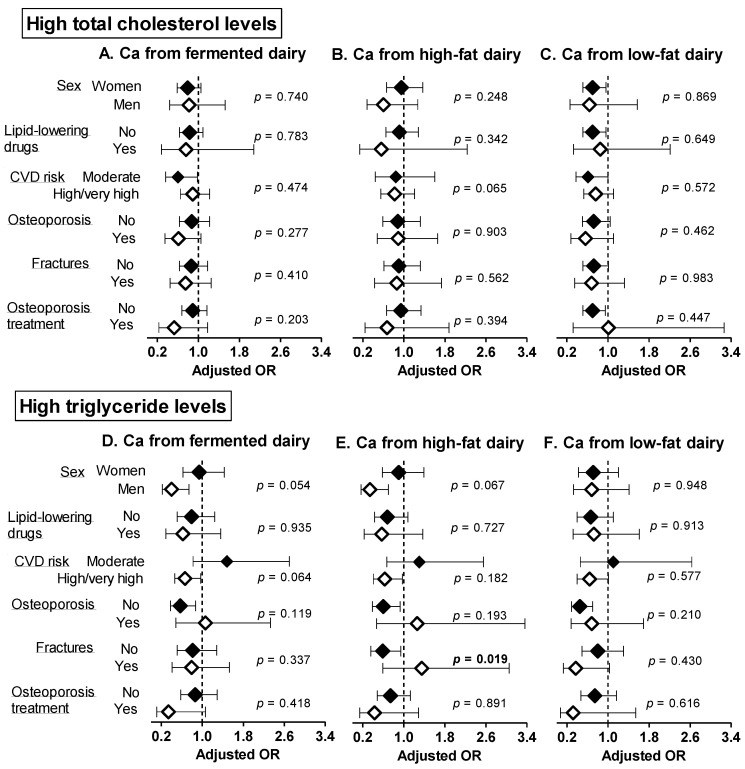
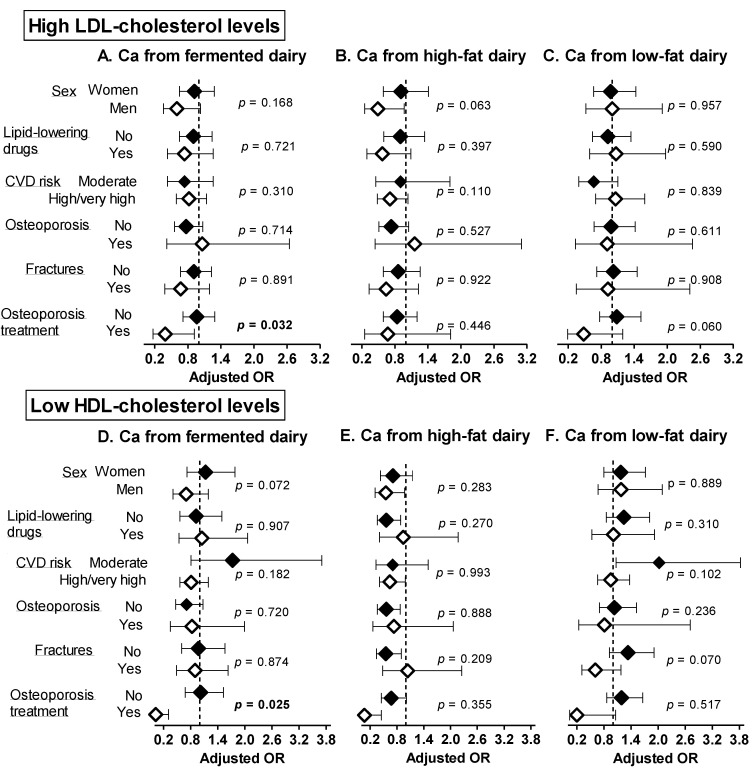
Promoting calcium intake is a cornerstone for osteoporosis management. Some individuals limit dairy product consumption, a major calcium source, due to their high content in saturated fats and their perceived negative impact on lipid profiles. This study explored the associations of calcium from various sources with blood lipids in community-dwelling elderly ( = 717) from the GERICO cohort. Dietary calcium intake was assessed at several timepoints using a validated food frequency questionnaire (FFQ) and calcium supplement use was recorded. Blood lipids were treated as categorical variables to distinguish those with normal and abnormal levels. Increasing total calcium intake was associated with lower risks for high total cholesterol ( = 0.038) and triglycerides ( = 0.007), and low HDL-cholesterol ( = 0.010). Dairy calcium ( = 0.031), especially calcium from milk ( = 0.044) and milk-based desserts ( = 0.039), i.e., low-fat ( = 0.022) and non-fermented ( = 0.005) dairy products, were associated with a lower risk of high total cholesterol. Greater calcium intakes from total dairies ( = 0.020), milk ( = 0.020) and non-fermented dairies ( = 0.027) were associated with a lower risk of hypertriglyceridemia. No association was observed between calcium from non-dairy sources, cheese or high-fat dairies and blood lipids. Increasing calcium through supplements was associated with lower risks for hypertriglyceridemia ( = 0.022) and low HDL-cholesterol ( = 0.001), but not after adjustments. Our results suggest that higher calcium intakes from dietary sources or supplements are not adversely associated with blood lipids in the elderly, whilst total, and particularly low-fat, dairy products are valuable calcium sources potentially related to favorable lipid profiles.
促进钙摄入是骨质疏松症管理的基石。由于某些人认为乳制品中的饱和脂肪含量高且对血脂谱有负面影响,因此限制了乳制品的摄入,而乳制品是钙的主要来源。本研究探讨了来自不同来源的钙与 GERICO 队列中社区居住的老年人(= 717)的血脂之间的关联。使用经过验证的食物频率问卷(FFQ)多次评估膳食钙摄入量,并记录钙补充剂的使用情况。将血脂视为分类变量,以区分正常和异常水平。总的来说,增加钙的摄入量与总胆固醇(= 0.038)和甘油三酯(= 0.007)水平升高的风险降低以及高密度脂蛋白胆固醇(= 0.010)水平降低相关。乳制品中的钙(= 0.031),尤其是牛奶中的钙(= 0.044)和牛奶基甜点中的钙(= 0.039),即低脂(= 0.022)和非发酵(= 0.005)乳制品,与总胆固醇升高的风险降低相关。来自全乳制品(= 0.020)、牛奶(= 0.020)和非发酵乳制品(= 0.027)的钙摄入量越大,发生高甘油三酯血症的风险越低。非乳制品来源、奶酪或高脂肪乳制品中的钙与血脂之间没有关联。通过补充剂增加钙的摄入与发生高甘油三酯血症(= 0.022)和低高密度脂蛋白胆固醇(= 0.001)的风险降低相关,但在调整后没有关联。我们的结果表明,来自饮食来源或补充剂的较高钙摄入量与老年人的血脂没有不利关联,而全脂,尤其是低脂乳制品是潜在的有益钙来源,与有利的血脂谱相关。