Department of Pharmacology and Molecular Sciences, Johns Hopkins University School of Medicine, Hunterian Building, Room 314, 725 North Wolfe St., Baltimore, MD, 21205, USA.
Department of Chemical and Biomolecular Engineering, Johns Hopkins University, Baltimore, MD, 21218, USA.
Anal Bioanal Chem. 2022 Jul;414(18):5627-5641. doi: 10.1007/s00216-022-04015-5. Epub 2022 Mar 30.
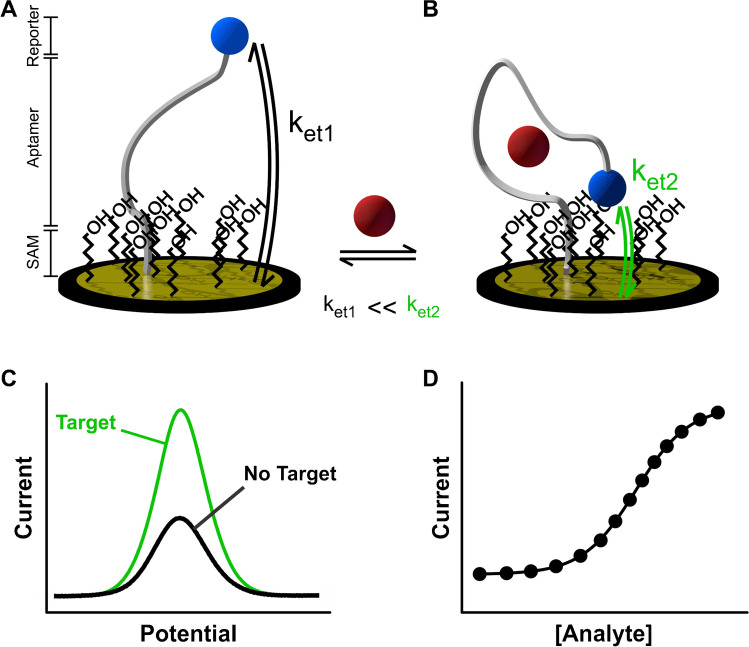
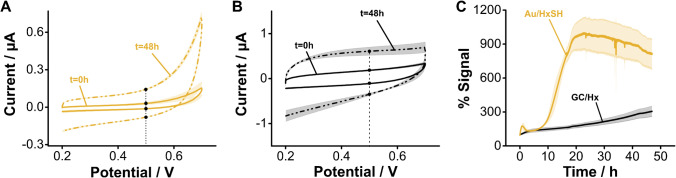
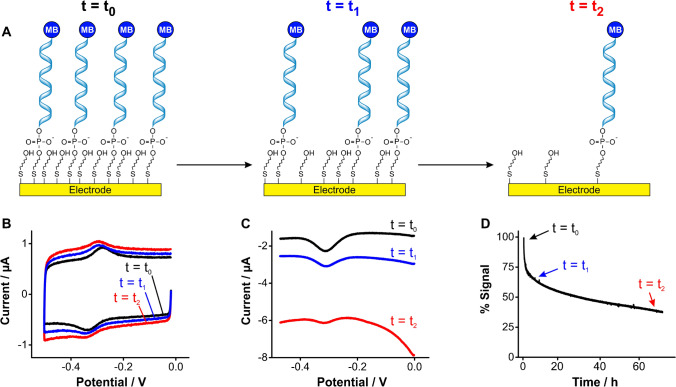
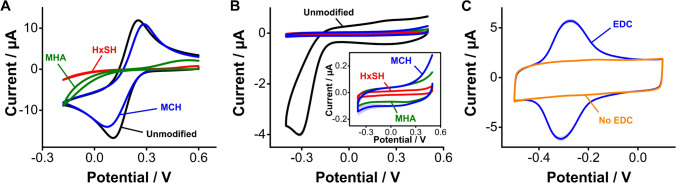
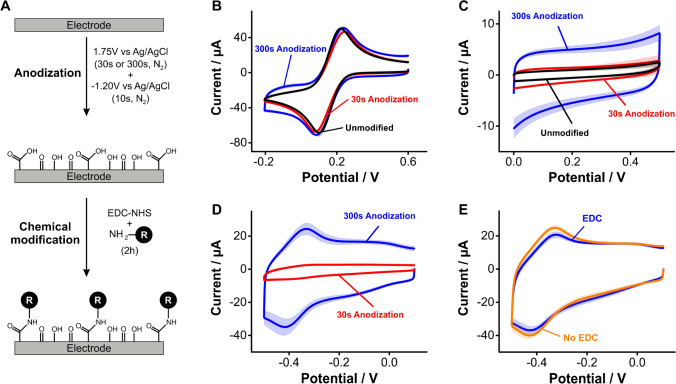
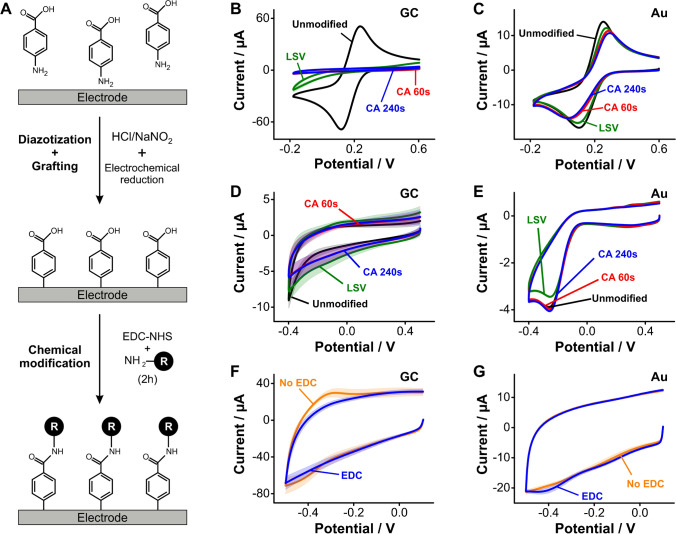
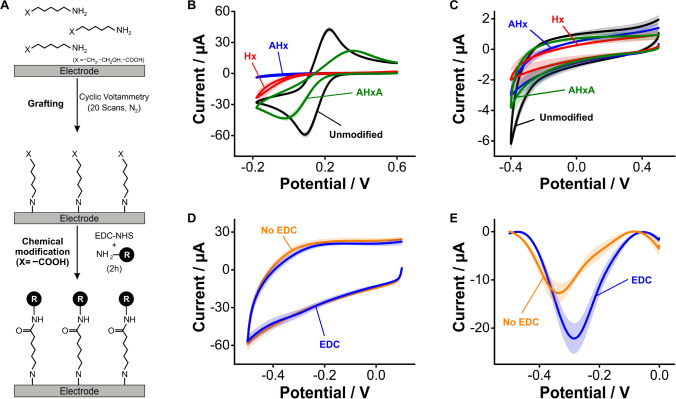
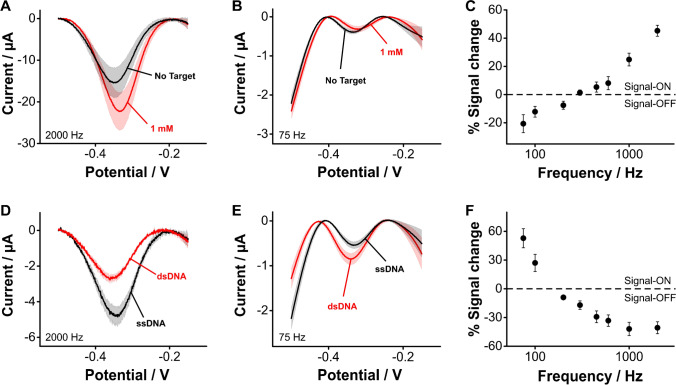
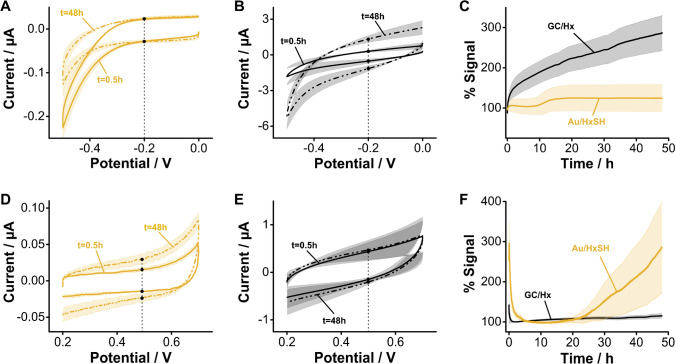
Electrochemical, aptamer-based (E-AB) sensors uniquely enable reagentless, reversible, and continuous molecular monitoring in biological fluids. Because of this ability, E-AB sensors have been proposed for therapeutic drug monitoring. However, to achieve translation from the bench to the clinic, E-AB sensors should ideally operate reliably and continuously for periods of days. Instead, because these sensors are typically fabricated on gold surfaces via self-assembly of alkanethiols that are prone to desorption from electrode surfaces, they undergo significant signal losses in just hours. To overcome this problem, our group is attempting to migrate E-AB sensor interfaces away from thiol-on-gold assembly towards stronger covalent bonds. Here, we explore the modification of carbon electrodes as an alternative substrate for E-AB sensors. We investigated three strategies to functionalize carbon surfaces: (I) anodization to generate surface carboxylic groups, (II) electrografting of arenediazonium ions, and (III) electrografting of primary aliphatic amines. Our results indicate that electrografting of primary aliphatic amines is the only strategy achieving monolayer organization and packing densities closely comparable to those obtained by alkanethiols on gold. In addition, the resulting monolayers enable covalent tethering of DNA aptamers and support electrochemical sensing of small molecule targets or complimentary DNA strands. These monolayers also achieve superior stability under continuous voltammetric interrogation in biological fluids relative to benchmark thiol-on-gold monolayers when a positive voltage scan window is used. Based on these results, we postulate the electrografting of primary aliphatic amines as a path forward to develop carbon-supported E-AB sensors with increased operational stability.
电化学、适配体(E-AB)传感器独特地实现了在生物流体中无试剂、可逆和连续的分子监测。由于这种能力,E-AB 传感器已被提议用于治疗药物监测。然而,为了将实验室研究转化为临床应用,E-AB 传感器应该能够可靠且连续地运行数天。然而,由于这些传感器通常通过自组装易于从电极表面解吸的烷硫醇在金表面上制造,因此它们在短短几个小时内就会发生显著的信号损失。为了解决这个问题,我们的团队正试图将 E-AB 传感器接口从硫醇-金组装转移到更强的共价键。在这里,我们探索了将碳电极修饰作为 E-AB 传感器的替代基底的方法。我们研究了三种功能化碳表面的策略:(I)阳极氧化生成表面羧酸基团,(II)电接枝芳基重氮离子,和(III)电接枝伯脂肪胺。我们的结果表明,只有电接枝伯脂肪胺的策略能够实现单层组织和紧密接近金上烷硫醇的组装密度。此外,所得的单层允许 DNA 适体的共价连接,并支持小分子靶标或互补 DNA 链的电化学传感。与使用正电压扫描窗口时的基准硫醇-金单层相比,这些单层在生物流体中的连续伏安检测下也具有更好的稳定性。基于这些结果,我们假设电接枝伯脂肪胺是开发具有增强操作稳定性的碳支持 E-AB 传感器的一种途径。