Li Ying, He Yongmei, Yang Lin, Liu Qingqi, Li Chao, Wang Yaqin, Yang Pingting, Wang Jiangang, Chen Zhiheng, Huang Xin
Department of Health Management, The Third Xiangya Hospital, Central South University, Changsha, China.
Department of Health Management, Aerospace Center Hospital, Beijing, China.
Front Nutr. 2022 Mar 10;9:801582. doi: 10.3389/fnut.2022.801582. eCollection 2022.
The appropriate optimal anthropometric indices and their thresholds within each BMI category for predicting those at a high risk of cardiovascular disease risk factors (CVDRFs) among the Chinese are still under dispute.
We aimed to identify the best indicators of CVDRFs and the optimal threshold within each BMI category among the Chinese.
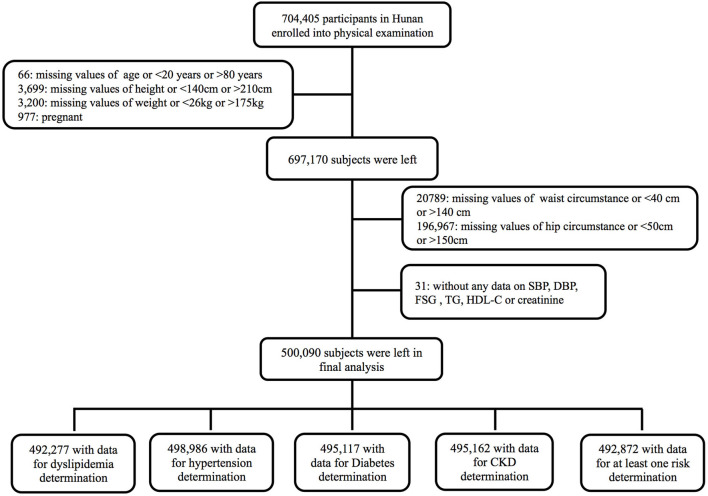
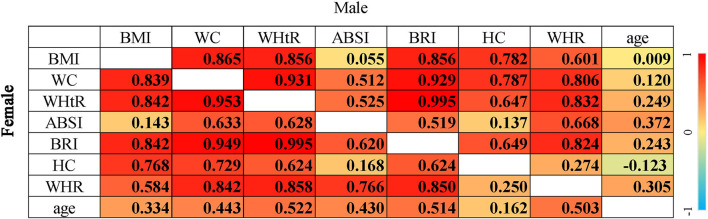
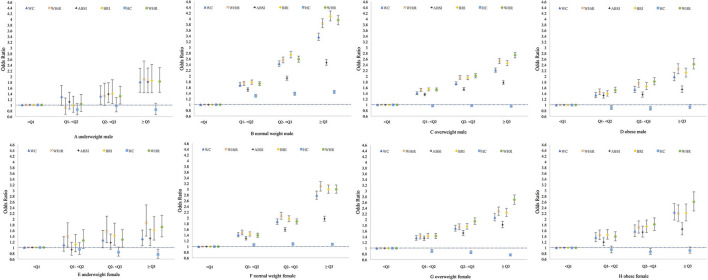
Between 2012 and 2020, a total of 500,090 participants were surveyed in Hunan, China. Six anthropometric indices including waist circumference (WC), a body shape index (ABSI), body roundness index (BRI), waist-hip ratio (WHR), hip circumference (HC), and waist-height ratio (WHtR) were evaluated in the present study. Considered CVDRFs included dyslipidaemia, hypertension, diabetes mellitus (DM), and chronic kidney disease (CKD). The associations of anthropometrics with CVDRFs within each BMI category were evaluated through logistic regression models. The area under the receiver operating characteristic curve (AUROC) was used to assess the predictive abilities.
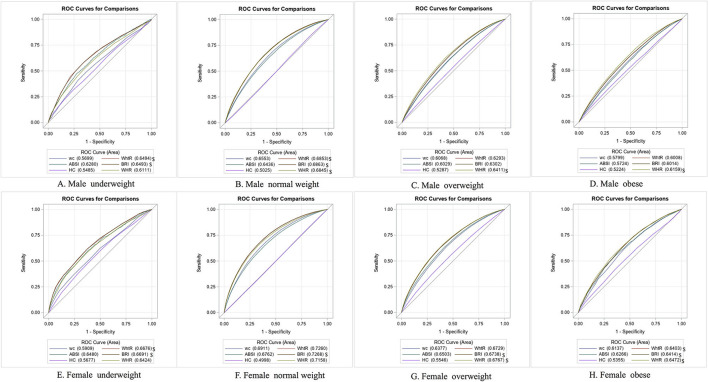
For the presence of at least one CVDRFs, the WHR had the highest AUROC in overweight [0.641 (95%CI:0.638, 0.644)] and obese [0.616 (95%CI:0.609, 0.623)] men. BRI had the highest AUROC in underweight [0.649 (95%CI:0.629, 0.670)] and normal weight [0.686 (95%CI:0.683, 0.690)] men. However, the BRI had the highest discrimination ability among women in all the BMI categories, with AUROC ranging from 0.641 to 0.727. In most cases, the discriminatory ability of WHtR was similar to BRI and was easier to calculate; therefore, thresholds of BRI, WHR, and WHtR for CVDRFs identification were all calculated. In men, BRI thresholds of 1.8, 3.0, 3.9, and 5.0, WHtR thresholds of 0.41, 0.48, 0.53, and 0.58, and WHR thresholds of 0.81, 0.88, 0.92, and 0.95 were identified as optimal thresholds across underweight, normal weight, overweight, and obese populations, respectively. The corresponding BRI values in women were 1.9, 2.9, 4.0, and 5.2, respectively, and WHtR were 0.41, 0.48, 0.54, and 0.59, while the WHR values were 0.77, 0.83, 0.88, and 0.90. The recommended BRI, WHtR, or WHR cut-offs could not statistically differentiate high-risk CKD or hypercholesterolemia populations.
We found that BRI and WHR were superior to other indices for predicting CVD risk factors, except CKD or hypercholesterolemia, among the Chinese.
在中国,用于预测心血管疾病风险因素(CVDRFs)高风险人群的合适的最佳人体测量指标及其在每个BMI类别中的阈值仍存在争议。
我们旨在确定中国人群中CVDRFs的最佳指标以及每个BMI类别中的最佳阈值。
2012年至2020年间,在中国湖南共对500,090名参与者进行了调查。本研究评估了六项人体测量指标,包括腰围(WC)、体型指数(ABSI)、身体圆度指数(BRI)、腰臀比(WHR)、臀围(HC)和腰高比(WHtR)。所考虑的CVDRFs包括血脂异常、高血压、糖尿病(DM)和慢性肾脏病(CKD)。通过逻辑回归模型评估每个BMI类别中人体测量指标与CVDRFs之间的关联。采用受试者工作特征曲线下面积(AUROC)来评估预测能力。
对于至少存在一种CVDRFs的情况,WHR在超重男性[0.641(95%CI:0.638,0.644)]和肥胖男性[0.616(95%CI:0.609,0.623)]中具有最高的AUROC。BRI在体重过轻男性[0.649(95%CI:0.629,0.670)]和正常体重男性[0.686(95%CI:0.683,0.690)]中具有最高的AUROC。然而,BRI在所有BMI类别的女性中具有最高的鉴别能力,AUROC范围为0.641至0.727。在大多数情况下,WHtR的鉴别能力与BRI相似且更易于计算;因此,还计算了用于识别CVDRFs的BRI、WHR和WHtR的阈值。在男性中,确定BRI阈值分别为1.8、3.0、3.9和5.0,WHtR阈值分别为0.41、0.48、0.53和0.58,WHR阈值分别为0.81、0.88、0.92和0.95,分别为体重过轻、正常体重、超重和肥胖人群的最佳阈值。女性中相应的BRI值分别为1.9、2.9、4.0和5.2,WHtR分别为0.41、0.48、0.54和0.59,而WHR值分别为0.77、0.83、0.88和0.90。推荐的BRI、WHtR或WHR切点在统计学上无法区分高风险的CKD或高胆固醇血症人群。
我们发现,在中国人群中,除CKD或高胆固醇血症外,BRI和WHR在预测心血管疾病风险因素方面优于其他指标。