Tulane Center of Biomedical Informatics and Genomics, Deming Department of Medicine, Tulane University School of Medicine, Tulane University, New Orleans, LA, United States.
Department of Endocrinology and Metabolism, The Third Affiliated Hospital of Southern Medical University, Guangzhou, China.
Front Cell Infect Microbiol. 2022 Mar 16;12:853499. doi: 10.3389/fcimb.2022.853499. eCollection 2022.
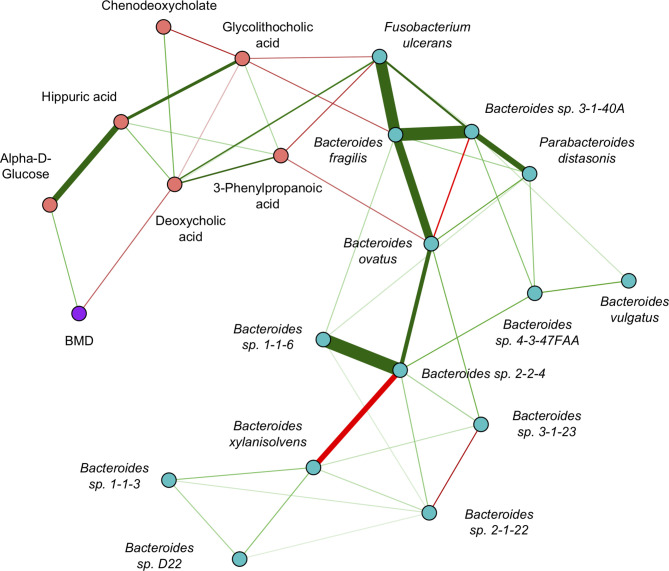
While the gut microbiome has been reported to play a role in bone metabolism, the individual species and underlying functional mechanisms have not yet been characterized. We conducted a systematic multi-omics analysis using paired metagenomic and untargeted serum metabolomic profiles from a large sample of 499 peri- and early post-menopausal women to identify the potential crosstalk between these biological factors which may be involved in the regulation of bone mineral density (BMD). Single omics association analyses identified 22 bacteria species and 17 serum metabolites for putative association with BMD. Among the identified bacteria, and were negatively associated, while were positively associated. Several of the identified serum metabolites including 3-phenylpropanoic acid, mainly derived from dietary polyphenols, and glycolithocholic acid, a secondary bile acid, are metabolic byproducts of the microbiota. We further conducted a supervised integrative feature selection with respect to BMD and constructed the inter-omics partial correlation network. Although still requiring replication and validation in future studies, the findings from this exploratory analysis provide novel insights into the interrelationships between the gut microbiome and serum metabolome that may potentially play a role in skeletal remodeling processes.
虽然肠道微生物群已被报道在骨骼代谢中发挥作用,但个体物种和潜在的功能机制尚未得到阐明。我们使用来自 499 名绝经前和早期绝经后女性的配对宏基因组和非靶向血清代谢组学图谱进行了系统的多组学分析,以确定这些生物因素之间可能涉及骨密度 (BMD) 调节的潜在串扰。单组学关联分析确定了 22 种细菌物种和 17 种与 BMD 可能相关的血清代谢物。在鉴定出的细菌中, 和 呈负相关,而 呈正相关。鉴定出的几种血清代谢物,包括主要来源于膳食多酚的 3-苯丙酸和次级胆汁酸甘氨胆酸,是微生物群的代谢副产物。我们进一步针对 BMD 进行了有监督的综合特征选择,并构建了组间部分相关网络。尽管这些发现仍需要在未来的研究中进行复制和验证,但这项探索性分析提供了肠道微生物组和血清代谢组之间相互关系的新见解,这些相互关系可能在骨骼重塑过程中发挥作用。