Yin Xiaochen, Altman Tomer, Rutherford Erica, West Kiana A, Wu Yonggan, Choi Jinlyung, Beck Paul L, Kaplan Gilaad G, Dabbagh Karim, DeSantis Todd Z, Iwai Shoko
Second Genome Inc., Brisbane, CA, United States.
Altman Analytics LLC, San Francisco, CA, United States.
Front Microbiol. 2020 Dec 4;11:595910. doi: 10.3389/fmicb.2020.595910. eCollection 2020.
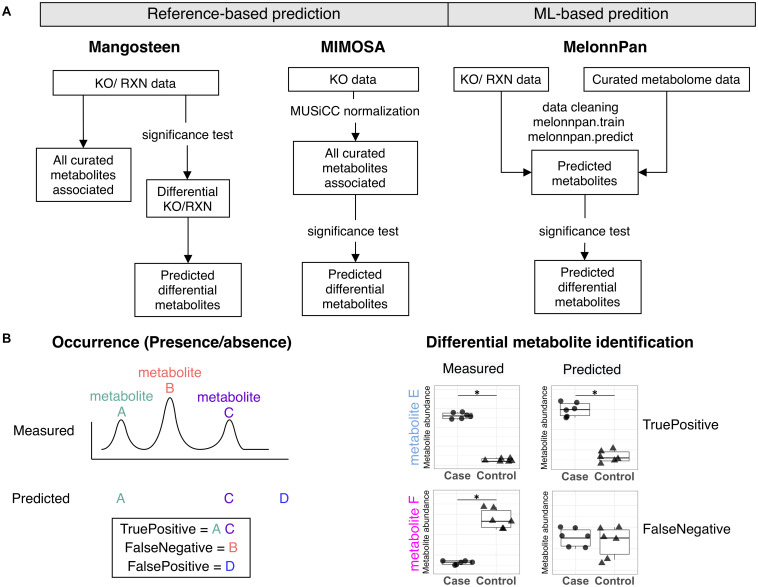
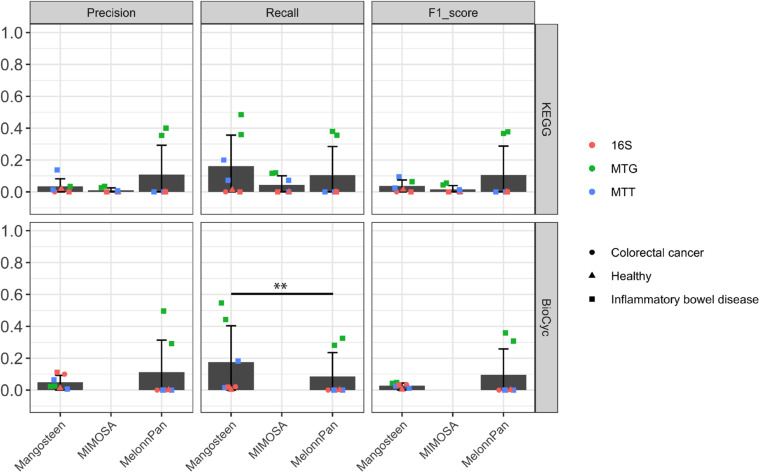
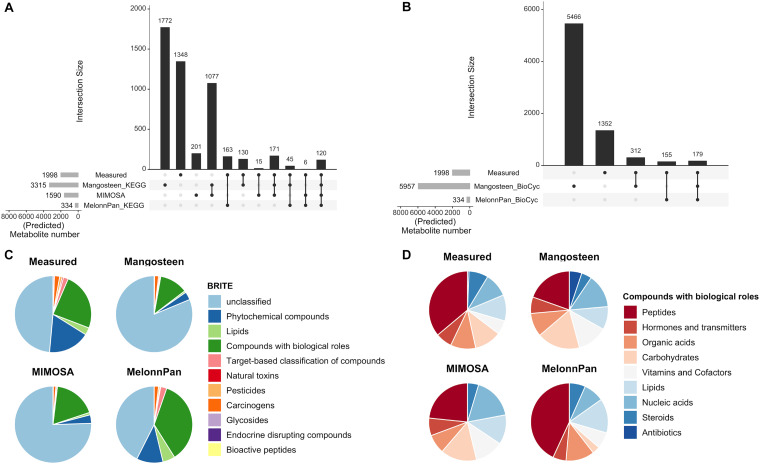
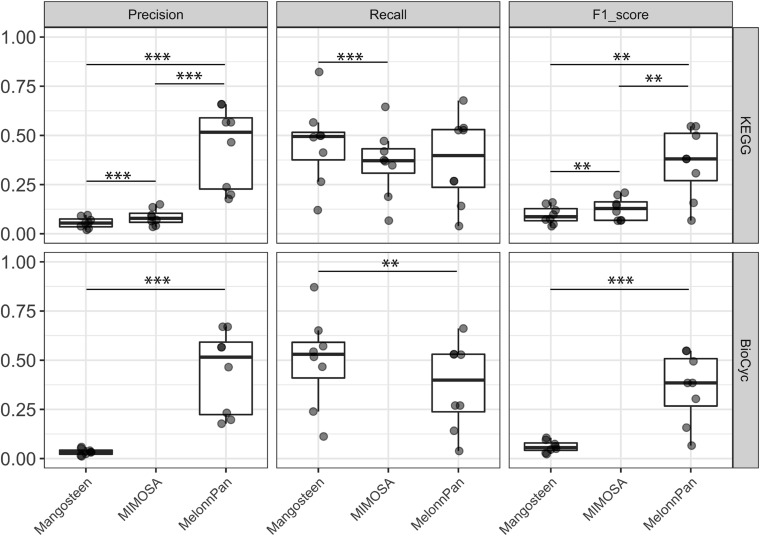
Metabolomic analyses of human gut microbiome samples can unveil the metabolic potential of host tissues and the numerous microorganisms they support, concurrently. As such, metabolomic information bears immense potential to improve disease diagnosis and therapeutic drug discovery. Unfortunately, as cohort sizes increase, comprehensive metabolomic profiling becomes costly and logistically difficult to perform at a large scale. To address these difficulties, we tested the feasibility of predicting the metabolites of a microbial community based solely on microbiome sequencing data. Paired microbiome sequencing (16S rRNA gene amplicons, shotgun metagenomics, and metatranscriptomics) and metabolome (mass spectrometry and nuclear magnetic resonance spectroscopy) datasets were collected from six independent studies spanning multiple diseases. We used these datasets to evaluate two reference-based gene-to-metabolite prediction pipelines and a machine-learning (ML) based metabolic profile prediction approach. With the pre-trained model on over 900 microbiome-metabolome paired samples, the ML approach yielded the most accurate predictions (i.e., highest F1 scores) of metabolite occurrences in the human gut and outperformed reference-based pipelines in predicting differential metabolites between case and control subjects. Our findings demonstrate the possibility of predicting metabolites from microbiome sequencing data, while highlighting certain limitations in detecting differential metabolites, and provide a framework to evaluate metabolite prediction pipelines, which will ultimately facilitate future investigations on microbial metabolites and human health.
对人类肠道微生物组样本进行代谢组学分析能够同时揭示宿主组织及其所支持的众多微生物的代谢潜力。因此,代谢组学信息在改善疾病诊断和治疗药物发现方面具有巨大潜力。不幸的是,随着队列规模的增加,全面的代谢组学分析成本高昂,并且在大规模操作上存在后勤困难。为了解决这些难题,我们测试了仅基于微生物组测序数据预测微生物群落代谢物的可行性。从涵盖多种疾病的六项独立研究中收集了配对的微生物组测序(16S rRNA基因扩增子、鸟枪法宏基因组学和宏转录组学)和代谢组(质谱和核磁共振光谱)数据集。我们使用这些数据集评估了两种基于参考的基因到代谢物预测流程以及一种基于机器学习(ML)的代谢谱预测方法。利用在900多个微生物组 - 代谢组配对样本上预训练的模型,ML方法在预测人类肠道中代谢物的出现情况时产生了最准确的预测结果(即最高的F1分数),并且在预测病例组和对照组之间的差异代谢物方面优于基于参考的流程。我们的研究结果证明了从微生物组测序数据预测代谢物的可能性,同时突出了在检测差异代谢物方面的某些局限性,并提供了一个评估代谢物预测流程的框架,这最终将促进未来对微生物代谢物与人类健康的研究。