Department of Psychiatry and Behavioral Sciences, Duke University, Durham, NC 27710, United States of America.
Department of Biomedical Engineering, Duke University, Durham, NC 27708, United States of America.
J Neural Eng. 2022 Apr 21;19(2). doi: 10.1088/1741-2552/ac63a4.
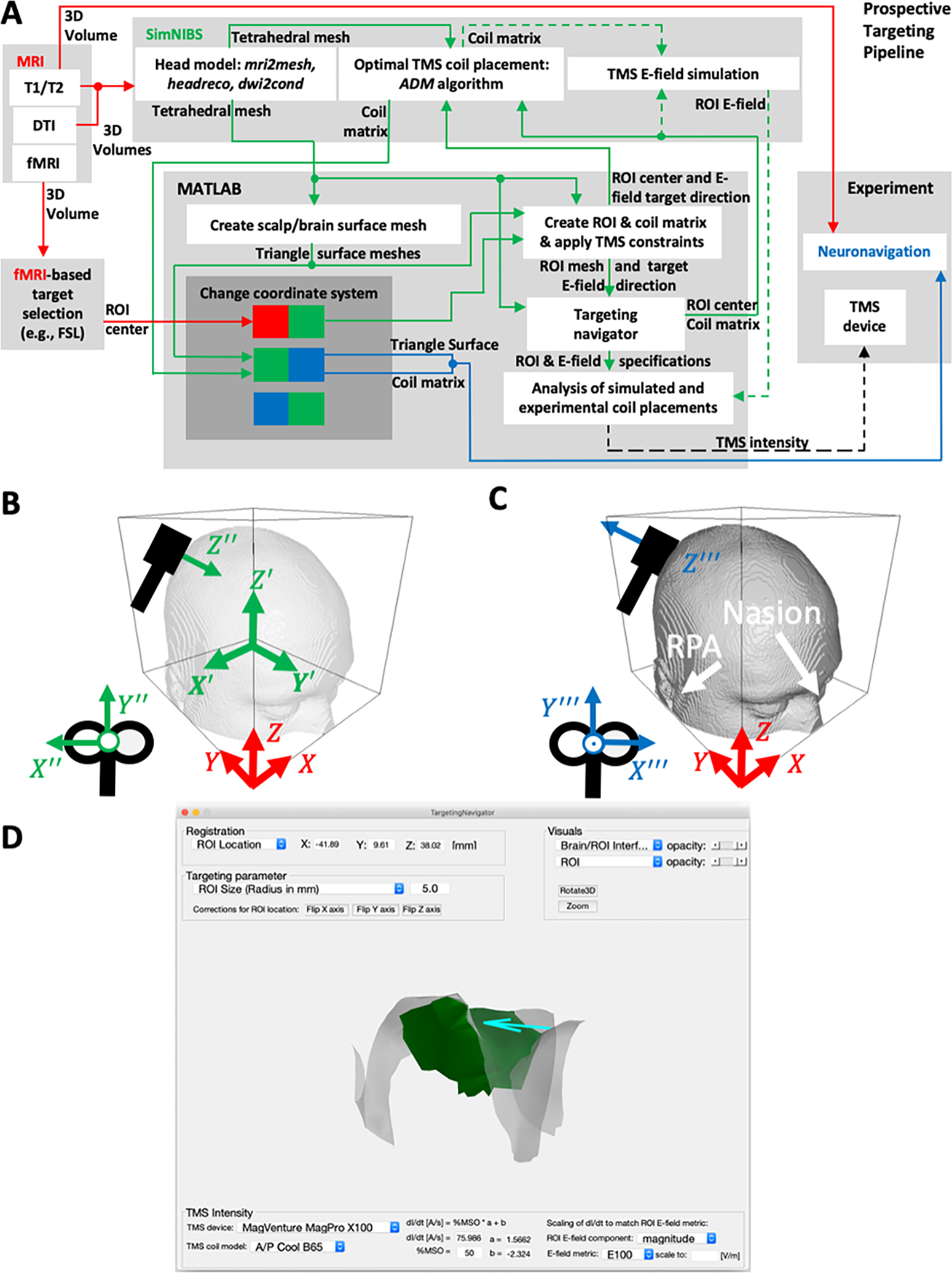
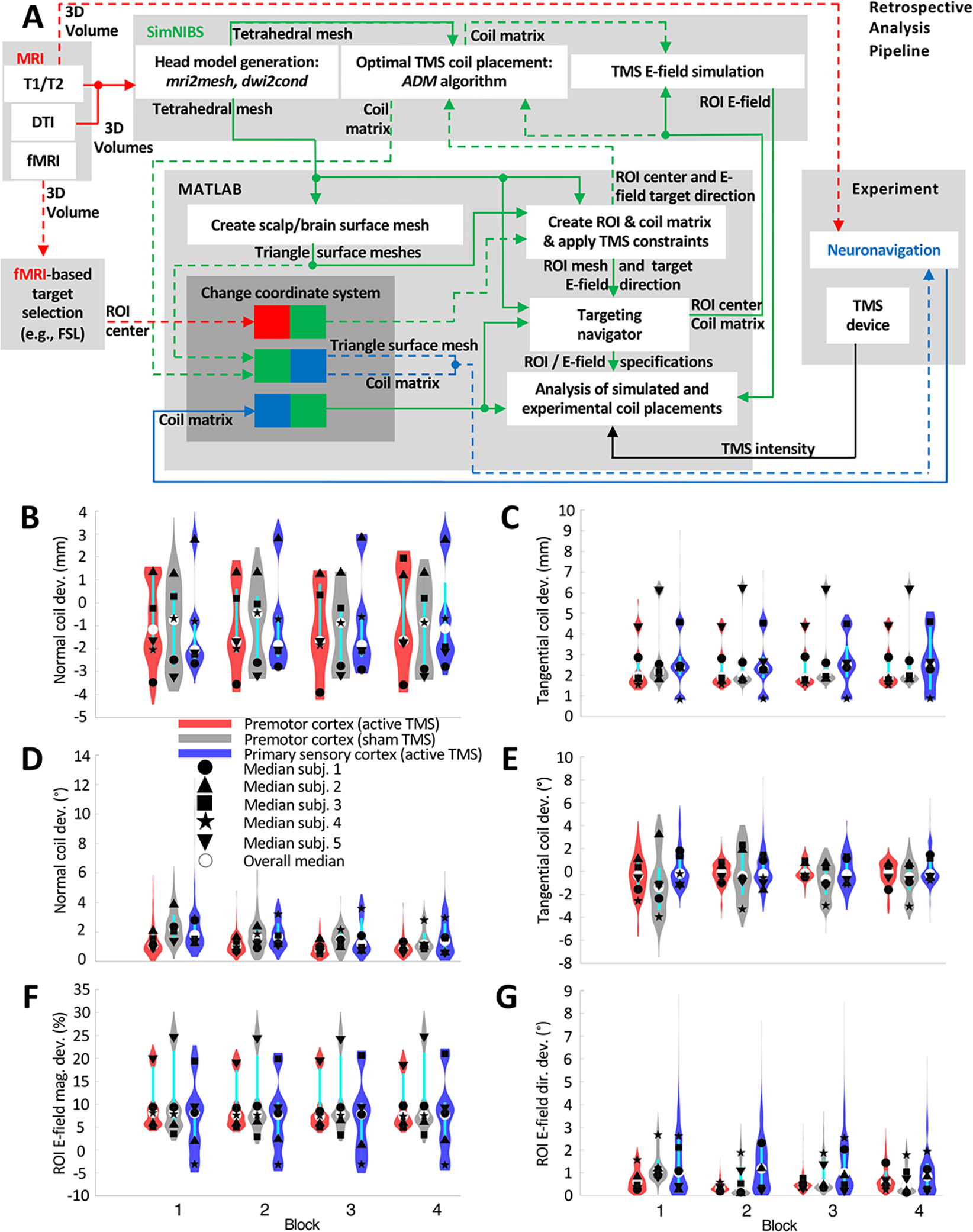
Transcranial magnetic stimulation (TMS) can modulate brain function via an electric field (E-field) induced in a brain region of interest (ROI). The ROI E-field can be computationally maximized and set to match a specific reference using individualized head models to find the optimal coil placement and stimulus intensity. However, the available software lacks many practical features for prospective planning of TMS interventions and retrospective evaluation of the experimental targeting accuracy.The TMS targeting and analysis pipeline (TAP) software uses an MRI/fMRI-derived brain target to optimize coil placement considering experimental parameters such as the subject's hair thickness and coil placement restrictions. The coil placement optimization is implemented in SimNIBS 3.2, for which an additional graphical user interface (TargetingNavigator) is provided to visualize/adjust procedural parameters. The coil optimization process also computes the E-field at the target, allowing the selection of the TMS device intensity setting to achieve specific E-field strengths. The optimized coil placement information is prepared for neuronavigation software, which supports targeting during the TMS procedure. The neuronavigation system can record the coil placement during the experiment, and these data can be processed in TAP to quantify the accuracy of the experimental TMS coil placement and induced E-field.TAP was demonstrated in a study consisting of three repetitive TMS sessions in five subjects. TMS was delivered by an experienced operator under neuronavigation with the computationally optimized coil placement. Analysis of the experimental accuracy from the recorded neuronavigation data indicated coil location and orientation deviations up to about 2 mm and 2°, respectively, resulting in an 8% median decrease in the target E-field magnitude compared to the optimal placement.TAP supports navigated TMS with a variety of features for rigorous and reproducible stimulation delivery, including planning and evaluation of coil placement and intensity selection for E-field-based dosing.
经颅磁刺激(TMS)可以通过在感兴趣脑区(ROI)中产生的电场(E-field)来调节脑功能。可以使用个体化的头部模型计算 ROI 的 E-field 并将其最大化,以匹配特定的参考值,从而找到最佳的线圈放置位置和刺激强度。但是,现有的软件缺乏许多用于 TMS 干预前瞻性规划和实验靶向准确性回顾性评估的实用功能。TMS 靶向和分析管道(TAP)软件使用基于 MRI/fMRI 的脑目标来优化线圈放置位置,同时考虑实验参数,如受试者的头发厚度和线圈放置限制。线圈放置优化是在 SimNIBS 3.2 中实现的,它提供了一个额外的图形用户界面(TargetingNavigator)来可视化/调整程序参数。线圈优化过程还计算了目标处的 E-field,允许选择 TMS 设备强度设置以达到特定的 E-field 强度。优化后的线圈放置信息准备用于神经导航软件,该软件支持 TMS 过程中的靶向。神经导航系统可以在实验过程中记录线圈放置位置,这些数据可以在 TAP 中进行处理,以量化实验 TMS 线圈放置位置和诱导的 E-field 的准确性。TAP 在一项由五名受试者进行的三个重复 TMS 疗程的研究中得到了验证。TMS 由一名经验丰富的操作员在神经导航下使用计算优化的线圈放置进行输送。对记录的神经导航数据进行的实验准确性分析表明,线圈位置和方向偏差分别高达约 2 毫米和 2°,导致目标 E-field 幅度与最佳放置位置相比降低了 8%。TAP 支持各种功能的导航 TMS,以实现严格和可重复的刺激输送,包括线圈放置位置和强度选择的规划和评估,以实现基于 E-field 的剂量。