Behavioral Research Program, Division of Cancer Control and Population Sciences, National Cancer Institute, 9609 Medical Center Drive, 3E216, Bethesda, MD, 20892-9761, USA.
Center for Outcomes Research and Evaluation, Maine Medical Center Research Institute, Scarborough, ME, USA.
J Behav Med. 2023 Apr;46(1-2):40-53. doi: 10.1007/s10865-022-00302-9. Epub 2022 Apr 8.
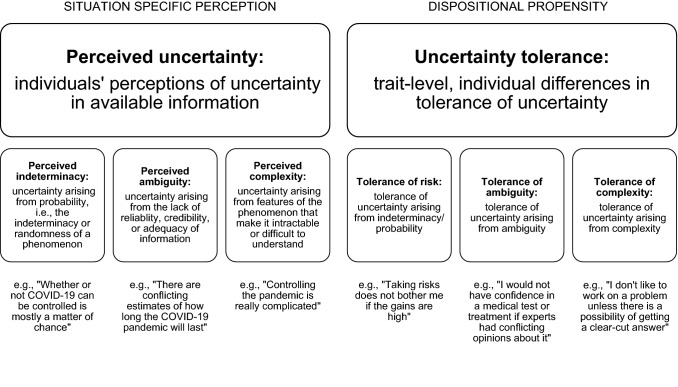
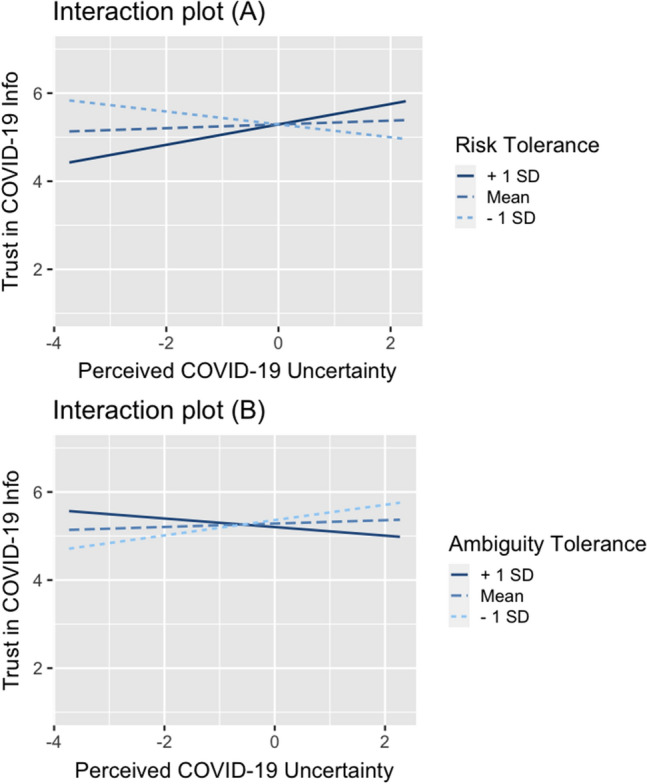
The COVID-19 crisis has exposed the public to considerable scientific uncertainty, which may promote vaccine hesitancy among individuals with lower tolerance of uncertainty. In a national sample of US adults in May-June 2020, we examined how both perceptions of uncertainty about COVID-19 and trait-level differences in tolerance of uncertainty arising from various sources (risk, ambiguity, and complexity) are related to vaccine hesitancy-related outcomes, including trust in COVID-19 information, COVID-19 vaccine intentions, and beliefs that COVID-19 vaccines should undergo a longer testing period before being released to the public. Overall, perceptions of COVID-19 uncertainty were not associated with trust in information, vaccine intentions, or beliefs about vaccine testing. However, higher tolerance of risk was associated with lower intentions to get vaccinated, and lower tolerance of ambiguity was associated with lower intentions to get vaccinated and preferring a longer period of vaccine testing. Critically, perceptions of COVID-19 uncertainty and trait-level tolerance for uncertainty also interacted as predicted, such that greater perceived COVID-19 uncertainty was more negatively associated with trust in COVID-19 information among individuals with lower tolerance for risk and ambiguity. Thus, although perceptions of uncertainty regarding COVID-19 may not reduce trust and vaccine hesitancy for all individuals, trait-level tolerance of uncertainty arising from various sources may have both direct and moderating effects on these outcomes. These findings can inform public health communication or other interventions to increase COVID-19 vaccination uptake.
COVID-19 危机使公众面临相当大的科学不确定性,这可能会导致不确定性容忍度较低的人对疫苗犹豫不决。在 2020 年 5 月至 6 月期间,我们对美国成年人进行了一项全国性抽样调查,研究了对 COVID-19 的不确定性的感知以及源于不同来源(风险、模糊性和复杂性)的不确定性容忍度的特质差异如何与疫苗犹豫相关的结果相关,包括对 COVID-19 信息的信任、对 COVID-19 疫苗的意愿,以及相信 COVID-19 疫苗在向公众发布之前应该进行更长时间的测试。总体而言,对 COVID-19 不确定性的感知与对信息的信任、疫苗接种意愿或对疫苗测试的看法无关。然而,更高的风险容忍度与较低的接种意愿相关,而较低的模糊容忍度与较低的接种意愿和更倾向于更长的疫苗测试期相关。至关重要的是,对 COVID-19 不确定性的感知和特质层面的不确定性容忍度也如预测的那样相互作用,即对于风险和模糊性容忍度较低的个体,对 COVID-19 的感知不确定性越大,对 COVID-19 信息的信任度越低。因此,尽管对 COVID-19 的不确定性的看法可能不会降低所有个体的信任度和疫苗犹豫,但源于不同来源的不确定性容忍度的特质水平可能对这些结果产生直接和调节作用。这些发现可以为提高 COVID-19 疫苗接种率的公共卫生宣传或其他干预措施提供信息。