Liu Ya-Li, Zheng Lei, Jin Long-Guo, Liu Yuan-Xia, Kong Ya-Nan, Wang Yi-Xuan, Yu Tai-Fei, Chen Jun, Zhou Yong-Bin, Chen Ming, Wang Feng-Zhi, Ma You-Zhi, Xu Zhao-Shi, Lan Jin-Hao
College of Agronomy, Qingdao Agricultural University, Qingdao, China.
Institute of Crop Science, Chinese Academy of Agricultural Sciences (CAAS)/National Key Facility for Crop Gene Resources and Genetic Improvement, Key Laboratory of Biology and Genetic Improvement of Triticeae Crops, Ministry of Agriculture, Beijing, China.
Front Plant Sci. 2022 Mar 23;13:845314. doi: 10.3389/fpls.2022.845314. eCollection 2022.
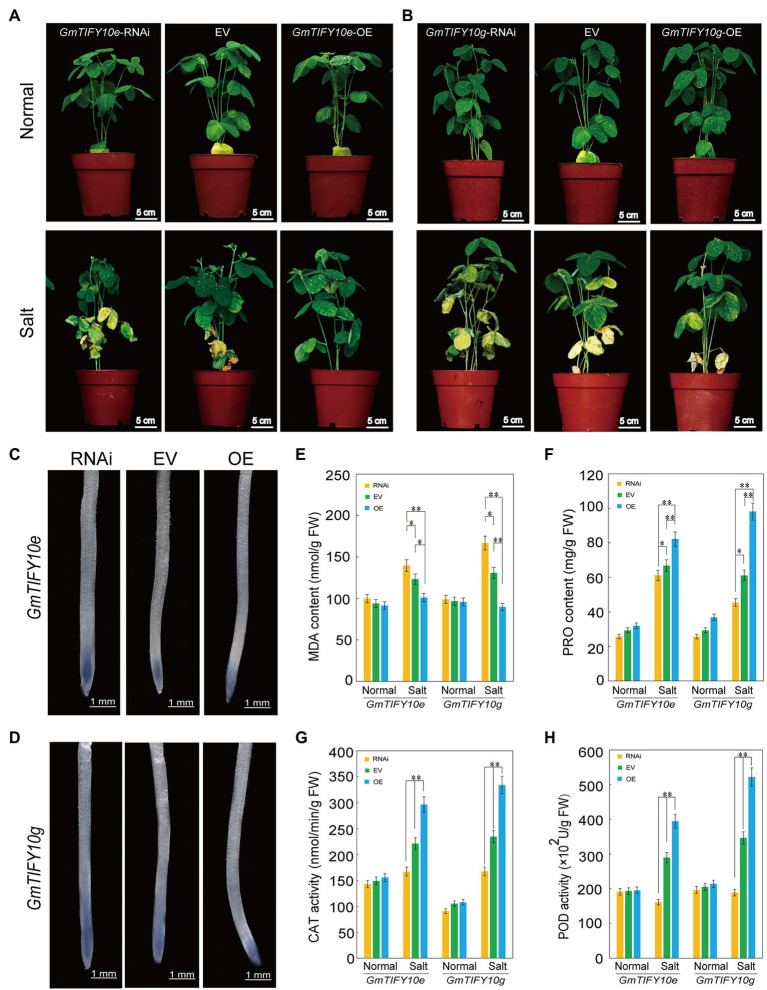
TIFY proteins play crucial roles in plant abiotic and biotic stress responses. Our transcriptome data revealed several family genes with significantly upregulated expression under drought, salt, and ABA treatments. However, the functions of the family genes are still unknown in abiotic stresses. We identified 38 genes and found that homologous genes have the most duplication events, higher selection pressure, and more obvious response to abiotic stresses compared with other homologous genes. Expression pattern analysis showed that and genes were significantly induced by salt stress. Under salt stress, and transgenic plants showed higher root lengths and fresh weights and had significantly better growth than the wild type (WT). In addition, overexpression of and genes in soybean improved salt tolerance by increasing the PRO, POD, and CAT contents and decreasing the MDA content; on the contrary, RNA interference plants showed sensitivity to salt stress. Overexpression of and in and soybean could improve the salt tolerance of plants, while the RNAi of and significantly increased sensitivity to salt stress in soybean. Further analysis demonstrated that and genes changed the expression levels of genes related to the ABA signal pathway, including , , , , and . This study provides a basis for comprehensive analysis of the role of soybean genes in stress response in the future.
TIFY蛋白在植物非生物和生物胁迫响应中发挥着关键作用。我们的转录组数据揭示了几个在干旱、盐和脱落酸(ABA)处理下表达显著上调的家族基因。然而,该家族基因在非生物胁迫中的功能仍不清楚。我们鉴定出38个TIFY基因,发现与其他同源基因相比,TIFY同源基因具有最多的复制事件、更高的选择压力以及对非生物胁迫更明显的响应。表达模式分析表明,TIFY10和TIFY11基因受盐胁迫显著诱导。在盐胁迫下,TIFY10和TIFY11转基因拟南芥植株表现出更长的根长和更高的鲜重,并且生长明显优于野生型(WT)。此外,在大豆中过表达TIFY10和TIFY11基因通过增加脯氨酸(PRO)、过氧化物酶(POD)和过氧化氢酶(CAT)含量以及降低丙二醛(MDA)含量来提高耐盐性;相反,RNA干扰植株对盐胁迫表现出敏感性。在拟南芥和大豆中过表达TIFY10和TIFY11可以提高植物的耐盐性,而对TIFY10和TIFY11进行RNA干扰则显著增加了大豆对盐胁迫的敏感性。进一步分析表明,TIFY10和TIFY11基因改变了与ABA信号通路相关基因的表达水平,包括ABI1、ABI2、PYL2、PP2C4和SnRK2.6。本研究为未来全面分析大豆TIFY基因在胁迫响应中的作用提供了依据。