National Heart and Lung Institute, Imperial College London, London W2 1NY, UK.
Cells. 2022 Mar 29;11(7):1153. doi: 10.3390/cells11071153.
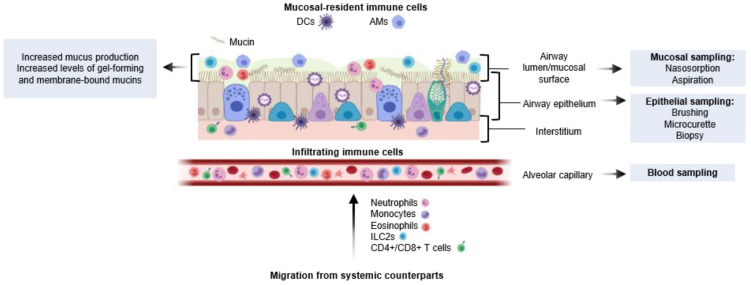
Despite over half a century of research, respiratory syncytial virus (RSV)-induced bronchiolitis remains a major cause of hospitalisation in infancy, while vaccines and specific therapies still await development. Our understanding of mucosal immune responses to RSV continues to evolve, but recent studies again highlight the role of Type-2 immune responses in RSV disease and hint at the possibility that it dampens Type-1 antiviral immunity. Other immunoregulatory pathways implicated in RSV disease highlight the importance of focussing on localised mucosal responses in the respiratory mucosa, as befits a virus that is essentially confined to the ciliated respiratory epithelium. In this review, we discuss studies of mucosal immune cell infiltration and production of inflammatory mediators in RSV bronchiolitis and relate these studies to observations from peripheral blood. We also discuss the advantages and limitations of studying the nasal mucosa in a disease that is most severe in the lower airway. A fresh focus on studies of RSV pathogenesis in the airway mucosa is set to revolutionise our understanding of this common and important infection.
尽管经过了半个多世纪的研究,呼吸道合胞病毒(RSV)引起的细支气管炎仍然是婴儿住院的主要原因,而疫苗和特定疗法仍在开发中。我们对 RSV 黏膜免疫反应的理解仍在不断发展,但最近的研究再次强调了 2 型免疫反应在 RSV 疾病中的作用,并暗示它可能抑制 1 型抗病毒免疫。其他与 RSV 疾病相关的免疫调节途径强调了关注呼吸道黏膜局部黏膜反应的重要性,因为这符合一种基本上局限于纤毛呼吸上皮的病毒。在这篇综述中,我们讨论了 RSV 细支气管炎中黏膜免疫细胞浸润和炎症介质产生的研究,并将这些研究与外周血的观察结果联系起来。我们还讨论了在以下呼吸道疾病最严重的情况下研究鼻黏膜的优势和局限性。对气道黏膜中 RSV 发病机制的研究的新重点有望彻底改变我们对这种常见且重要感染的认识。